Gemini 3.5 Flash Deep Dive: How AI Visualizes Complex Academic Papers

Gemini 3.5 Flash deeply understands complex academic papers and generates personalized visualizations.
Google's Gemini 3.5 Flash demonstrates deep understanding and personalized visualization of complex academic papers. Through multimodal joint reasoning, it comprehends mathematical concepts and charts, and uses a "Code as Reasoning Medium" paradigm to generate visualizations. As a lightweight model, it combines speed with quality, offering significant value for research efficiency, cross-disciplinary communication, and teaching support — reflecting AI's evolution toward multimodal understanding and creative output.
Overview
Google's latest Gemini 3.5 Flash has demonstrated a remarkable capability — it can not only understand complex academic topics and charts but also visualize results in the most appropriate way based on users' specific needs. This capability is particularly impressive when handling advanced mathematics papers, offering academic researchers and students an entirely new paper-reading experience.
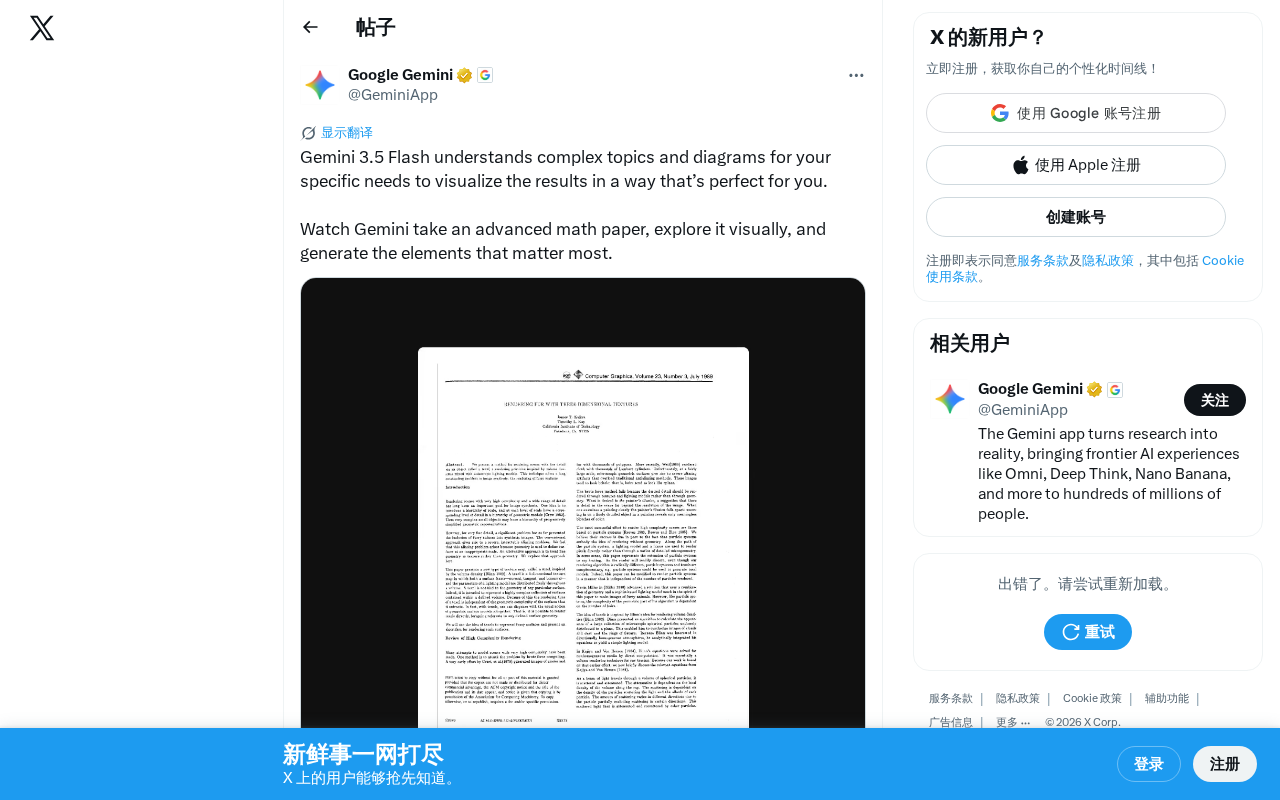
From Paper Comprehension to Visual Exploration
Deep Understanding of Complex Academic Content
The core breakthrough of Gemini 3.5 Flash lies in its deep comprehension of complex academic content. Traditional AI models often only perform surface-level text parsing when confronted with advanced mathematics papers, whereas Gemini 3.5 Flash can truly "understand" the mathematical concepts, formula derivations, and chart meanings within a paper.
This comprehension capability relies on the joint reasoning mechanism of multimodal large models for academic content. Modern multimodal large models don't simply perform OCR text recognition on academic papers — they integrate the joint reasoning capabilities of a Vision Encoder and a language model. Taking the Gemini architecture as an example, its visual component can parse rendered LaTeX formula images, coordinate system charts, and even complex topological structure diagrams, mapping this visual information into a vector space aligned with textual semantics. This Cross-modal Alignment capability enables the model to understand complex semantic relationships like "Figure 3 illustrates the geometric intuition of Theorem 2.1," which requires simultaneously associating text and images — a core barrier that traditional NLP tools cannot overcome.
Specifically, users can directly input an advanced mathematics paper into the model, and Gemini can not only interpret its core ideas but also identify key charts and data structures within the paper, laying the foundation for subsequent visualization processing. This deep semantic understanding capability is the key differentiator from traditional text summarization tools.
Personalized Visual Output
Even more noteworthy is Gemini 3.5 Flash's visualization generation capability. It can select the most appropriate visualization method to present results based on users' specific needs:
- Transform complex mathematical relationships into intuitive geometric graphics
- Extract and reorganize key elements from papers into structured charts
- Adjust visualization complexity based on the user's background
Behind this visualization generation capability lies a complete technical pipeline of code generation and execution. The model typically generates Python (Matplotlib, Plotly) or JavaScript (D3.js) visualization code, which is then executed in a sandboxed environment and returns rendered results, achieving the transformation from abstract mathematical concepts to concrete graphics. This paradigm is known as "Code as Reasoning Medium" — compared to directly generating pixel images, the code path offers stronger interpretability and editability. Users can not only see the final graphic but also further modify parameters, enabling truly interactive exploration.
This tailored visualization approach means that users from different backgrounds — whether mathematics researchers, interdisciplinary scholars, or undergraduate students — can all receive visualization results best suited to their level of understanding.
Technical Significance and Use Cases
Boosting Academic Research Efficiency
Gemini 3.5 Flash's capability holds practical value for the academic research field:
- Rapid Paper Comprehension: Researchers can leverage AI to parse complex papers in unfamiliar fields and quickly grasp core ideas through visualization
- Cross-disciplinary Communication: Converting highly specialized mathematical content into more accessible visual representations lowers communication barriers between disciplines
- Teaching Support: Educators can use this tool to generate explanatory visual materials at varying difficulty levels for students
- Accelerated Literature Reviews: When batch-processing large volumes of papers, visual output helps quickly screen relevant research
Performance Advantages of the Flash Version
Interestingly, this capability comes from the "Flash" version — the lightweight model in the Google Gemini series known for speed and efficiency. The Google Gemini series adopts a tiered architecture design, with the Flash version representing the efficiency-first technical approach. Compared to flagship versions like Ultra and Pro, Flash retains core reasoning capabilities while dramatically reducing parameter scale through Knowledge Distillation and model compression techniques. The success of Gemini 1.5 Flash already proved the viability of this approach — it achieved near-Pro-level performance with extremely low latency across multiple benchmarks. Gemini 3.5 Flash continues and strengthens this design philosophy, making it particularly suitable for high-frequency invocation scenarios such as real-time paper parsing and interactive visualization generation. Compared to larger-scale versions like Pro, Flash maintains high-quality output while offering the following advantages:
- Faster response times, ideal for real-time interactive scenarios
- Lower computational costs, reducing the barrier to everyday use
- Easy integration into existing academic workflows
Industry Impact
From a broader perspective, this Gemini 3.5 Flash demonstration reflects an important direction in AI large model development: evolving from pure text generation toward multimodal understanding and creative output. Models are no longer merely tools that "answer questions" — they are intelligent assistants capable of proactively exploring, analyzing, and presenting information in optimal ways.
As Gemini 3.5 Flash enters the academic arena, it faces a market with several established players. Semantic Scholar, Elicit, and Consensus focus on paper retrieval and summarization; Wolfram Alpha and Mathematica have decades of expertise in mathematical computation visualization; and Notebook LM (also a Google product) specializes in multi-document knowledge integration. Gemini 3.5 Flash's differentiation lies in integrating deep semantic understanding with dynamic visualization generation within a single interactive interface, reducing the cognitive overhead researchers face when switching between multiple tools. This "full-stack" academic assistant positioning is reshaping the tool selection logic in research workflows.
This trend has particularly notable implications for several domains:
- Research Tools Market: Traditional paper management and reading tools face upgrade pressure
- Academic Publishing: Paper presentation may evolve from static PDFs to interactive visualizations
- Online Education: Methods for teaching complex knowledge will become more diversified
When AI can truly understand complex academic content and create personalized visualizations, the efficiency of knowledge acquisition and dissemination will improve significantly.
Conclusion
Gemini 3.5 Flash's performance in complex academic content understanding and visualization marks a shift in AI tools — from general-purpose assistants toward specialized research partners. For researchers who routinely read large volumes of papers, the maturation of such tools will tangibly transform their workflows. As Google continues to iterate on the Gemini model series, there is every reason to expect AI to play an increasingly critical role in academic research and knowledge dissemination.
Key Takeaways
- Gemini 3.5 Flash can deeply understand mathematical concepts and charts in complex academic papers
- The model generates personalized visualization results based on users' specific needs
- As a lightweight Flash version, it achieves speed and efficiency advantages while maintaining high-quality output through Knowledge Distillation
- Visualization generation relies on the "Code as Reasoning Medium" paradigm, supporting interactive parameter adjustments by users
- This capability holds significant application value for academic research, cross-disciplinary communication, and teaching support
- It reflects the broader industry trend of AI evolving from text generation toward multimodal understanding and creative output
Related articles
 Tech Frontiers
A Rare Quiet Day in AI: Recursive Self-Improvement Stirs Beneath the Surface
A rare quiet day in AI sees multiple sources go silent simultaneously. Behind the calm, Recursive Self-Improvement (RSI) research continues. What this means for the industry.
 Tech Frontiers
Reve 2 vs. Ideogram 4: A Deep Dive into Layout Control in AI Image Generation
A deep comparison of Reve 2 and Ideogram 4's layout control capabilities, covering technical approaches, real-world use cases, and industry trends for designers and creators.
 Tech Frontiers
In the Weights: Check Your Influence Score in the AI World
In the Weights is an AI influence search engine that quantifies your presence in the AI world with a score. Explore how it evaluates practitioners and what it means for digital identity.