Gemini 3.5 Flash Launch: 3x Price Hike Yet Full-Scale Deployment — AI Pricing Logic Has Changed

Google launches Gemini 3.5 Flash with full-scale deployment but a significant 3x price increase.
At Google I/O, Google officially released Gemini 3.5 Flash, skipping the preview stage to deploy directly across consumer, developer, and enterprise products, reaching billions of users. It also introduced the Interactions API to address multi-turn conversation costs, but model API pricing has risen significantly, reflecting a broader industry-wide price increase trend.
Overview
At Google I/O, Google officially released the Gemini 3.5 Flash model. Unlike previous launches, this release skipped the -preview stage and went straight to general availability, being deployed across virtually all of Google's core products. However, alongside the performance improvements comes a significant price increase — a trend that's spreading across the entire AI industry.
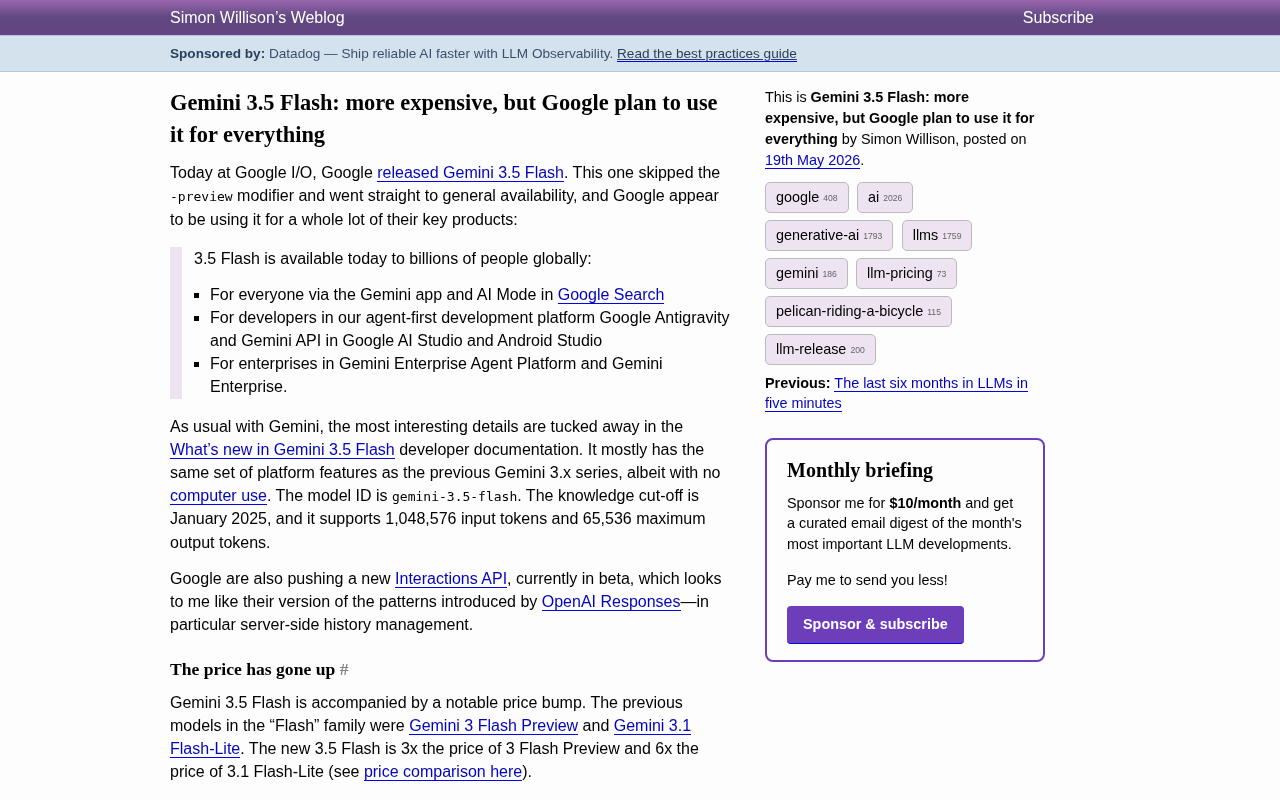
Gemini 3.5 Flash Goes All-In: Reaching Billions of Users
Google states that 3.5 Flash is now available to billions of users worldwide, with specific deployments including:
- Consumer-facing: Available through the Gemini app and AI Mode in Google Search
- Developer-facing: Integrated into Google Antigravity (an agent-first development platform), Google AI Studio, and the Gemini API in Android Studio
- Enterprise-facing: Available through the Gemini Enterprise Agent Platform and Gemini Enterprise
In terms of technical specifications, the model ID is gemini-3.5-flash, with a knowledge cutoff date of January 2025, supporting 1,048,576 input tokens and a maximum of 65,536 output tokens. Functionally, it's largely consistent with the earlier Gemini 3.x series, though computer use is not yet supported.
Notably, Google simultaneously launched the new Interactions API (currently in beta). This API addresses a long-standing engineering pain point in AI application development: context management for multi-turn conversations.
The traditional stateless API design stems from HTTP's stateless philosophy — carrying the full context with each request ensures horizontal scalability on the server side, but it comes at a steep cost in multi-turn conversation scenarios. Take a 100-turn conversation as an example: if each turn averages 200 tokens, by the 100th turn a single request's input tokens already reach approximately 10,000, with cumulative costs growing quadratically. With traditional API calls being stateless, developers must send the complete conversation history as input with every request. As the number of conversation turns increases, input token counts grow linearly and costs skyrocket.
OpenAI's Responses API, introduced in early 2025, pioneered server-side session state storage, allowing the API to reference history via a session ID rather than transmitting the full context each time. Google's Interactions API follows this same pattern, essentially pushing "stateful conversation management" down from the application layer to the infrastructure layer. Server-side state management — by maintaining KV Cache or compressed conversation summaries in the cloud — reduces each request's input tokens to only the current turn's content, theoretically cutting long-conversation costs by 60%-80%. For developers building customer service bots, long-running task agents, and similar applications, this feature can significantly reduce costs and simplify architecture. The tradeoff, however, is increased architectural coupling — developers become dependent on a specific cloud provider's session lifecycle management, raising migration costs. It also means conversation data is stored in the cloud, introducing new privacy considerations.
Major API Price Hike: Flash Is No Longer "Cheap"
Related articles
 Tech Frontiers
A Rare Quiet Day in AI: Recursive Self-Improvement Stirs Beneath the Surface
A rare quiet day in AI sees multiple sources go silent simultaneously. Behind the calm, Recursive Self-Improvement (RSI) research continues. What this means for the industry.
 Tech Frontiers
Reve 2 vs. Ideogram 4: A Deep Dive into Layout Control in AI Image Generation
A deep comparison of Reve 2 and Ideogram 4's layout control capabilities, covering technical approaches, real-world use cases, and industry trends for designers and creators.
 Tech Frontiers
In the Weights: Check Your Influence Score in the AI World
In the Weights is an AI influence search engine that quantifies your presence in the AI world with a score. Explore how it evaluates practitioners and what it means for digital identity.