Gemini 3.5 Flash Released: How Google Balances AI Model Speed and Capability

Google releases Gemini 3.5 Flash, balancing speed and capability.
Google has released the Gemini 3.5 Flash model, significantly improving reasoning capabilities while maintaining low latency, addressing the classic trade-off of "stronger means slower" in large models. The model likely employs Mixture of Experts (MoE) architecture and Speculative Decoding, aligning with the lightweight efficiency trends seen from OpenAI and Anthropic, aiming to lower AI development barriers and API costs.
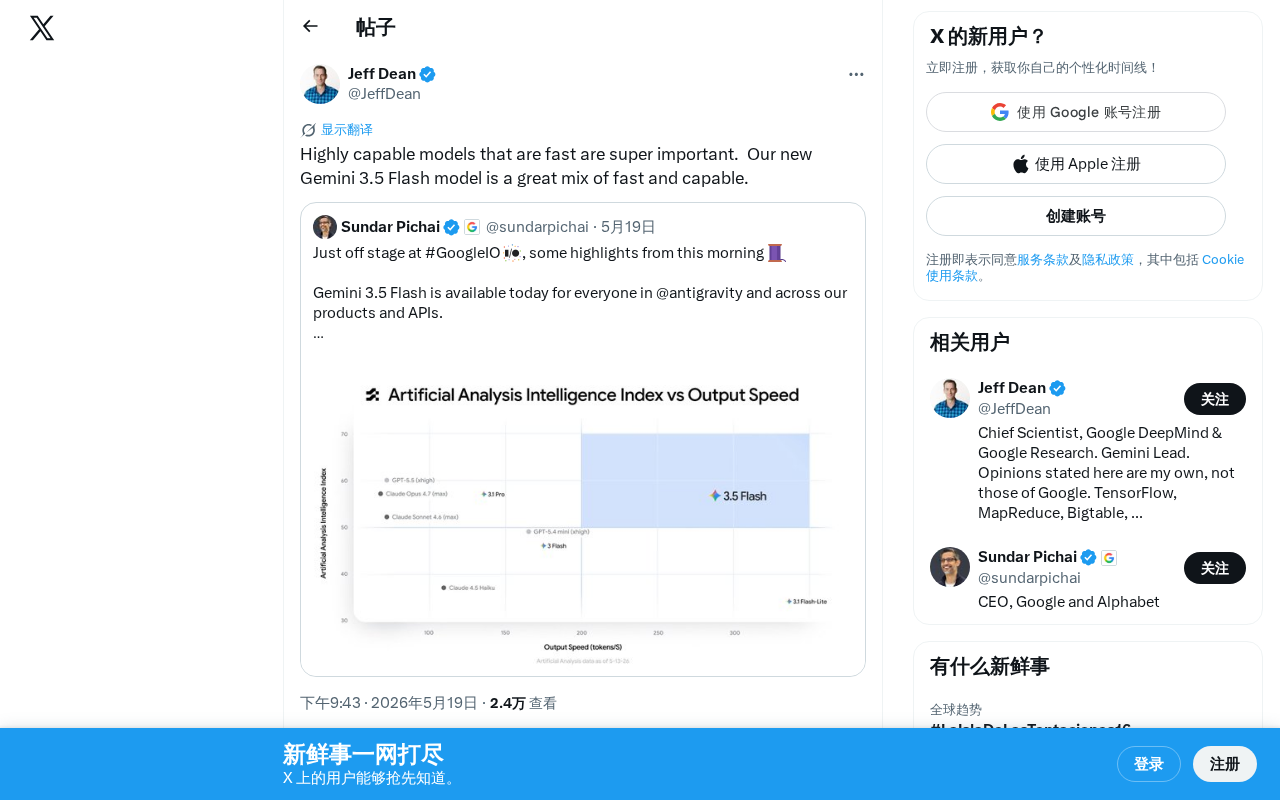
Google recently released the new Gemini 3.5 Flash model, emphasizing an excellent balance between speed and capability. This announcement came from Google's official social media channels, once again confirming that the AI industry is shifting from purely pursuing model capability toward a more pragmatic "fast and powerful" approach.
Speed vs. Capability: The Core Tension in Large AI Models
Throughout the development of large models, a classic trade-off has persisted: the larger the model and the more parameters it has, the stronger its reasoning capabilities—but the slower its response time and the higher its inference cost. Conversely, lightweight models offer fast speeds and low costs, but their performance on complex tasks often leaves much to be desired.
The root of this tension lies in the inherent challenges of the Transformer architecture. The computational complexity of the standard Self-Attention mechanism scales quadratically with sequence length (O(n²)), causing computation to explode as context windows grow. Meanwhile, large models contain hundreds of billions or even trillions of parameters, and each inference requires repeatedly reading these parameters from GPU memory, creating a severe "memory bandwidth bottleneck." This problem is particularly acute in Auto-regressive Generation—the model must run a complete forward pass for every single Token generated, making Time to First Token (TTFT) and overall throughput critical metrics that constrain user experience.
When releasing Gemini 3.5 Flash, Google explicitly stated: "Models that are highly capable AND fast are important." This seemingly simple statement captures the core pain point of current AI application deployment. Whether it's real-time conversation, code generation, or multimodal understanding, users need both high-quality output and cannot tolerate long wait times.
The Positioning and Evolution of the Gemini Flash Series
The Upgrade Path from Flash 1.5 to 3.5 Flash
Google's Flash series has always been positioned for "fast response" scenarios. From the earlier Gemini 1.5 Flash to today's 3.5 Flash, Google has continuously refined this approach. The 3.5 Flash is officially described as "a great mix of fast and capable," indicating that this generation significantly improves reasoning and comprehension capabilities while maintaining low latency.
The Flash series' ability to achieve this goal likely relies on two key architectural innovations. Mixture of Experts (MoE) is the mainstream direction for improving large model efficiency: unlike traditional dense models that activate all parameters during every inference, MoE models partition parameters into multiple "expert" sub-networks, with only a few experts dynamically selected by a Router for each inference. This means the model's "total parameter count" can be very large (ensuring capability ceiling), while the "active parameter count" per inference remains small (ensuring speed and cost efficiency). Google's Gemini 1.5 series has been confirmed to use MoE architecture, and 3.5 Flash most likely continues and optimizes this design. Additionally, Speculative Decoding uses a tiny draft model to quickly generate candidate Token sequences, which are then verified in parallel by the main model. This transforms serial generation into partially parallel processing, significantly improving throughput without changing output quality.
Industry Trend: Lightweight, High-Efficiency Models Become Mainstream
This release aligns closely with broader industry trends. Products like OpenAI's GPT-4o mini and Anthropic's Claude 3.5 Haiku are following similar paths—achieving near-flagship performance with smaller model sizes. The core technical foundations behind this are Knowledge Distillation and Model Quantization.
Knowledge Distillation, proposed by Hinton et al. in 2015, uses the output probability distributions (soft labels) of a large "teacher model" to train a smaller "student model." Compared to training directly with hard labels, soft labels contain rich information about inter-class relationships, enabling student models to learn comparable reasoning capabilities with far fewer parameters than the teacher. Model Quantization compresses model weights from high-precision floating point (e.g., FP32, BF16) to low-precision integers (e.g., INT8, INT4), reducing model size by 2-8x and improving inference speed several times over with virtually no loss in accuracy. The maturity of post-training quantization algorithms like GPTQ and AWQ has made quantized deployment an industry standard.
The reason is straightforward: in real-world commercial applications, the vast majority of scenarios don't require top-tier reasoning capabilities, but they do have strict requirements for response speed and API call costs.
What Gemini 3.5 Flash Means for Developers and Users
Lowering the Barrier to AI Application Development
Fast and highly capable models are crucial for the widespread adoption of AI applications. To understand this, one needs to understand the cost structure of large model inference. The billing unit for mainstream large model APIs is currently the "Token
Related articles
 Tech Frontiers
A Rare Quiet Day in AI: Recursive Self-Improvement Stirs Beneath the Surface
A rare quiet day in AI sees multiple sources go silent simultaneously. Behind the calm, Recursive Self-Improvement (RSI) research continues. What this means for the industry.
 Tech Frontiers
Reve 2 vs. Ideogram 4: A Deep Dive into Layout Control in AI Image Generation
A deep comparison of Reve 2 and Ideogram 4's layout control capabilities, covering technical approaches, real-world use cases, and industry trends for designers and creators.
 Tech Frontiers
In the Weights: Check Your Influence Score in the AI World
In the Weights is an AI influence search engine that quantifies your presence in the AI world with a score. Explore how it evaluates practitioners and what it means for digital identity.