Gemini 3.5 Free Access Guide: Direct Connection from China Without VPN

Free access to Gemini 3.5 from China via aggregation platforms, with code generation benchmarks.
This article explains how users in China can access Google's Gemini 3.5 for free through third-party aggregation platforms without VPN or registration. Using a web-based Minecraft generation test, it demonstrates Gemini 3.5's dramatic code generation improvement over version 3.1—jumping from demo-level output to fully functional applications. The article also warns about privacy, stability, and model authenticity risks associated with third-party platforms.
Why Gemini 3.5 Deserves Your Attention
Google recently released the Gemini 3.5 model, and multiple benchmarks show its overall capabilities have reached a level competitive with GPT-5.5 and Claude 4.7. However, for users in China, conveniently accessing Gemini 3.5 has always been a challenge—official channels are restricted, and the registration process is cumbersome.
Technical Background of the Gemini Series: The Gemini series is a multimodal large language model family developed by Google DeepMind. From the original Gemini 1.0 to today's 3.5, each generation has continuously evolved in parameter scale, reasoning capabilities, and multimodal understanding. Gemini employs a deeply refined version of the Transformer architecture with native support for multiple input modalities including text, images, audio, and video. This positions it in a three-way competitive landscape alongside OpenAI's GPT series and Anthropic's Claude series. Notably, Gemini was designed from the ground up with "native multimodality" as a core objective, rather than integrating visual capabilities as an add-on module like early GPT-4V. This architectural difference yields significant performance advantages when handling complex cross-modal tasks.
This article outlines a complete approach to use Gemini 3.5 for free through third-party aggregation platforms, along with real-world examples demonstrating just how powerful its code generation capabilities are.
Note: This article is purely an informational technical overview. Please evaluate the stability and security of third-party platforms on your own. Exercise caution with personal information when using any unofficial channels.
How to Use Gemini 3.5 for Free from China
Based on actual demonstrations, the entire process is remarkably simple: access a domestically available aggregation site, find the Gemini entry in the left navigation bar, and click any available channel to enter the interface.
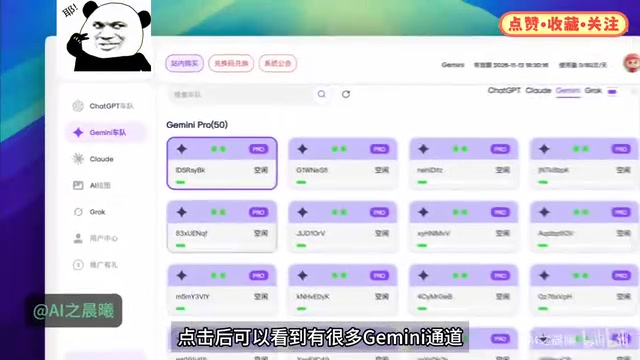
Key features of this approach:
- No VPN required: Directly accessible from China's domestic network—just open your browser
- No registration needed: No Google account required, no additional sign-up process
- Free to use: At least in the current phase, Gemini 3.5 can be experienced at no cost
- Multi-model aggregation: The same platform also integrates GPT, Claude, and other mainstream LLMs
These aggregation platforms essentially work through API relay, consolidating the capabilities of major models into a unified entry point. From a technical standpoint, the platform calls the REST API interfaces published by each model provider, wrapping user requests in a unified format before forwarding them to the corresponding model server, then returning the responses to the user. This architecture is essentially a reverse proxy plus routing layer—technically straightforward, but involving engineering challenges like API Key management, request rate limiting, and load balancing. Because requests pass through third-party servers for relay, your conversation content travels through an additional node in the transmission chain, which is the fundamental reason for the privacy security concerns emphasized in the risk section below. For users who want to quickly try different AI models, these platforms genuinely lower the barrier to entry.
Gemini 3.5 Code Generation Test: Web-Based Minecraft
Saying it works isn't enough—how does Gemini 3.5 actually perform? Let's get a feel for its capabilities through a case study of generating a web-based Minecraft game.
Gemini 3.1 vs. 3.5 Generation Results Comparison
Using both Gemini 3.1 and Gemini 3.5 to generate the same Minecraft game project, the differences were striking:
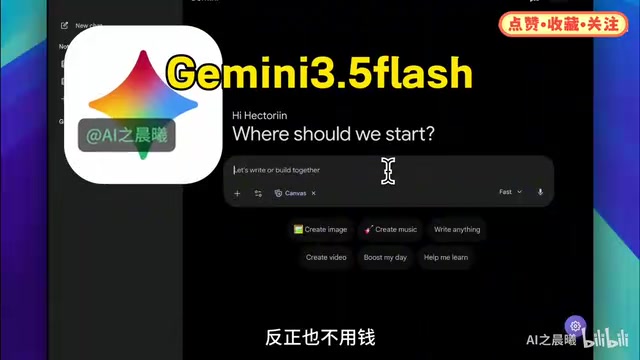
Gemini 3.1's performance:
- Could only implement basic gameplay
- Overall completion was low—at best a demo-level product
Gemini 3.5's performance:
- Perfectly reproduced the game's core mechanics
- Settings interface fully functional, including server settings, difficulty selection, game mode switching, etc.
- All interactive buttons work properly
- Implemented audio feedback—spacebar jump has sound effects, pressing E opens the crafting table

The Qualitative Leap from Demo to Complete Application
This case clearly demonstrates that Gemini 3.5 has achieved a qualitative leap in code generation. This isn't a quantitative improvement from "can write code" to "writes better code"—it's a jump from "a barely runnable demo" to "a fully functional application."
Understanding the technical background of this leap: Code generation capabilities in LLMs are typically evaluated across multiple dimensions: syntactic correctness, logical completeness, runnability, code style standards, and the ability to systematically decompose complex requirements. Earlier models could often generate syntactically correct code by "memorizing code snippets from training data," but when facing complete applications requiring multiple modules to work in coordination, they frequently suffered from inconsistent inter-module interfaces and chaotic state management. The leap from demo-level to complete application fundamentally reflects a deepening of the model's understanding of "the full picture of software engineering"—it's no longer just a "code completion tool" but is beginning to exhibit "product thinking," proactively considering user experience, error handling, and feature completeness.

The specific improvements manifest in three dimensions:
- Systems thinking: Gemini 3.5 not only generated the core game logic but proactively considered complete product elements like settings interfaces and UI interactions
- Attention to detail: The inclusion of sound effects, key feedback, and other details shows the model has a deeper understanding of "what constitutes a complete application"
- Code quality: The generated code runs directly with functional interactions, showing major improvements in structure and correctness
Practical Value of Multi-Model Aggregation Platforms
Beyond Gemini 3.5, these aggregation platforms typically support switching between GPT, Claude 4.7, and other top-tier LLMs within the same interface.
Why cross-model comparison matters so much: Current mainstream LLMs each have different strengths across different tasks—the GPT series excels in general conversation and creative writing, the Claude series is known for long-text processing and safety alignment, while the Gemini series continues to push boundaries in multimodal understanding and code generation. These differences stem from each company's distinct choices in training data composition, reinforcement learning strategies (RLHF), and model alignment objectives. Testing multiple models with the same prompt is a common industry method for evaluating model capabilities (and is the core mechanism behind AI evaluation leaderboards like LMSYS Chatbot Arena), as well as the most direct path for regular users to find "the model best suited to their use case."
The practical value of this approach includes:
- Side-by-side comparison: Test different models with the same prompt to quickly find the best fit for a specific task
- Complementary use cases: Use one model for copywriting, another for coding, a third for research—leveraging each model's strengths
- Reduced switching costs: No need to jump between multiple platforms—handle everything in one place
Usage Recommendations and Risk Warnings
While these free aggregation platforms are convenient, several issues warrant attention:
- Stability risk: Third-party platforms may adjust their policies at any time; free quotas may be limited or revoked
- Privacy security: When using unofficial channels, conversation content may pass through third-party servers—never input sensitive information. From a technical perspective, even if a platform claims not to store conversation records, the relay server still briefly holds plaintext data while processing requests, creating potential data leakage risks
- Model authenticity: There's no way to fully verify whether the backend is calling the official latest version; actual experience may differ. Some platforms may use older API versions or unofficially fine-tuned models while claiming to offer the latest version
- Compliance: Pay attention to the platform's operational compliance and try to choose service providers with established reputations
Conclusion
The release of Gemini 3.5 marks another important iteration for Google in the LLM race, showcasing particularly impressive capability improvements in code generation—the gap from 3.1 to 3.5 is visible to the naked eye. Behind this progress lies Google DeepMind's sustained investment in model architecture optimization, code-specific training data expansion, and reinforcement learning alignment strategies. It also confirms the "emergent capabilities" pattern in LLMs: when model scale and training quality cross a certain threshold, capability improvements are often not linear but exponential.
For users in China, experiencing Gemini 3.5 for free through aggregation platforms is currently the lowest-barrier option, but while enjoying the convenience, maintain reasonable expectations about security and stability. If possible, it's recommended to also follow Google's official access channels for the most stable and complete experience.
Related articles
 Tutorials
ChatGPT Plus Subscription Guide: Are GPT-5.5, image-2, and Codex Worth the Upgrade?
A detailed look at ChatGPT Plus features — GPT-5.5, image-2, and Codex — with a Plus vs Pro comparison and a complete step-by-step subscription guide for users outside the US.
 Tutorials
Harness AI Engineering in Practice: Using Claude Code to Master Enterprise-Level E-Commerce Development
Deep dive into Harness AI Engineering: master enterprise e-commerce development with Claude Code using the Rules, Skills, Wiki, and Changes framework.
 Tutorials
Cursor + Codex Dual-IDE Collaboration: A Practical Methodology for Open-Source Project Customization
A complete methodology for open-source project customization based on real-world experience, detailing the Cursor+Codex dual-IDE workflow, seven-stage process, MVP validation, and AI source code reading techniques.