Gemini 3.5 Transcribe: A Comprehensive Look at Google's Intelligent Speech Transcription Model

Google's Gemini 3.5 Transcribe brings LLM-powered intelligence and precision to speech-to-text.
Google launched Gemini 3.5 Transcribe, a speech-to-text model combining large language model understanding with acoustic recognition. It offers stronger disambiguation, semantic error correction, and formatted output. Targeting meetings, subtitles, call centers, and accessibility, it competes with OpenAI Whisper and other STT solutions by emphasizing precision and contextual intelligence.
Google Launches Gemini 3.5 Transcribe
Google recently released its latest Speech-to-Text model — Gemini 3.5 Transcribe — built around two core capabilities: "precision" and "intelligence." As an extension of the Gemini series into speech processing, this model is more than a simple speech recognition tool. It represents Google's new approach to bringing large language model comprehension into the audio transcription space.
Based on its official positioning, Gemini 3.5 Transcribe aims to solve long-standing pain points in traditional automatic speech recognition (ASR): inaccurate transcriptions, inability to understand contextual semantics, and poor adaptability to specialized terminology and accents. By integrating the language understanding capabilities of the Gemini large model, this transcription model promises to deliver results closer to human-level comprehension in real-world applications.
What "Intelligent Transcription" Means for Gemini 3.5 Transcribe
Traditional speech-to-text systems primarily rely on a combination of acoustic models and language models to map audio signals into text. The core goal of these systems is to "hear" every word clearly, but they often lack a grasp of overall context.
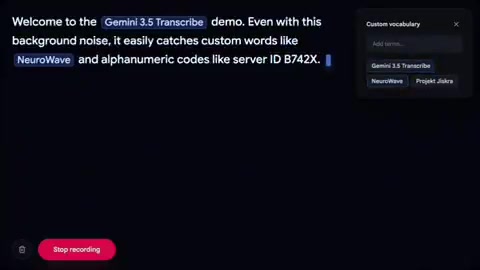
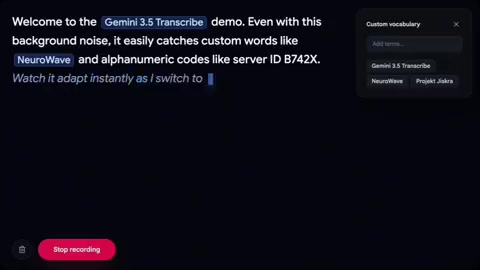
The "intelligence" that Gemini 3.5 Transcribe emphasizes lies in its ability to make judgments based on contextual semantics. This is reflected in several key areas:
- Stronger disambiguation: When encountering homophones, specialized terminology, or abbreviations, the model can choose the most reasonable transcription based on surrounding context.
- Better formatted output: Intelligent recognition of punctuation, paragraphs, and speaker transitions produces output closer to a ready-to-use document format.
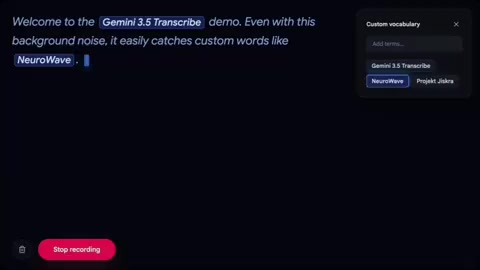
- Semantic error correction: When audio signals are unclear or affected by noise interference, the model leverages its language understanding capabilities to make reasonable inferences, reducing transcription errors.
This shift from "recognition" to "understanding" is a key direction for speech technology in the large model era. Compared to earlier purely acoustic-driven approaches, semantically-driven transcription can significantly improve usability in complex real-world scenarios.
Transcription Accuracy: The Core Competitive Advantage of Gemini 3.5 Transcribe
Google particularly highlighted "Precise" as a keyword in the release. For speech transcription products, accuracy (typically measured by Word Error Rate, or WER) remains the most critical evaluation criterion.
In practice, transcription accuracy faces challenges from multiple fronts:
Performance in Complex Acoustic Environments
Noisy backgrounds, overlapping multi-speaker conversations, and far-field audio capture all significantly increase recognition difficulty. An excellent transcription model needs to maintain stable performance under these non-ideal conditions.
Accent and Multilingual Support
Regional accents, dialects, and code-switching between languages place high demands on model generalization. The Gemini series has consistently emphasized multilingual capabilities, which is also a potential advantage in transcription tasks.
Specialized Domain Vocabulary Recognition
Vertical industries like healthcare, legal, and finance contain large volumes of specialized terminology. Leveraging the knowledge base of a large model, Gemini 3.5 Transcribe is well-positioned to achieve more accurate term recognition in these fields.
Application Scenarios for Gemini 3.5 Transcribe
High-quality speech transcription technology has broad application potential:
- Meeting minutes and summary generation: Automatically converting meeting audio into structured text, with the added ability to generate summaries using large model capabilities.
- Media subtitle production: Quickly generating accurate subtitles for videos, podcasts, and other content to improve accessibility.
- Customer service and call centers: Real-time call transcription for quality assurance, analytics, and intelligent assistance.
- Accessibility services: Providing real-time transcription for people who are deaf or hard of hearing, improving their access to information.
As AI applications increasingly permeate daily workflows, speech — as one of the most natural forms of human-computer interaction — directly impacts the effectiveness of downstream applications through its transcription quality. The launch of Gemini 3.5 Transcribe reflects Google's ambition to establish competitiveness at this infrastructure level.
Competitive Landscape: Gemini 3.5 Transcribe vs. Whisper and Other Solutions
The speech transcription space is far from uncontested. OpenAI's Whisper series has gained widespread adoption through its open-source approach and high accuracy, and major cloud providers all offer their own STT APIs. By bringing transcription capabilities under the Gemini brand, Google is positioning "large model-driven intelligent transcription" as its differentiator.
Deeply integrating speech recognition with powerful language understanding models is a clear trend in current technological evolution. Whoever achieves the best balance among accuracy, multilingual support, real-time performance, and cost will hold the advantage in this market.
Conclusion
The release of Gemini 3.5 Transcribe is another step forward in Google's multimodal AI strategy. The dual positioning of "precision" and "intelligence" shows that Google is driving speech transcription to evolve from traditional acoustic recognition toward semantic understanding. For developers and enterprise users, a transcription model with higher accuracy and better contextual awareness will undoubtedly open up greater possibilities for speech-related AI applications.
As more testing and real-world feedback emerges, the actual performance of Gemini 3.5 Transcribe will be worth watching closely.
Related articles

Why Does the Tesla Roadster Need to Fly? A Deep Dive into Musk's Wild Demo
Tesla's Roadster launch showed wall-climbing, upside-down driving, and flying stunts—but The Vergecast notes the demo car may lack a battery, the Rocket version is invite-only and not street-legal, and the website terms don't guarantee delivery. After nine years of delays, why does this car still need to exist?

AI Is Not a Replacement: Human-AI Collaboration Through the Lens of Factory Root Cause Analysis
Starting from factory root cause analysis, this article explains how AI accelerates evidence chain construction rather than replacing human experts, exploring the pragmatic implementation logic and business value of 'AI supporting people rather than replacing them.'

AI Agent Decision Auditing: Building an Evidence Chain in Regulated Workflows
Starting from a Reddit discussion, this article analyzes three core issues in AI agent decision auditing within regulated workflows: what fields audit records should contain, how to handle feedback latency for erroneous decisions, and how to continuously calibrate LLM judge consistency with human judgment.