Gemini 3.7 Flash Released and Tested, GPT-5.6 Ultra-Fast Mode Achieves 14x Speed Boost

Gemini 3.7 Flash leads mid-tier benchmarks while GPT-5.6 Ultra-Fast Mode delivers 14x speed via Cerebras chips.
Google launched Gemini 3.7 Flash just three weeks after its predecessor, delivering notable gains in code quality and web development benchmarks that lead same-tier competitors. Meanwhile, OpenAI opened the waitlist for GPT-5.6 Ultra-Fast Mode, leveraging Cerebras wafer-scale chips to achieve 750 tokens/sec — a 14x speedup targeting latency-sensitive production use cases. The two contrasting strategies highlight how mid-tier AI competition has evolved beyond intelligence into speed, cost, and scenario fitness.
Google Iterates on Flash Model in Just Three Weeks
Only three weeks after the release of Gemini 3.6 Flash, Google DeepMind rapidly launched Gemini 3.7 Flash, positioning it as the current "smartest workhorse model." This intense iteration pace is uncommon in the industry and has sparked considerable speculation about Google's internal product line strategy.
According to analysis from tech content creators on Bilibili, a widely circulated theory suggests that Google may be quietly killing off Gemini 3.5 Pro, "repackaging" algorithmic improvements originally planned for the Pro model into the Flash product line, while concentrating resources on developing the next-generation flagship Gemini 4 series. This explanation partly accounts for why a Flash model could achieve such noticeable performance gains in such a short time — it may carry technical accumulations originally intended for Pro-level products.
Within Google's Gemini model hierarchy, the Flash series is positioned as a fast, low-cost mid-tier workhorse suitable for large-scale production deployment; the Pro series pursues higher reasoning accuracy and complex task handling; while Opus is the flagship that spares no cost in pursuit of ultimate intelligence. This tiered strategy resembles product line segmentation in the chip industry — similar to NVIDIA's consumer, professional, and data center GPU tiers. Flash models typically employ techniques like model distillation, quantization compression, or architectural streamlining to drastically reduce inference cost and latency while preserving most capabilities. Bringing Pro-level algorithmic improvements down to the Flash product line essentially raises the model's ceiling without increasing inference costs, which is extremely attractive to enterprise users.
It's important to clarify that Flash is inherently positioned as a mid-tier workhorse prioritizing speed and cost, not a flagship product competing against Opus 5 or top-tier Pro models. Therefore, when evaluating it, the reference point should be same-tier Flash models, not frontier models priced several times higher.
Gemini 3.7 Flash Benchmarks: Steady Improvement but Not Revolutionary
Based on published data, Gemini 3.7 Flash shows genuine improvement over its predecessor, though the upgrade magnitude isn't exactly stunning.
Code and Software Engineering Capabilities
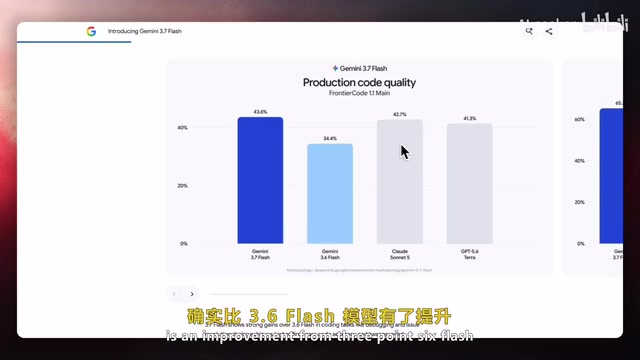
In production code quality testing, 3.7 Flash scored 43.6%, significantly outperforming 3.6 Flash's 34.4% and also surpassing same-tier competitor Sonnet 5's 42.7%. On long-horizon software engineering tasks, the model scored 65.3%, a substantial improvement from the older 3.6 Flash's 48.6%, though still slightly behind GPT-5.6 Turbo's 69.6%.
It's worth noting that the "production code quality tests" and "long-horizon software engineering tasks" mentioned here represent key dimensions in current AI model evaluation systems. The former typically measures a model's ability to generate directly deployable code, including correctness, maintainability, and security; the latter tests model performance in complex cross-file, cross-module software engineering scenarios involving understanding large codebases, refactoring, and debugging. Compared to simple competitive programming problems (like LeetCode-style algorithm challenges), these tests more closely approximate real development scenarios and are therefore considered core metrics for measuring AI programming's practical value. The 3.7 Flash jump from 48.6% to 65.3% on long-horizon software engineering tasks means it has achieved qualitative improvement in handling real project-level code tasks.
As a side note, Meta's model (MusePack 1.2, scoring 54.9%) is increasingly appearing on various benchmark leaderboards, signaling that the competitive landscape between open-source and major tech company models is becoming further complicated.
Leading Performance in Web Development
If there's one standout highlight for 3.7 Flash, it's web development capability. The model's score in this domain rose slightly from approximately 1538 to 1588 compared to the older version — not a dramatic increase, but enough to firmly hold the top position among all endpoint models. Given Google's deep roots in the enterprise market, this advantage is likely to translate into widespread deployment in enterprise application scenarios.
Additionally, in scenarios like long video understanding (85.4%) and long context processing (97%), 3.7 Flash's performance also leads same-tier competitors, demonstrating Google's traditional strengths in multimodal and long-sequence processing. Long context processing capability is particularly critical for enterprise applications — when analyzing lengthy legal documents, processing complete code repositories, or understanding hours of meeting recordings, whether a model can maintain accurate information recall and reasoning consistency across ultra-long inputs directly determines its practical value. A 97% long context processing score means 3.7 Flash can nearly perfectly locate and utilize key information within million-level Token inputs.
Gemini 3.7 Flash Pricing Strategy: Enticing Short-Term, Questionable Long-Term
Google has introduced a limited-time promotional pricing plan for Gemini 3.7 Flash that is quite aggressive.
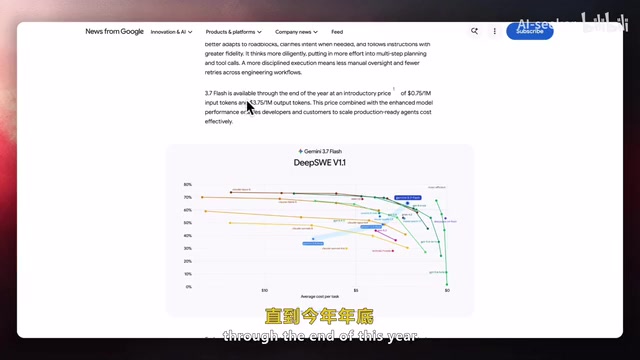
Until the end of 2026, the model costs only $0.75 per million input Tokens and $3.75 per million output Tokens — quite competitive pricing. However, this is promotional pricing only — starting January 2027, prices will double to $1.5 for input and $7.5 for output.
To understand the significance of this pricing, one needs to grasp the basic logic of Token pricing models: Tokens are the fundamental units by which large language models process text, roughly equivalent to 0.75 English words or 0.5-1 Chinese characters. API pricing uses "per million Tokens" as the unit, split into input (prompt) and output (completion) prices. Output pricing is typically higher than input because generating text consumes more compute than understanding it — the model needs to perform autoregressive inference Token by Token, with each generated Token requiring a full forward pass. For enterprise users, model selection considers not just intelligence level but also per-call cost and monthly total expenditure. A typical enterprise application (such as a customer service system or code assistant) might consume billions of Tokens daily — even a few cents difference per million Tokens can accumulate into tens of thousands of dollars in monthly cost variance.
In other words, Google is using six months of low prices to capture market share and developer mindshare, but long-term costs will rise significantly. Compared to other frontier labs, its pricing remains cheap; however, compared to DeepSeek's Flash version — especially after the price increase — the advantage becomes less obvious.
DeepSeek is a series of models from the Chinese AI startup DeepSeek, known for extremely low training and inference costs. Their technical approach emphasizes Mixture of Experts (MoE) architecture and efficient training strategies, achieving performance close to frontier models with lower compute investment. The core idea of MoE architecture is dividing model parameters into multiple "expert" modules, activating only a few during each inference pass, thereby dramatically reducing actual computation while maintaining total parameter count (i.e., model capacity). DeepSeek's Flash version has gained widespread attention in the international developer community because it offers competitive performance at prices far below competitors, forcing Google, OpenAI, and others to continuously lower pricing or introduce promotional plans to maintain market share.
Community Controversy: Are Real Costs Being Underestimated?
After the release, quite a few critical voices emerged in the community.
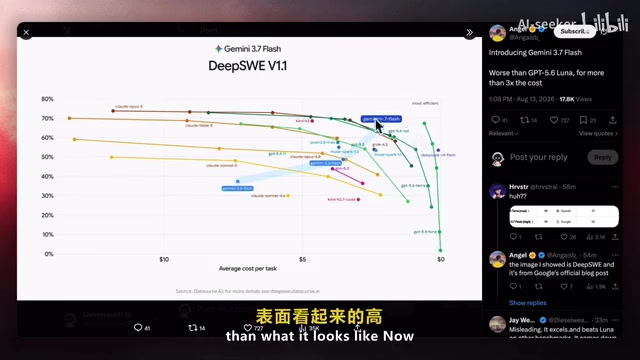
The core controversy is: the cost-effectiveness shown in charts may obscure real costs. In deep software engineering tests, Gemini 3.7 Flash underperforms GPT-5.6 Luna, while actual usage costs are approximately three times the stated figures. This has frustrated some users who feel Google deliberately excluded stronger models like Opus and Fable from comparisons, essentially "avoiding competition."
The claim that "actual usage costs are approximately three times the stated figures" deserves deeper examination. In complex software engineering tasks, models often require multiple rounds of interaction, Chain of Thought reasoning, and multiple retries to complete tasks. If the model generates large volumes of intermediate reasoning Tokens during its thinking process (so-called "thinking Tokens"), these are still billed but often aren't reflected in official simple pricing comparisons. Furthermore, if the model's code quality isn't high enough on the first attempt, developers may need multiple calls to get satisfactory results, further driving up actual costs. This gap between "nominal price" and "effective price" is a microcosm of current AI product pricing transparency issues.
A rational perspective on this: 3.7 Flash is, after all, a Flash-tier product and shouldn't be competing head-to-head with flagships like Opus, Sonnet, or Fable. The real product to look forward to for comparison is the yet-to-be-released Gemini 4 series. Until Gemini 4 arrives, it's unfair to judge a mid-tier model by flagship standards.
Additionally, commentators generally believe that if DeepSeek's Flash version were added to the leaderboard, it would likely "disrupt the rankings" — being both cheaper and smarter in certain domains. This also reflects how competition in the mid-tier model market has become extraordinarily intense.
OpenAI Strikes Back: GPT-5.6 Ultra-Fast Mode with 14x Speed Boost
Just as Google released its new model, OpenAI also opened the waitlist for GPT-5.6 Ultra-Fast Mode, becoming another major highlight of this competitive round.
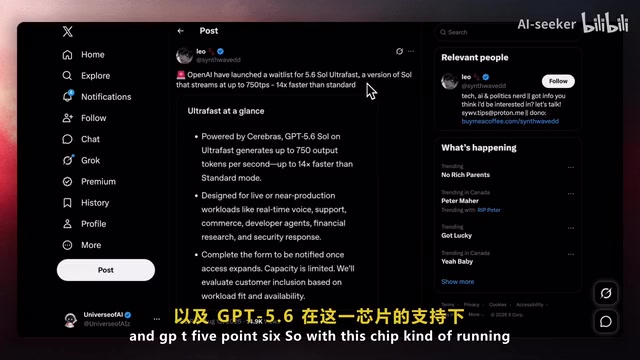
Leveraging high-speed chips obtained through Cerebras, GPT-5.6 in ultra-fast mode can run at up to 750 output Tokens per second, approximately 14x faster than standard mode. The significance of this breakthrough lies not in intelligence improvement but in the extreme compression of response latency.
Cerebras Systems is a company focused on AI acceleration chips. Its core product is the Wafer-Scale Engine (WSE), which fabricates an entire silicon wafer into a single massive chip with an area of approximately 46,225 square millimeters — dozens of times larger than traditional GPUs (such as NVIDIA's H100 at approximately 814 square millimeters). This architectural design eliminates inter-chip communication bottlenecks found in traditional multi-chip systems. In large language model inference, Tokens are generated sequentially one at a time, with each Token generation requiring access to all model parameters — meaning inference speed is primarily limited by memory bandwidth rather than compute capability. Cerebras's design integrates large amounts of high-speed SRAM directly adjacent to compute units, dramatically reducing data transfer latency and thus achieving extremely high per-Token generation speeds. 750 Tokens/second means approximately 560 English words can be output per second — nearly equivalent to a person's one-minute reading volume being generated in a single second.
Target Scenarios for GPT-5.6 Ultra-Fast Mode
This ultra-high-speed capability primarily targets production environments that are extremely latency-sensitive, including:
- Real-time voice support: Enabling near-zero-latency interaction for voice assistants and customer support. In voice conversation scenarios, human tolerance threshold for response delay is approximately 300-500 milliseconds — beyond this, noticeable "lag" occurs. At 750 Tokens/second, even longer responses can keep first-Token latency and overall generation time within the natural conversational rhythm humans perceive.
- Financial research and reports: Providing instant responses when interacting with AI agents. In financial markets, millisecond-level information advantages can translate into enormous trading value, and the ability to quickly generate analytical reports and decision recommendations has direct commercial value in high-frequency trading and real-time risk control scenarios.
- Security compliance and incident response: Providing fast, reliable support at critical moments
- Business agent applications: Supporting high-throughput automated workflows. When AI agents need to make dozens or even hundreds of model calls within a complex workflow, time saved on each call accumulates into significant end-to-end efficiency improvements.
However, this mode is currently still at the waitlist stage. OpenAI has not yet announced pricing or disclosed the specific cost implications of the speed improvement. Software-hardware co-optimization (especially the partnership with Cerebras) is considered crucial for OpenAI's future development, but the speed-for-cost equation requires more information to fully calculate. From a business model perspective, Cerebras's wafer-scale chips have limited production capacity and extremely high yield requirements, which may constrain large-scale rollout of ultra-fast mode, making it primarily serve enterprise customers willing to pay a premium in the short term.
Summary: Mid-Tier AI Model Market Enters Close-Combat Phase
Overall, this round of updates reflects the fierce competition among AI giants in the mid-tier workhorse model segment:
Google has chosen high-frequency iteration and limited-time low pricing to consolidate its enterprise market position, particularly building differentiated advantages in web development and multimodal long-sequence tasks; OpenAI, meanwhile, is betting on hardware acceleration, using a 14x speed improvement to pioneer the new battlefield of real-time interaction.
For developers, Gemini 3.7 Flash is a solid but unspectacular upgrade — the real headline act may have to wait for Gemini 4; GPT-5.6's ultra-fast mode opens new possibilities for real-time applications. These two distinctly different approaches perfectly illustrate how current AI competition has shifted from simply "who's smarter" to a multi-dimensional contest of "who's faster, cheaper, and better suited to specific scenarios." This competitive landscape benefits the industry's healthy development — it forces companies to move beyond merely pursuing paper improvements in benchmark scores and truly think about how to create practical value for users in different scenarios.
Key Takeaways
Related articles

Self-Hosted LLM Tech Stack: A Complete Guide to Managing Your Local AI Cluster from the Terminal
A deep dive into self-hosting LLM tech stacks: inference engines, model management, vector databases, and how to manage your local AI cluster from the terminal.

How a Hugging Face Engineer Automated His Team's Entire Workflow with AI Agents
Hugging Face ML engineer Niels shares how he automated his Community Science Team's workflow using AI Agents, from deterministic Workflows to autonomous Agents.

Fine-Tuning Qwen3-4B in Practice: Fixing Role Confusion with Just 100 Data Samples
A hands-on guide to fine-tuning Qwen3-4B: solving role confusion with just 100-200 identity stability samples. Covers data strategy, evaluation methods, and MoE architecture plans.