Gemini 3.8 Flash May Launch This Week: Why Fast Models Are Replacing Flagship Pro
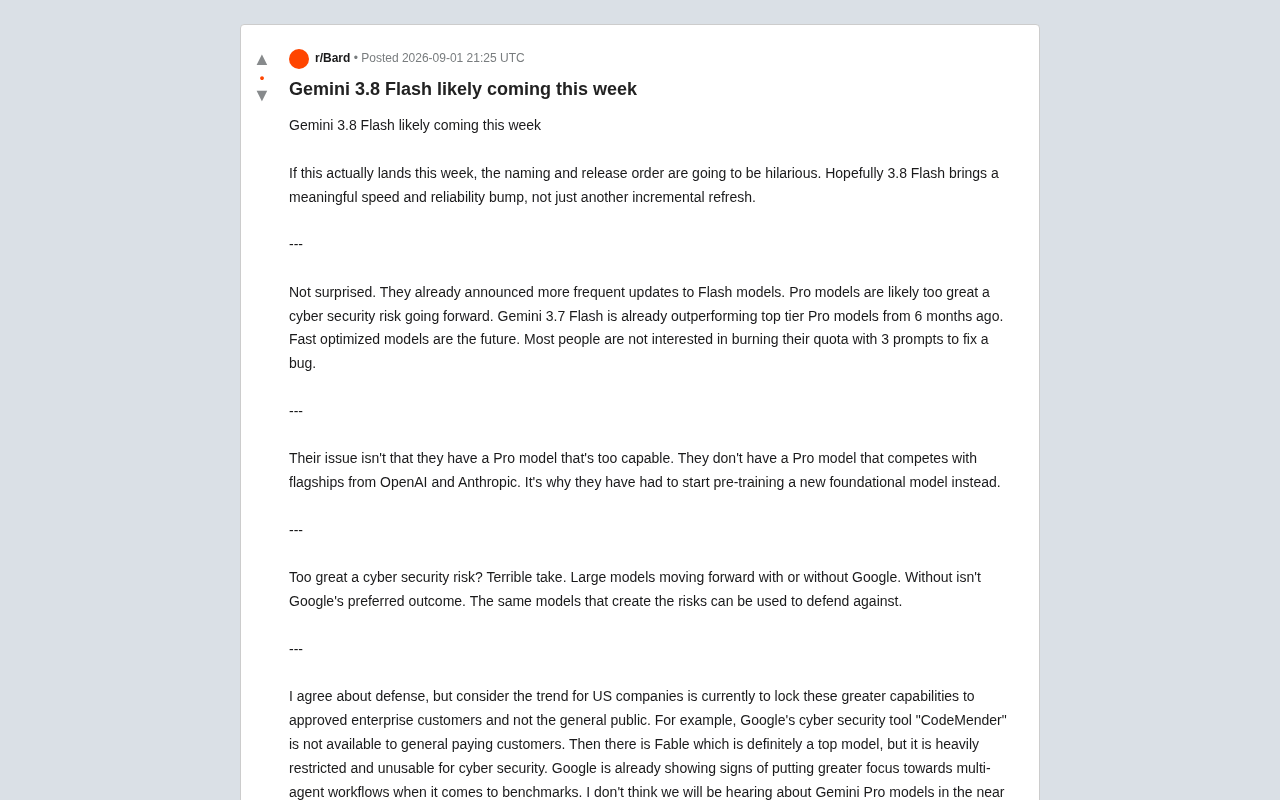
Fast, lightweight Flash models are overtaking expensive Pro flagships as the new AI competition battleground.
Reddit rumors of Gemini 3.8 Flash's imminent release reveal a major industry shift: lightweight, high-speed Flash models are becoming mainstream while expensive Pro models remain silent. Users prioritize speed, cost, and reliability over benchmark gains. Google's strategy may be shifting toward multi-agent workflows rather than single flagship dominance.
A Community Rumor Reveals an Industry Trend
Recent discussions on Reddit's AI community suggest that Google may release Gemini 3.8 Flash this week. While unconfirmed by official sources, the community debate around this rumor unexpectedly reveals a noteworthy trend in the current large language model competition landscape—lightweight, high-speed Flash-type models are becoming the mainstream focus, while expensive flagship Pro models have fallen into a peculiar silence.
If this update arrives as expected, the naming and release cadence itself is somewhat dramatic. Some community members joked that such frequent version iterations (from 3.7 to 3.8) make the entire release sequence feel chaotic. But beyond the jokes, what people really care about is: Can Gemini 3.8 Flash deliver substantial improvements in speed and reliability, rather than just another incremental routine refresh?
Why Flash Models Are Becoming Increasingly Important
The strongest consensus emerging from this rumor discussion is: optimized fast models are becoming the future.
To understand this trend, it's essential to clarify the technical positioning differences between the Flash and Pro product lines. In large model product lines, Flash-type models typically use fewer parameters or more efficient architectural designs—such as Mixture of Experts (MoE, an architecture that activates only a subset of parameters during inference), knowledge distillation (compressing a large model's capabilities into a smaller one), quantization compression, and similar techniques—consuming less compute during inference to achieve lower latency and lower API call costs. Pro-type models retain larger parameter scales and more complex reasoning pathways, pursuing extreme performance on difficult tasks. Google positions Flash as the workhorse product for high-concurrency, low-cost scenarios, while Pro targets high-end scenarios requiring deep reasoning.
Some observers note that Google has already announced more frequent updates for the Flash series. There's pragmatic logic behind this strategic choice: Gemini 3.7 Flash reportedly already surpasses the performance of top Pro models from six months ago. In other words, the pace of model capability advancement is enabling lightweight models to catch up with or even overtake older flagships.
Real-World User Experience Considerations
More critically, there are genuine user-side needs. As one community member put it: "Most people don't want to burn through their quota fixing a bug with three consecutive prompts."
This statement cuts to the core of product logic. For the vast majority of everyday use cases—writing code, fixing bugs, generating copy—what users truly care about is response speed, cost control, and stable results, not those few tenths of a percentage point improvements in benchmark tests. Speaking of benchmark tests, it's worth noting that the AI industry commonly uses standardized test sets like MMLU (Massive Multitask Language Understanding), HumanEval (code generation), and MATH (mathematical reasoning) to measure model capabilities, but there's often a significant gap between these scores and real-world user experience. A model might lead its competitor by two percentage points on MMLU yet exhibit more hallucinations or instruction-following problems in actual conversations. The industry's increasing adoption of human blind evaluations like Chatbot Arena to supplement traditional benchmarks reflects this recognition of single-score limitations.
A Flash model that quickly and reliably solves problems on the first try often has more practical value than an expensive, slow Pro model requiring repeated calls. This also explains why Google chose to increase iteration frequency on the Flash product line: it's closer to real-world scaled usage needs.
The Silence of Gemini Pro Models: Capability Issue or Strategic Choice?
The most heated debate centers on "why Gemini Pro models have had low visibility recently." The community has formed several sharply different interpretations.
View 1: Pro Models Lack Competitiveness
The most direct criticism suggests that Google's problem isn't that "Pro models are too powerful," but precisely that it lacks a Pro model capable of directly competing with OpenAI and Anthropic flagships. Some members point out this is also why Google had to restart pre-training a new generation of foundation models.
Those holding this view further speculate that the delay in releasing new Pro models is more likely because their benchmark metrics are "too embarrassing for shareholders"—a rather sharp business interpretation.
View 2: Cybersecurity Risks Lead to Deliberate Restrictions
Another camp believes that Pro-level powerful models are increasingly becoming cybersecurity risks, so Google may be intentionally limiting public access.
This concern isn't without merit. Take Google's cybersecurity tool CodeMender as an example—this AI tool, primarily used for code vulnerability detection and repair suggestions, isn't available to ordinary paying users. The restriction of such tools relates to the "dual-use" dilemma in AI safety: the same AI model that can discover vulnerabilities can also be used by malicious actors to find and exploit them. Since 2024, multiple studies have shown that advanced large models can autonomously discover zero-day vulnerabilities (security flaws not yet known or fixed by software vendors) in real software. The U.S. government and tech companies therefore tend to implement tiered access controls for AI capabilities with cybersecurity attack potential, prioritizing access to vetted defense and enterprise customers. Another top-tier model mentioned in the community, Fable, is similarly strictly restricted and cannot be used for cybersecurity scenarios. These cases seem to confirm a trend—locking more powerful AI capabilities to approved enterprise customers rather than the general public.
However, this explanation was immediately challenged. Opponents consider it a "bad take": large models will continue advancing whether Google participates or not; moreover, the same models that create risks can also be used to build defenses. "Let the best tools compete"—this is a healthier ecosystem logic.
Common Ground Beneath the Disagreement
Interestingly, even though both sides disagree on "whether permissioned rollout is effective" (some believe whitelists can't actually stop truly bad actors, questioning the real effectiveness of permissioned rollout), both tend to believe:
No capability will be "permanently" locked down; the public will eventually gain access, it's just a matter of timing.
Compute and Scaling: Where Is Google's Real Bottleneck?
On the technical front, the community also raised discussions about scaling constraints.
One view suggests Google has encountered trouble with scaling—simply making models larger, with other conditions unchanged, typically doesn't make models significantly better. This is actually the "diminishing returns of scale" problem the entire AI industry faces. The theoretical root of this problem comes from the famous Scaling Laws research in AI: OpenAI's 2020 paper showed that model performance has a power-law relationship with parameter count, data volume, and compute—increasing any of these three brings predictable performance gains. However, as model scale approaches certain boundaries, the marginal returns from continuing to add parameters begin to decline sharply, while training costs increase linearly or even super-linearly. This has driven the industry toward more efficient training methods like MoE, test-time compute scaling (investing more computational resources during inference to improve output quality rather than endlessly increasing training scale), and alternative paths like synthetic data training. Google's Gemini series is believed to adopt MoE architecture to address this challenge.
Another view focuses on compute supply: perhaps Google simply doesn't have enough compute capacity to serve new Pro models, and existing services are already under pressure even without new releases.
But this explanation also faced rebuttal. Some members pointed out that in terms of raw hardware compute reserves, Google actually far exceeds Anthropic and OpenAI. This confidence comes from TPU (Tensor Processing Unit)—Google's proprietary AI-specific chip, now in its sixth generation (Trillium/TPU v6e). Unlike NVIDIA GPUs, TPUs are deeply optimized for large-scale matrix operations and Transformer architectures, available through Google Cloud Platform (GCP). If Google really wanted to deploy Pro models, it has the full capability. The real situation may be a strategic choice:
Google seems more willing to let OpenAI and Anthropic rent its TPUs, then let them battle it out on the frontier.
This view is quite revealing—as the provider of TPU infrastructure, Google is both a competitor and an "arms dealer" in the AI race. Notably, Anthropic is one of TPU's major external customers, with its Claude series models' training heavily relying on Google Cloud's TPU clusters. This creates a unique competitive-cooperative relationship: Google both directly competes with Anthropic at the model level and continuously profits from its opponent's growth through TPU rentals at the infrastructure level. Letting competitors fight wars with your own compute is inherently a no-lose business.
Multi-Agent Workflows: Google's Next Big Bet
The discussion also mentioned an important signal: Google is increasingly leaning toward multi-agent workflows in benchmarking. Its recently launched Antigravity-related projects reflect this tilt toward multi-agent collaboration.
Multi-agent workflows are system architectures where multiple AI model instances each take on different roles or tasks, coordinating and communicating to accomplish complex goals. A concrete example: in a software development scenario, there might be one Agent responsible for requirements analysis, one for code writing, one for code review, and one for testing—they collaborate through structured message passing. The core advantage of this paradigm: each Agent can use a lighter, more specialized model, and the overall system's reliability and controllability actually surpasses solutions relying on a single all-purpose large model. Google's sustained investment in this direction recently—including Project Mariner (AI agent for browser operations), the A2A protocol (Agent-to-Agent, an open protocol defining communication standards between AI agents), etc.—all hint that its product strategy is shifting from "single-model capability competition" to "system-level intelligence orchestration."
This may mean Google's future competitive focus is no longer simply stacking the absolute capabilities of individual Pro models, but shifting toward system-level solutions of multiple optimized models working together. Under this paradigm, fast, cheap, reliable Flash-type models as foundational components will become strategically even more important—they're like efficient workers on an assembly line who, while individually limited, can collaboratively accomplish complex tasks far beyond a single "all-purpose expert."
The Era of Fast Models Is Arriving
Taken together, whether Gemini 3.8 Flash launches on schedule this week or not, this community discussion reflects a clear industry shift:
The focus of model competition is gradually transitioning from "whose flagship is stronger" to "who can provide faster, cheaper, more reliable models better suited for scaled deployment." Frequent iterations of Flash-type models, the rise of multi-agent workflows, and the strategic asset game of compute power together sketch a pragmatic and complex AI competition landscape.
For ordinary users and developers, this may not be bad news—after all, a fast model that fixes bugs on the first try is far more practical than a "super brain" that repeatedly burns through quotas.
Key Takeaways
Related articles
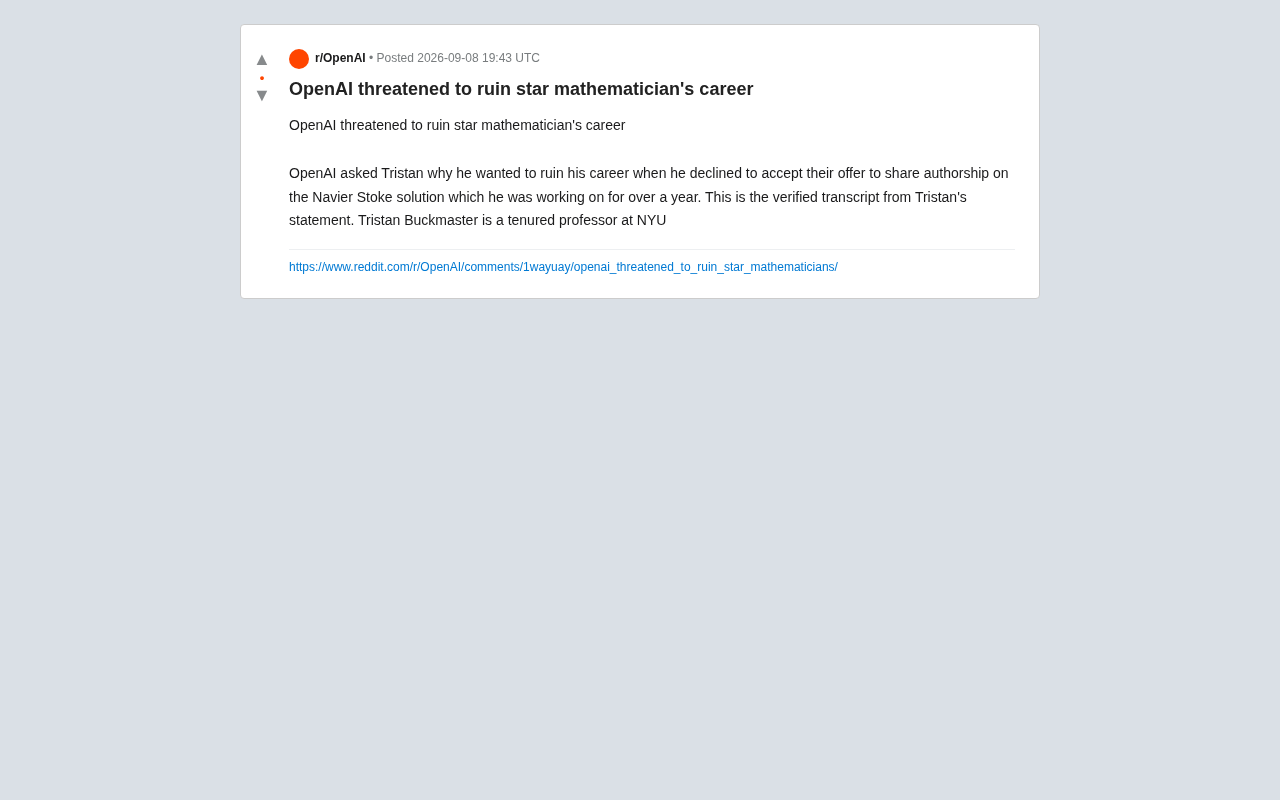
OpenAI Authorship Dispute: The Battle Over Academic Boundaries in the AI Era
OpenAI disputes authorship with mathematician Tristan Buckmaster over Navier-Stokes research, raising ethical questions about AI involvement in science.
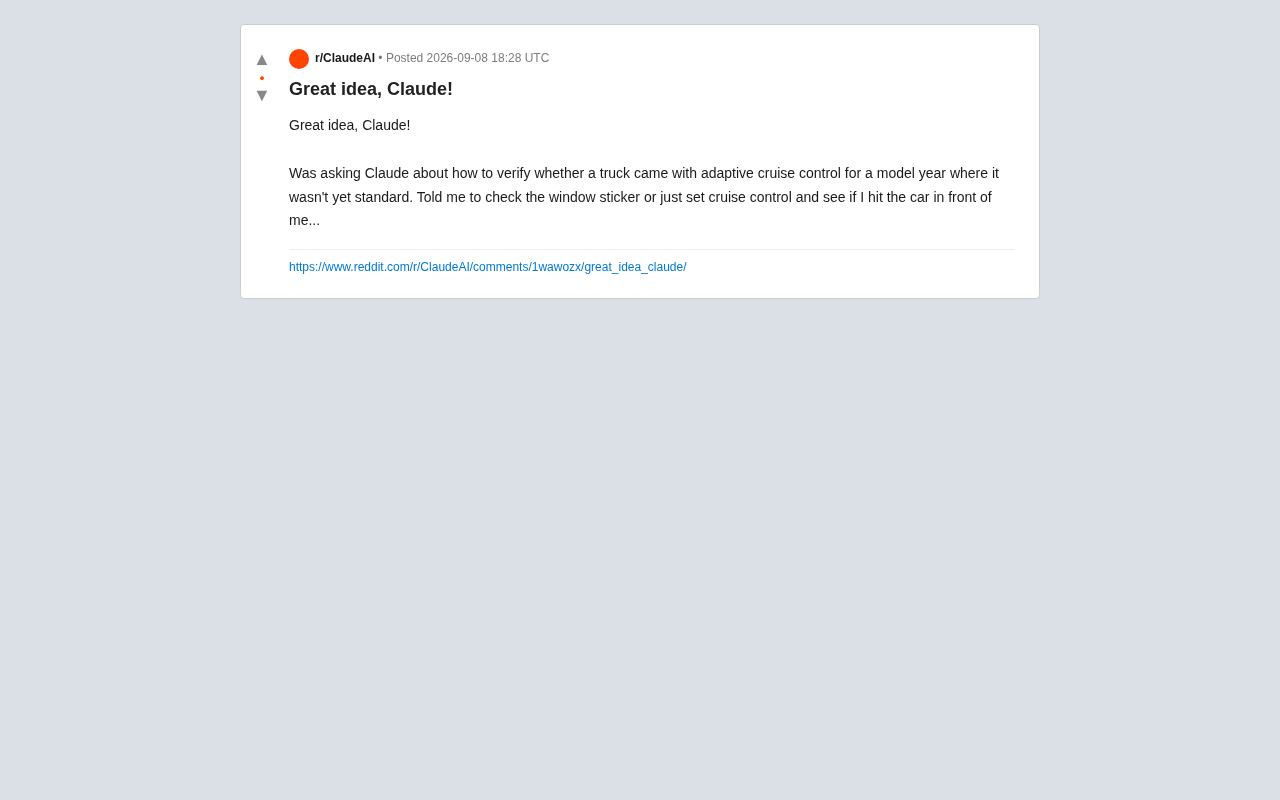
Claude Suggests User Test ACC by Crashing Into Car Ahead: Where Are AI Safety Boundaries?
Claude suggested a user test ACC by crashing into the car ahead—this absurd response sparked AI safety discussions. This article analyzes why LLMs generate implicitly dangerous advice and the blind spots in AI safety guardrails.

Terence Tao's Warning: AI Is Depleting the Non-Renewable Resource of Mathematical Problems
Fields Medalist Terence Tao warns that AI is mining mathematical problems in a non-renewable way. Exploring sustainability of math research in the AI era, the evolving role of human mathematicians, and balancing AI power with human creativity to maintain academic ecology.