Gemini 4 Argon Deep Dive: Million-Token Output Reshapes AI Reasoning Paradigm

Google's Gemini 4 Argon delivers frontier performance at Sonnet pricing with a 1M-token output limit.
Google's new flagship Gemini 4 Argon outperforms GPT-6 Astra and Claude Opus 5.5 on key benchmarks while launching at Claude Sonnet 5.5 pricing before eventually rising to Opus-level rates. Its core technical breakthrough is raising the single-response output limit from the industry-standard 128K tokens to 1 million tokens, opening new frontiers for test-time compute. Google is targeting three high-value domains: enterprise knowledge work (finance, legal, tax), long-horizon software engineering (including large-scale C/C++ to Rust migration), and cybersecurity defense. Currently available only to trusted testers, Argon is already being used internally to optimize Google's own data center infrastructure.
Google's new flagship model Gemini 4 breaks from the familiar "Pro" naming convention, adopting "Argon" (the third most abundant gas in Earth's atmosphere) as its codename. According to analyses from YouTube creators, this model outperforms competitors like GPT-6 Astra and Opus 5.5 across multiple core benchmarks, pulling Google back into the front-tier model race. But the real story isn't the leaderboard rankings — it's the model's ability to generate up to 1 million tokens in a single response, which fundamentally redefines the boundaries of test-time compute.
Performance & Pricing: Frontier Performance at Sonnet Prices
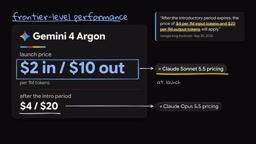
Google's previous Pro-tier model was Gemini Pro 3.1, released quite some time ago. With Argon, Google returns to the frontier on performance while also playing an aggressively competitive pricing card.
According to Arena benchmark data, Argon costs approximately 33% less per task than GPT-6.1 and roughly 70% less than Claude Opus 5.5, firmly placing it at the frontier of the performance-to-cost curve. On pricing strategy, the launch price matches Claude Sonnet 5.5 — meaning users get frontier-level performance at Sonnet prices — before eventually rising to Opus 5.5 pricing after the introductory period ends.
This "start low to gain share, then align with the premium tier" approach signals Google's clear determination to recapture developer and enterprise mindshare.
Three Core Focus Areas: Knowledge Work, Coding, and Cybersecurity
Google has explicitly positioned Argon around three application domains, each targeting high-value productivity use cases.
Enterprise Knowledge Work
Argon's advantages are most pronounced in enterprise knowledge work — finance, legal, and tax. It ranks first on the WALLS index, which weights different job categories by their contribution to the U.S. economy, and it also tops Zapier's Automation Bench, a benchmark that tests whether a model can complete real business workflows end-to-end. Knowledge work is becoming a concentrated focus for every frontier lab, since it directly relates to expanding the boundaries of productivity.
The WALLS index (Work Automation for Labor and Legal Services, or a similar full name) is a benchmark that scores models on their automation potential across different occupation types, weighted by economic contribution. It aims to measure AI performance on "the types of work that matter most to the economy" rather than purely academic question accuracy. This is fundamentally different from traditional benchmarks like MMLU (Massive Multitask Language Understanding), which focuses on breadth of knowledge — WALLS focuses on actual execution capability in high-value white-collar work such as financial analysis, legal document review, and tax compliance. Zapier Automation Bench takes a different angle: it tests whether a model can complete a full business process end-to-end within real SaaS tool ecosystems (like Google Workspace, Salesforce, Slack, etc.), not merely describe how to do it. Together, these two benchmarks reflect Google's strategic intent to position Argon as a leader in "scenarios that create direct business value."
Long-Horizon Software Engineering
Coding is the second focus, particularly long-horizon software engineering. Google claims Argon sets a new state-of-the-art (SOTA) on Deep SWE. More compelling than the leaderboard numbers are several internal case studies: fleets of Argon agents are migrating Google's internal C/C++ codebases to Rust — including an entire OS kernel — and another case involves accelerating an existing Rust port of an open-source video decoder while guaranteeing byte-identical output. These are "Google-scale" software systems potentially serving billions of users.
Long-horizon software engineering differs fundamentally from ordinary code completion tasks in terms of task scope. Short-horizon tasks typically involve completing a function or fixing a single bug, requiring only local context. Long-horizon tasks require the model to understand system architecture spanning dozens or hundreds of files, plan multiple interdependent subtasks, and continuously track the overall objective throughout execution. Migrating a C/C++ codebase to Rust requires simultaneously handling semantic equivalence verification, memory-safe rewrites, and cross-module dependency analysis — a single mistake at any step can cause the entire effort to fail. This is why long-horizon capability is considered a key indicator of real engineering value in AI agents, rather than simply writing "code that runs." Deep SWE is a benchmark specifically designed for these kinds of long-horizon engineering tasks, and is far closer to the complexity of real-world software development than earlier code benchmarks like HumanEval.
Cybersecurity Defense
The third focus area is cybersecurity. Argon can discover, validate, and fix vulnerabilities, and it ties for first place on the CWE Bench leaderboard alongside two other models.
Million-Token Output: A New Paradigm for Test-Time Compute
Beyond the impressive benchmark scores, the most significant change in this release is the output limit.
The Gemini series has long been known for its ultra-long context windows — Google was the first major lab to offer developers a 1-million-token context window, and even experimented with a 10-million-token research version. But on the output side, previous Gemini models were capped at around 64K tokens, while most current frontier models top out at around 128K tokens per response. Argon raises the output ceiling to 1 million tokens — what Google calls an "industry-leading" capability.
Why does this matter so much? In the era of reasoning models, test-time compute is becoming a critical component of the system. As tasks grow harder, models need more time to "think." When a model has enough space to generate hundreds of thousands of tokens within a single reasoning trace — especially when interleaved with function calls and tool calls — it gains an entirely new dimension of reasoning depth for tackling extremely difficult problems in a single pass.
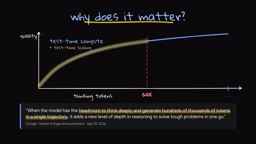
A relevant paper from Google DeepMind provides supporting evidence: if you allow a smaller model to think more deeply and generate hundreds of thousands of tokens, it can outperform a model 14 times larger on problems where the smaller model already has a reasonable chance of success. This suggests that compute allocated during inference may eventually exceed that spent on training — test-time compute is evolving into an entirely new paradigm. Of course, the robustness of this finding in real-world scenarios still remains to be validated.
Test-time compute is one of the core concepts in AI reasoning research over the past two years. It refers to investing more compute during the inference phase (rather than the training phase) to improve output quality. Traditional deep learning performance gains have largely depended on "training-time scaling laws" — training stronger base models with larger datasets and more parameters. Test-time compute represents a different path: by having models generate longer chains of thought, perform multi-step verification, or engage in self-reflection, more compute is dynamically consumed during inference in exchange for higher accuracy. OpenAI's o-series models and Anthropic's Extended Thinking mode are canonical examples of this paradigm. The 1-million-token output limit essentially provides ample room for this kind of "deep thinking" — the model can complete multiple rounds of tool calls, error correction, and path exploration within a single inference pass, without being truncated or split into multiple requests.
Not Yet Public, But Already Proving Its Worth Internally
Somewhat unfortunately, Argon is not yet available to general users. It is currently being made available to select enterprises and partners through Google's trusted tester program, with a public release expected soon.
Google has disclosed that Argon agents are already being used internally to optimize their own infrastructure, freeing up significant memory at the data center level — this kind of "self-optimization" application is often the strongest signal of a model's practical utility. The launch blog post also mentions additional use cases worth reading about.

As for the name "Argon" — it is the third most abundant gas in Earth's atmosphere, but why Google chose it as a codename remains a mystery.
Competitive Landscape: The Frontier Is Getting Crowded Again
Regardless of the naming logic, one thing is clear: Google's return to the frontier means that the relatively limited choices users faced just weeks ago are rapidly expanding. GPT-6 Astra, Opus 5.5, Sonnet 5.5, and Gemini 4 Argon are all competing on the same stage, and each lab will be forced to push its capability boundaries further.
For developers and consumers, the endgame of this race may be exactly as some analysts suggest — intelligence will become "cheap enough to be almost unremarkable." The real test will come once Argon opens to the public and gets put through the grind of real-world tasks.
Related articles

Amphibious Transforming Drone: Beyond 100x Power Savings, What Are the Real Needs?
Is the amphibious transforming drone just a gimmick? Starting from the 100x power difference of the M4 Morphobot, explore real application scenarios and thesis topic ideas, analyzing boundary conditions where pure drones and pure ground robots both fail.

Warhound Raises $200 Million: Genetically Engineered "War Dogs" Paired with Anduril Gear
Warhound raises $200M, backed by Ben Lamm and Palmer Luckey, to genetically engineer dogs for military and law enforcement use and equip them with Anduril gear. This article analyzes its technology direction, funding logic, and ethical controversy.

Claude API Comes to Google Cloud: IAM Integration and SDK Access Guide
Anthropic hosts the full Claude API on Google Cloud with IAM-controlled permissions and unified billing. This guide covers the Vertex AI and Anthropic-hosted entry points, IAM role configuration, and SDK access.