Gemini 4 Argon Full Review: Can Google's Flagship Model Crush Opus 5.5?

Google releases Gemini 4 Argon, leading Opus 5.5 in benchmarks and focusing on multi-step reasoning and professional-scenario deployment.
Google officially released its flagship AI model Gemini 4 Argon (codename R2). According to a Bilibili creator's review, it ranks first on the BOSS INDEX economic-domain leaderboard and scores 53 on the Artificial Analysis Intelligence Index, with benchmark results comprehensively leading competitor Opus 5.5. The article breaks down the model from three dimensions: benchmark scores, capabilities, and application scenarios. Its upgrade focus shifts from chat experience to complex reasoning and deep work, performing strongly in professional tasks such as programming, finance, law, cybersecurity, and science, and capable of completing complex engineering tasks such as a single-HTML-file Minecraft clone. At the same time, Google extends its positioning to robot control, reflecting cross-domain generalization ability. However, the review is mainly based on benchmark scores and single-point cases, and real-world experience such as long-context stability and instruction-following consistency still requires more independent verification.
Google officially released its flagship AI model Gemini 4 Argon (codename R2) last night, with benchmark scores comprehensively leading competitor Opus 5.5. According to a review video by a Bilibili creator, the model performs strongly in real-world tasks across programming, finance, law, cybersecurity, and science, and its depth and precision in multi-step reasoning make it superior to other frontier models in cross-domain foundational tests. Based on publicly available review information, this article breaks down this "unstoppable" new model from three dimensions: benchmark scores, capabilities, and application scenarios.
Topping the Benchmarks: Leading Both BOSS INDEX and Artificial Analysis
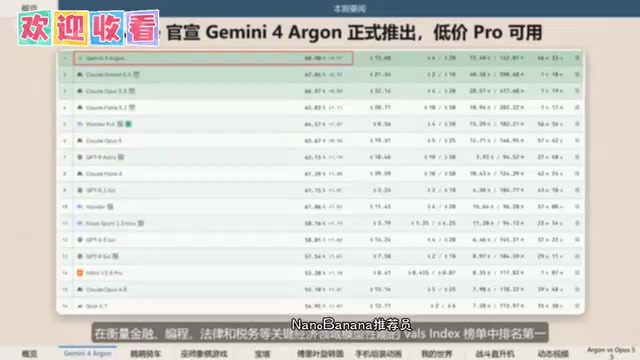
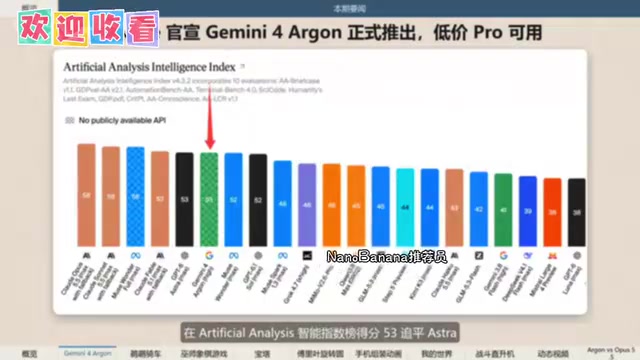
According to screenshots shared by the Bilibili creator, Gemini 4 Argon ranks first on the BOSS INDEX leaderboard, which measures model performance in key economic domains such as finance, programming, law, and tax. On the Artificial Analysis Intelligence Index, the model scores 53, on par with Astra. The benchmark data "leads OPUS 5.5 by a wide margin," becoming the most直观 selling point of this release.
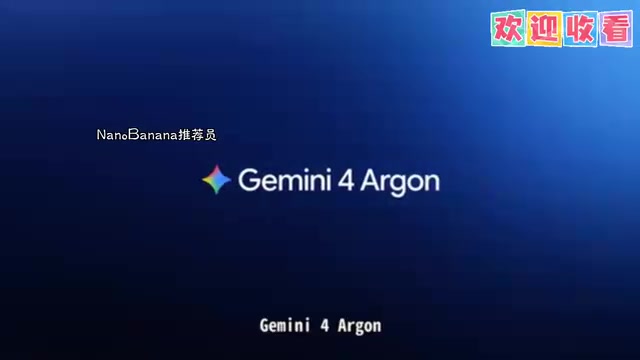
A quick note: leading benchmark scores do not equate to comprehensively superior real-world experience. BOSS INDEX focuses on economic-domain tasks, while the Artificial Analysis Index leans toward comprehensive intelligence evaluation. The difference in weighting between the two leaderboards means Gemini 4 Argon's advantages are concentrated in professional scenarios rather than general conversation.
BOSS INDEX is a benchmark leaderboard focused on model performance in high economic value domains such as finance, programming, law, and tax. Its evaluation questions typically simulate real professional workflows and emphasize whether the model can produce results directly usable in business. Unlike general capability leaderboards, BOSS INDEX pays more attention to task completion and professional accuracy, so its scores have strong reference value for judging whether a model can be deployed in professional scenarios, though they can hardly reflect performance in non-professional tasks such as daily conversation and creative writing.
Artificial Analysis Intelligence Index is a comprehensive model capability scoring system that aggregates results from multiple public benchmarks and produces a weighted summary of model reasoning, knowledge, programming, and other capabilities into a single score for horizontal comparison. Its advantages are broad coverage and fast updates, but weighting design affects final rankings, and scores across different indices should not be treated as directly equivalent.
Multi-Step Reasoning Depth: From Chat Model to "Deep Work" Tool
Google's upgrade this time focuses not on chat experience but on complex reasoning and professional knowledge processing. The review notes that Gemini 4 Argon demonstrates depth and precision in multi-step axis tasks and can efficiently complete deep work. This positioning aligns with the current trend of AI models evolving from "conversational assistants" to "productivity tools."
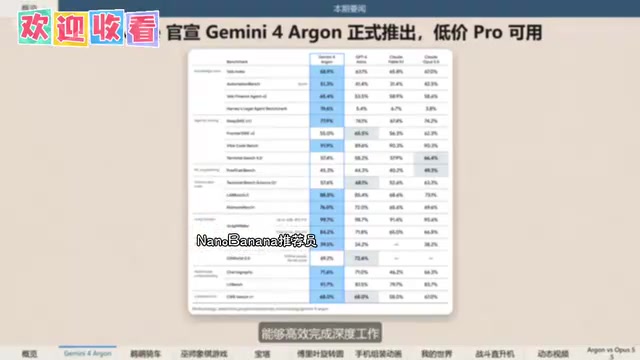
The difficulty of multi-step tasks lies in the accumulation of errors across intermediate steps; the model needs to maintain consistency throughout long chains of reasoning. Gemini 4 Argon's improvement in this dimension directly corresponds to scenarios requiring rigorous processes, such as financial analysis, legal document review, and cybersecurity auditing.
Multi-step reasoning refers to task formats in which a model must complete multiple reasoning steps consecutively to reach a final answer, for example first extracting conditions, then performing calculations, and finally verifying conclusions. Compared with single-step Q&A, the difficulty of multi-step reasoning lies in error accumulation along the reasoning chain: a deviation at one intermediate step may be amplified in subsequent steps, causing the final result to drift. Therefore, when evaluating multi-step tasks, more attention is usually paid to the model's ability to maintain logical consistency and self-correct over long chains, which is also a key indicator for judging whether a model can handle rigorous processes such as financial analysis and legal review.
Real-World Tests in Professional Domains: Comprehensive Coverage of Finance, Law, and Programming
In comparisons of model performance in key economic domains, Gemini 4 Argon covers multiple directions including finance, programming, law, and tax. The reviewer specifically mentioned enhanced programming and development capabilities and gave a concrete case: building a single-HTML-file clone of Minecraft, with the requirement to "make it beautiful and add all features of the original game."
Such tasks test the model's ability to decompose complex requirements, organize code, and fully understand game mechanics. The single-file constraint further increases difficulty, requiring the model to implement complete functionality within a limited structure. Judging from the review description, Gemini 4 Argon showed strong engineering implementation capability in such tasks.
Robot Control and Cross-Domain Generalization
Beyond software-level capabilities, Google is also aiming at real-world robot control this time. This means Gemini 4 Argon is positioned not merely as a chat model or programming assistant, but is extending toward embodied intelligence. Its comprehensive lead in cross-domain foundational tests indicates strong generalization ability, enabling transfer of reasoning capabilities across different task types.
From the review information, Gemini 4 Argon's upgrade path is clear: with complex reasoning as the foundation, it expands in three directions: professional knowledge, programming development, and robot control. This "one foundation, multiple scenarios" strategy aligns with the competitive logic of current leading AI vendors.
Embodied intelligence refers to the ability of an agent to perceive, decide, and act by interacting with the environment through a physical body; robot control is a typical application. Unlike traditional pure-software models, embodied intelligence requires models to combine language understanding, spatial reasoning, and motion planning, translating abstract instructions into concrete motion control sequences. Extending large model capabilities to robot control means the model needs cross-modal generalization ability, but noise in real environments, real-time constraints, and safety requirements also mean such capabilities still face many engineering challenges in moving from demos to practical use.
Review Conclusion: Clear Advantages, but a Rational Perspective Is Needed
Based on the Bilibili creator's review information, Gemini 4 Argon indeed shows pressure on Opus 5.5 in benchmark scores and professional tasks, especially in high economic value domains such as finance, law, and programming. However, the review content mainly consists of benchmark scores and single-point cases and lacks large-scale real-world usage feedback; the model's performance in long-context stability and instruction-following consistency still awaits more independent verification.
For developers and professional users, the core reason to watch Gemini 4 Argon lies in multi-step reasoning and deployment capability in professional scenarios. If it subsequently opens its API and maintains competitive pricing, it is expected to become a strong candidate for deep work scenarios.
One-line Summary
Google releases Gemini 4 Argon, leading Opus 5.5 in benchmarks and focusing on multi-step reasoning and professional-scenario deployment.
Paragraph Summary
Google officially released its flagship AI model Gemini 4 Argon (codename R2). According to a Bilibili creator's review, it ranks first on the BOSS INDEX economic-domain leaderboard and scores 53 on the Artificial Analysis Intelligence Index, with benchmark results comprehensively leading competitor Opus 5.5. The article breaks down the model from three dimensions: benchmark scores, capabilities, and application scenarios. Its upgrade focus shifts from chat experience to complex reasoning and deep work, performing strongly in professional tasks such as programming, finance, law, cybersecurity, and science, and capable of completing complex engineering tasks such as a single-HTML-file Minecraft clone. At the same time, Google extends its positioning to robot control, reflecting cross-domain generalization ability. However, the review is mainly based on benchmark scores and single-point cases, and real-world experience such as long-context stability and instruction-following consistency still requires more independent verification.
Related articles

JobRunner MCP Server: AI Agents Can Now Fix Failed Java Jobs
JobRunner launches an open-source MCP server enabling AI agents to view cluster status, diagnose failures, and recover Java jobs—incident response from any cloud coding environment or existing agent.

MLAI Digital Launches 9 Security Agents: MCP Server Safeguards the Full Lifecycle of Agentic AI
MLAI Digital launches Security MCP Server with nine built-in specialized security agents covering vulnerability discovery, attack simulation, prompt injection detection, API and infrastructure assessment, and accelerated remediation—embedding security validation across the full Agentic AI lifecycle from development to production.

Running Isaac Lab on H100 GPUs: Exploring Better Approaches
Exploring optimization methods for running Isaac Lab on NVIDIA H100 GPUs, including MIG configuration, mixed precision, TensorRT acceleration, and community experience to improve robotics simulation and reinforcement learning efficiency.