Gemini 4 Argon Hands-On: 12 Demos Showcasing 3D World and Game Generation

Gemini 4 Argon impresses in 3D and game generation, physics simulation remains a shortcoming, and Google is back in the top tier.
After Gemini 4 Argon's official launch, a Bilibili creator demonstrated its capability boundaries through 12 hands-on cases. 3D world generation stands out, capable of transforming oil paintings and floor plans into walkable spaces, but requires structured prompts to avoid triggering image generation. Game generation is a strong suit, producing playable prototypes from a single sentence, even a virtual computer containing 20 applications. Physics simulation is a clear shortcoming, with a 5,000-brick scene showing floating and spontaneous collapse. Among practical tasks, the native Google ecosystem integration (search + Sheets) becomes a differentiating advantage over Claude and ChatGPT, though the new Tasks feature lacks stability. Compared with Claude Opus, the same 3D scene was built about 10x faster. Chinese users can follow along through API discounts, the Antigravity platform, and Gemini Skills, but need to assess network and account conditions.
Gemini 4 Argon has officially launched, and Google has found its rhythm again in the AI race. A Bilibili creator with early access ran hands-on tests over several consecutive days, showcasing 12 cases of this new model in 3D world building, physics rendering, game generation, and practical tasks. Here are the highlights of these demos and practical guidance for Chinese users.
3D Generation: From an Oil Painting to a Walkable Space
The most striking leap shows in 3D world generation. The creator uploaded a Van Gogh painting and asked the model to turn it into an interactive 3D room. Not only did the model construct a freely walkable space, it also recreated the painting's floating particle effects in the 3D scene, with detail density exceeding expectations.

There's a notable prompt engineering trick here: a simple description directly triggers the built-in nano banana image generation capability, causing the model to continuously output static images rather than interactive applications. The creator only obtained the ideal 3D scene after switching to a structured instruction like "build an interactive application in canvas and preview it here." Similar cases include converting a flat floor plan into a first-person walkable 3D house, with the floor plan overlaid on the screen and the current position marked in real time, even supporting a night mode.
This capability has direct value for interior design, game prototyping, and space planning workflows.
The "nano banana image generation capability" mentioned in the article deserves elaboration. Based on currently public information, nano banana is presumably a lightweight image generation module that Google internally equips for the Gemini series, positioned like an auxiliary renderer: when the model determines that a task belongs to "static image output" rather than "executable code," it automatically dispatches this module for quick image generation. The advantage of this automatic routing mechanism is fast response and stable visual quality, but the side effect is also obvious — when users want an interactive application, the model keeps returning images. Therefore, the structured instructions summarized by the creator, such as "build an interactive application in canvas and preview it here," essentially force the model to choose the code generation path rather than the image generation path. Understanding this mechanism helps developers reliably control output type through prompt engineering in actual use.
Physics Simulation: Clear Progress, But Still Flawed
Physics rendering is where this test best reveals the boundaries of Gemini 4. The creator asked it to generate a city and smash buildings with a demolition hammer, setting a physics load of 5,000 bricks. The result was not ideal: bricks floated, and the city collapsed on its own before the hammer even swung — the physics engine's performance was clearly out of control.
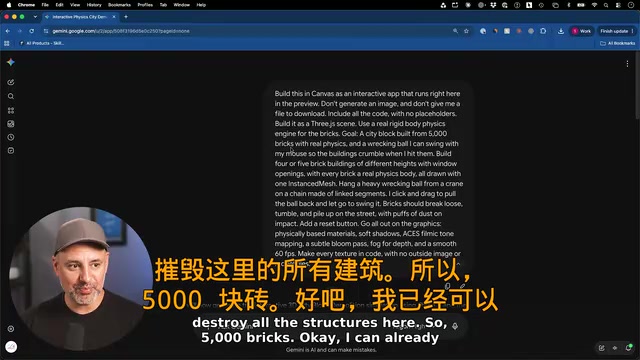
After switching to a simpler second version, the floating bricks disappeared and the physics improved, but it still fell short of usable standards. Worth noting is that the simplified version supported view switching, even allowing observation from a street-level perspective, making the interaction design actually more complete.
The conclusion is clear: Gemini 4 is stunning at 3D scene generation, but real physics simulation still needs another round of iteration. If your project relies on precise physical feedback, it's not recommended for direct production use at this stage.
"The physics engine's performance out of control" does not mean the model itself possesses genuine physics simulation capability. When current large models generate physics effects in 3D scenes, they typically do so by generating invocation code for JavaScript physics libraries (such as Cannon.js, Rapier), rather than having established a precise physical world model internally. Floating bricks and collapse before impact often stem from the model's incorrect parameter estimation of collision body sizes, masses, and constraint conditions in the code, rather than defects in the engine itself. This also explains why performance improved markedly after simplifying the scene: with fewer objects, the constraint relationships the model needs to reason about decrease, naturally lowering the error rate. In other words, the shortcomings of physics simulation are more a matter of "code generation precision" than "understanding physics," and this shortcoming is expected to improve relatively quickly as model reasoning capabilities advance.
Game Generation: One Sentence to a Playable Prototype
Game generation is Gemini 4's strong suit. The creator handed a hand-drawn sketch to the model and asked it to generate a playable game matching the sketch. The first attempt with a simple prompt again took the old image generation path, outputting a beautiful but unplayable image. After switching to a structured prompt, the model accurately reproduced the sketch layout, and the character could jump and move like Mario.
Several other game cases include: a one-click restored 3x3 Rubik's Cube, a roller coaster park with speed adjustment, and a music studio application that generates original tracks. The most extreme test was asking it to build an entire virtual computer containing 20 usable applications — file manager, drawing tool, calculator, Snake, Minesweeper, and more, all supporting multiple windows open simultaneously.
Google also launched a game creation space at labs.google/playground, where users can directly browse others' work or create their own games.
Practical Tasks: Native Advantages of the Google Ecosystem
In a party planning task, the model invoked search capabilities, compared five venues, and automatically generated a Google Sheet.

This is Gemini's unique advantage over Claude and ChatGPT: because it belongs to the same Google ecosystem, calls to Docs, Sheets, and Drive are natively integrated, requiring no third-party connectors, making the experience smoother. However, the creator also encountered problems: when using the new Tasks feature to process multi-format files, it still hadn't produced a presentation after 30 minutes; switching to regular chat mode completed the task within a minute. The stability of Tasks remains to be seen.
Gemini Skills is a reusable instruction set mechanism previously launched by Google, understandable as a "skill pack" for repetitive tasks: developers or users solidify a category of task prompts, tool invocation flows, and output formats into a template, and thereafter only need to trigger the skill name to reuse it. When combined with Gemini 4, Skills can significantly reduce prompt debugging costs, especially suitable for high-frequency scenarios such as document processing, data analysis, and schedule planning. The Tasks feature mentioned in the article leans more toward an "automatic multi-step executor," responsible for breaking complex tasks into sub-steps and invoking tools in sequence. The two have different positioning: Skills focuses on solidifying processes, while Tasks focuses on autonomous orchestration. The current stability issues with Tasks suggest that autonomous orchestration-type features are still prone to going out of control with complex multi-format inputs, while more deterministic mechanisms like Skills are actually more reliable and worth trying first.
Comparison with Claude: A Drastic Speed Gap
The creator used the same ancient Roman 3D scene for a cross-platform comparison. Gemini 4 completed the build in about 5 minutes, while Claude (Opus version, thinking level set to maximum) took over an hour — roughly a 10x difference.
The Gemini version also came out ahead in feature richness, supporting lighting switching and fast travel, while the Claude version lacked some settings. However, the creator also noted that the Claude version's visual style was equally impressive. The combined advantage in speed and features is the most convincing selling point for Gemini 4 in this round of competition.
"Thinking level set to maximum" refers to the extended thinking capability offered by the Claude series. Users can allocate an additional internal reasoning budget to the model, letting it perform longer step-by-step thinking before giving results. Raising the thinking level typically improves accuracy on complex tasks, at the cost of significantly longer response times, so taking an hour to complete a 3D scene is not surprising. Gemini 4 completing a similar task in about 5 minutes may benefit from more efficient reasoning scheduling or more aggressive parallel strategies, but may also have sacrificed some depth of verification. Therefore, the "10x speed gap" comparison needs to be understood under their respective default reasoning configurations: if Gemini 4's reasoning intensity were raised to the same level, the gap might narrow. Developers should consider their own actual needs for speed versus precision when choosing, rather than looking solely at a single comparison data point.
How Chinese Users Can Follow Along
For Chinese developers, several practical pieces of information are worth noting: Gemini 4 is now available in both the Gemini App and API, with the API currently in a discount pricing phase; the model has been integrated into Google's programming platform Antigravity; and the previously released Gemini Skills system can be combined with Gemini 4 to help solidify instruction sets for repetitive tasks.
It's worth noting that some of the creator's demos rely on Google AI Pro or Ultra subscriptions, and a large number of features are deeply tied to Google's own ecosystem. If domestic users want to replicate these workflows, they need to assess the feasibility of their network and account conditions themselves.
From this batch of demos, Gemini 4 Argon's biggest breakthroughs are concentrated in code generation and 3D construction, while physics simulation remains a shortcoming. The signal that Google has returned to the top tier is clear, but there's still a distance to go before comprehensive leadership.
One-line Summary
Gemini 4 Argon impresses in 3D and game generation, physics simulation remains a shortcoming, and Google is back in the top tier.
Paragraph Summary
After Gemini 4 Argon's official launch, a Bilibili creator demonstrated its capability boundaries through 12 hands-on cases. 3D world generation stands out, capable of transforming oil paintings and floor plans into walkable spaces, but requires structured prompts to avoid triggering image generation. Game generation is a strong suit, producing playable prototypes from a single sentence, even a virtual computer containing 20 applications. Physics simulation is a clear shortcoming, with a 5,000-brick scene showing floating and spontaneous collapse. Among practical tasks, the native Google ecosystem integration (search + Sheets) becomes a differentiating advantage over Claude and ChatGPT, though the new Tasks feature lacks stability. Compared with Claude Opus, the same 3D scene was built about 10x faster. Chinese users can follow along through API discounts, the Antigravity platform, and Gemini Skills, but need to assess network and account conditions.
Related articles

Why Does the Tesla Roadster Need to Fly? A Deep Dive into Musk's Wild Demo
Tesla's Roadster launch showed wall-climbing, upside-down driving, and flying stunts—but The Vergecast notes the demo car may lack a battery, the Rocket version is invite-only and not street-legal, and the website terms don't guarantee delivery. After nine years of delays, why does this car still need to exist?

AI Is Not a Replacement: Human-AI Collaboration Through the Lens of Factory Root Cause Analysis
Starting from factory root cause analysis, this article explains how AI accelerates evidence chain construction rather than replacing human experts, exploring the pragmatic implementation logic and business value of 'AI supporting people rather than replacing them.'

AI Agent Decision Auditing: Building an Evidence Chain in Regulated Workflows
Starting from a Reddit discussion, this article analyzes three core issues in AI agent decision auditing within regulated workflows: what fields audit records should contain, how to handle feedback latency for erroneous decisions, and how to continuously calibrate LLM judge consistency with human judgment.