Gemini 4 Argon Launches: Google Returns to the Frontier — But It's Not That Simple

Google's Gemini 4 Argon tops key benchmarks after six months away — but remains closed to the public.
Google has released Gemini 4 Argon, its first frontier model in over six months, claiming state-of-the-art results on VALS knowledge work, DeepSui coding, and legal agent benchmarks. However, the model is not yet publicly available, lags on FrontierSui and TerminalBench, and carries the baggage of past benchmark-vs-reality gaps that have eroded developer trust. Anthropic's simultaneous Sonnet 5.5 launch impressed on coding benchmarks but drew criticism for unexpectedly high token costs. The deeper story: AI competition has shifted from raw model intelligence toward the combined package of model, coding harness, and product experience — an area where Google is still catching up.
Heading into 2026, Google's position in the AI race once looked promising. Internal issues at DeepMind had been addressed, the Gemini model family remained competitive, and Google's natural advantages in consumer distribution and data led many to expect it to emerge as a top-tier contender. Then the "vibe coding" wave hit. A leap in coding capabilities, combined with the power of new harnesses like Claude Code and Codex, unleashed agentic abilities in ways no one had fully anticipated. Google suddenly found itself falling behind.
Being generous: Google spent most of 2026 playing catch-up. Being blunt: it was largely excluded from conversations about "top-tier model labs." This week, Google released its first frontier model in over six months — Gemini 4 Argon. On the benchmarks, Google appears to have made a triumphant return. But is that the whole story?
Gemini 4 Argon: Strong Benchmark Numbers, Restricted Access
Google's 2026 struggles are well-documented. We never saw Gemini 3.5 Pro — the company deemed it not good enough and quietly shelved it. This week's Gemini 4 Argon, however, does claim state-of-the-art results across multiple benchmarks.
On agentic knowledge work, Gemini 4 scored 68.9% on the VALS index, beating Fable 5.1 and GPT-6 Astra, and edging out the previous leader Opus 5.5 by several percentage points. Its leads on AutomationBench and VALS FinanceAgent are even larger. On Harvey's LegalAgent benchmark, Gemini 4 scored 19.6% — more than three times the current leader, Fable 5.1.

Agentic coding performance was more mixed. It set a new record on DeepSui at 77.9% (Opus 5.5 scored 74.2%), but scored only 55% on FrontierSui, trailing current leader Astra 6 by 10 points. On TerminalBench 4.0, it came in last at 57.4%, roughly 9 points behind Opus 5.5.
There are two ways to read this: coding is one of the most important use cases, and not topping those charts is a real problem. But from another angle, this represents significant progress for Google — coding was Gemini's biggest weakness over the past year, and being able to compete at the frontier at all is no small feat.
The VALS index (Verified Agent Leaderboard Score) is a third-party benchmark designed specifically to measure AI models' ability to complete agentic tasks in real-world knowledge work scenarios, spanning multi-step autonomous tasks in verticals like law, finance, and research. Unlike traditional question-answering or code generation benchmarks, VALS requires models to continuously call tools, process intermediate results, and make decisions over extended time windows — closer to what an "AI employee" would actually do in practice. It's widely regarded as a meaningful measure of real-world agentic capability. DeepSui and FrontierSui are specialized benchmarks for software engineering automation: the former focuses on code debugging and feature implementation with well-defined solutions, while the latter involves open-ended engineering problems requiring multi-file edits and architectural decisions in real codebases. FrontierSui's higher difficulty and stricter scoring standard explains the notable gap in Gemini 4's performance between the two.
Pricing and Efficiency: An Awkward Middle Ground
Artificial Analysis confirms Google's return to the top tier. Gemini 4 Argon scored 53 on the Intelligence Index, tying with GPT-6 Astra and Fable 5.1 for third place, trailing Sonnet 5.5 and Opus 5.5 by 3 and 5 points respectively.
On cost, it ran $1.99 per task in AA benchmark runs — cheaper than Astra's $3.26 and Fable 5.1's $7.63. But that reflects Google's "50% launch discount," with no stated end date; at full price, it would be more expensive than Astra. It also occupies an awkward middle ground: even with the discount, it costs more than twice as much as GPT-6 1 Sol, with no clear benchmark advantage to justify it.
More critically, Google is not currently making Gemini 4 Argon publicly available. The official reason involves cybersecurity — the model scored 68% on CWE Bench, on par with Grok 4.7 and GPT-6 Astra. Google has used this to limit access to so-called "trusted network defenders," noting it is participating in U.S. government voluntary testing and pre-release access programs, with plans to gradually expand — starting with API and Google Ultra subscribers.
"Google Is Back" — Or Another Benchmark Mirage?
Launching without opening up access is a curious choice. For those with long memories, it echoes December 2023, when Google rushed out Gemini in a bid to close the gap, only to have the Pro version remain unavailable for months.
That said, social media did erupt with "Google so back" energy. Dr. Daria Anutmaz wrote: "Google DeepMind is back with Gemini 4 Argon — stunning benchmark scores that catapult it to the very top of the AI frontier." He did add the crucial caveat: "Try Gemini 4 ASAP." Ethan Mollick called it "a three-way race again." Even Nathan Lambert, an open-source model researcher known for avoiding hype, commented: "More labs at the frontier is good for consumers (competition) and the world (power distribution)."
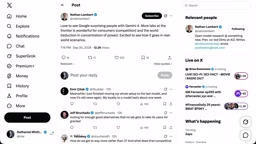
The skeptics were equally pointed. One user flatly stated: "We literally can't use this model, and Google's benchmarks have always been unreliable — don't forget what happened with Gemini 3 Pro." Ishu Agrawal added that when Gemini 3.1 Pro launched, official benchmarks claimed it "comprehensively outperformed Opus 4.6" — and reality didn't bear that out.
Google product lead Logan Kilpatrick offered a rare direct response: "We've gotten much better at stress-testing models at scale. Most new Gemini versions go through weeks of testing by thousands of software engineers before launch — hopefully that really does close the gap between benchmarks and reality." But a Bloomberg report, Google Addresses Employee Skepticism About Gemini 4, noted the model underperformed its benchmarks in actual employee use, particularly on certain coding tasks. Google denied the claims.
The Nature of the Competition Has Changed
Google's deeper problem is that while it was absent from the top of the leaderboard, the nature of the race itself changed. As Peter Yang put it, having a great model is no longer enough — you also need a competitive coding harness (like Antigravity) and a personal agent product (like Spark).
Meanwhile, Anthropic released Sonnet 5.5. Given that Opus 5 and Sonnet 5 were received poorly (the latter being expensive and extremely token-hungry), there was reason for skepticism. But following Opus 5.5's "return to the top," Sonnet 5.5 appears to continue that momentum.
Anthropic claims Sonnet 5.5 is 30% faster and 30% cheaper than Sonnet 5. On TerminalBench 4.0, it scored 70.6% (Sonnet 5 had only scored 10.3%), even surpassing Opus 5.5's 66.4%. Artificial Analysis gave it 56 points, placing it second — ahead of both Fable 5.1 and GPT-6 Astra.
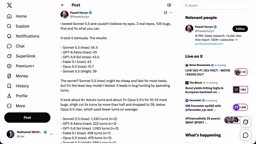
Cost remains a point of contention. AA testing found Sonnet 5.5 costs $7.60 per task — 27% more than Opus 5.5 and more than twice the cost of GPT-6 Astra, with far higher token consumption than Sonnet 5. Developer Kun Chen concluded from real-world use that Sonnet works well for execution while Opus is better for planning ambiguous product problems — they're not a simple "cheaper substitute" relationship. YouTuber Theo was even sharper: "Sonnet 5.5 is a remarkable model, but you probably shouldn't use it" — because under max reasoning settings it tends to overthink, while on lower settings it offers no real cost advantage over Opus.
In the context of AI agents, a harness refers to the scaffolding system built around a base model — including tool-calling frameworks, context management, multi-step reasoning orchestration, and error recovery mechanisms. Claude Code and Codex are fundamentally harnesses: they don't just call a model to generate code; they embed the model in a complete workflow that can read and write files, execute terminal commands, iterate through debugging, and understand project structure. A powerful harness can dramatically amplify a model's real-world output — the same base model, paired with an excellent harness, may complete complex engineering tasks at several times the success rate of a bare API call. This is the core meaning behind "the nature of the competition has changed": as raw capability gaps narrow, harness design and engineering integration depth are becoming the new differentiators. Google's Antigravity coding harness and personal agent Spark represent its attempts to catch up on this dimension.
Product Experience vs. Model Intelligence: An Open Question
Another thread worth watching: can a great user experience with a non-top-tier model beat a mediocre experience backed by the smartest model? Muse offers an interesting data point — it hit 3 million weekly active users and 1 million daily actives in just over three weeks, growing even faster than Codex (which took roughly three months to reach 3 million weekly actives).
But after spending time with it, Eureka co-founder Sina found "the underlying model isn't smart enough and has been making errors frequently," adding candidly: "As a consumer I'm not loyal to any product — I use whatever works best, and intelligence is still the moat." OpenAI's dots launch also drew complaints about friction: "It wants to help you manage work across ChatGPT and Codex, but without sufficient tool access and data permissions."
DoorDash announced this week that its AI agent can accept orders via SMS, replicating the Muse-style personal agent experience. Combined with Amazon's decision to block Muse agents, a big question emerges: what's the best agent strategy — partnering with category leaders, or building platform-exclusive agents? DoorDash's logic is clear — agent-placed orders carry 50% higher basket values, and building in-house means owning the customer profile. The risk is that external agents could bypass DoorDash entirely and order directly from restaurants. For now, it's hedging both ways.
Back to Gemini 4 Argon: as Nathan Lambert noted, Google performing well is good for consumers and competition alike. But until we can actually get our hands on it, all judgments rest on self-reported benchmarks and employees complaining to Bloomberg. The meal has been announced — we're still waiting at the door.
Background
The Gemini 3 Pro "lesson" is essential context for understanding the current wave of community skepticism. In early 2025, when Google launched Gemini 3.1 Pro, official benchmarks showed it comprehensively outperforming Anthropic's Opus 4.6 on reasoning, code, and multiple other metrics — sparking another round of "Google reclaims the throne" coverage. But over the following weeks, real-world developer feedback diverged sharply from the benchmark data: the model frequently exhibited logical leaps and hallucinations in actual coding tasks, and multi-turn consistency left much to be desired. This episode seriously damaged Google's credibility in the developer community and created a persistent mental model — apply a systematic discount to Google's official benchmark claims. Logan Kilpatrick's mention of "thousands of software engineers testing for weeks" is a direct response to that specific historical wound.
Related articles

Gemini 4 Argon Hands-On: AI Builds Board Games, Constructs Temples, and Trains Robots Autonomously
Gemini 4 Argon hands-on roundup: AI autonomously builds a desk racetrack and temple in Blender, writes a ray tracing engine, trains a humanoid robot to sink 7 shots, plus API pricing and developer access.

The Magic Octagonal Coin: Why Only 9% of People Can Predict Its Flip?
Only 9% of people can correctly predict the Magic Octagon coin flip. This article explains its spatial rotation mechanism, common cognitive pitfalls, and a new hypothesis based on Relevance Theory, exploring the limits of human spatial reasoning.

Sam Altman: AI Is Entering the Era of Scientific Discovery — Math Breakthroughs Will Replicate in Biology and Energy
Sam Altman says AI is entering the era of scientific discovery — math breakthroughs will replicate in biology, materials science, and energy to help develop new drugs and energy sources.