Gemini 4 Argon Tested: 13 Wins Out of 19 Benchmarks — Can It Beat Opus 5.5 on the Same Prompt?

Gemini 4 Argon scores big, but a same-prompt test reveals style differences and boundaries among three models.
Google released Gemini 4 Argon, which took 13 outright first-place finishes in 19 official benchmarks, reached 51.3% in workflow automation and 91.9% on Vibe Code Bench, shifting its positioning from "chats well" to "gets things done." A Bilibili creator used the same prompt to have Argon, GPT-6 Astra, and Claude Opus 5.5 each make a code-generated video; Argon chose a dense 20-second visual route, creating a sharp stylistic contrast with the other two. But Argon is not all-powerful: other models still lead in complex engineering, terminal operations, and scientific research tasks. A single test, affected by tools and environment, is not enough for a comprehensive verdict. The article notes that the path from idea to shareable work is shortening, and creators' ideas, taste, and judgment are becoming a new competitive dimension.
Google's next-generation large model, Gemini 4 Argon, has officially launched. From internal use to a limited rollout for safety teams, Google released a rather impressive scorecard: 19 benchmarks, 13 outright first-place finishes, and 1 tied for first. Knowledge work, long context, multimodal understanding — it scored high across multiple directions simultaneously.
But no matter how high the benchmark scores are, there's only one thing that truly makes people curious — when you let it get hands-on, what stunning things can it actually create? A Bilibili creator ran a same-prompt head-to-head test, putting Gemini 4 Argon, GPT-6 Astra, and Claude Opus 5.5 together, using the same single prompt to have each model produce a video, all generated entirely with code. The results turned out to be far more interesting than the benchmark scores.

The Official Scorecard: What 13 First-Place Wins Really Mean
First, look at the official comparison table. Out of 19 rows of results, Argon took 13 outright first-place finishes and 1 tied for first. What's most worth noting isn't the scores themselves, but the capability directions it targets — handling complex tasks, reading materials, analyzing problems, writing code, and then using tools to execute multiple steps in sequence.
Put plainly, Argon's positioning isn't "chats well" but "gets things done." Pushing a complex requirement forward step by step into an actual result — that's what it's really trying to prove.
Specifically on a few key metrics: all 4 knowledge work tests ranked highest, workflow automation reached 51.3% (the runner-up only managed 42.5%), the group of more input-heavy context tests led the runner-up by 12.4 percentage points, and web app development Vibe Code Bench hit 91.9%.
Put together, these numbers are enough to generate expectations for its actual creative capabilities — especially code-based creation. Being able to write something is one thing; whether the visuals grab people, whether the animation moves, and whether the whole video makes people want to watch to the end is another.
The limits of benchmarks and how to interpret them: Large model evaluations typically rely on standardized benchmarks, such as sub-scores for knowledge work, long context, and code generation. But there's a structural gap between benchmark scores and real-world experience. First, test sets are often carefully curated, and a model's training data may already cover similar distributions, creating a risk of "data leakage." Second, benchmark tasks are usually idealized scenarios: single-turn, no tools, no time pressure. Real usage, by contrast, involves multi-turn interaction, tool calling, error recovery, and interpreting ambiguous instructions. Therefore, "13 first-place finishes" shows the model has a high capability ceiling under controlled conditions, but it doesn't mean it performs best on any real task. A more reasonable interpretation is: treat benchmark scores as a screening signal, then validate with small samples in your own real workflow.
Same-Prompt Test: One Sentence of Prompt, Three Models Each Deliver a Video
The creator gave all three models the same prompt: "Help me make a video. This video should be written entirely in code. Style is up to you. The theme is the AI era — the future is already here."
No color scheme, no storyboard, no reference images. The four words "style is up to you" handed all creative choices to the models themselves. For fairness, the names were hidden first, labeled A, B, and C, so viewers could guess along the way which one came from Gemini.
After all three works were submitted, the answers were revealed:
- A came from OpenAI's GPT-6 Astra, using green wireframes, spatial structures, and big titles, feeling overall like a themed promotional film;
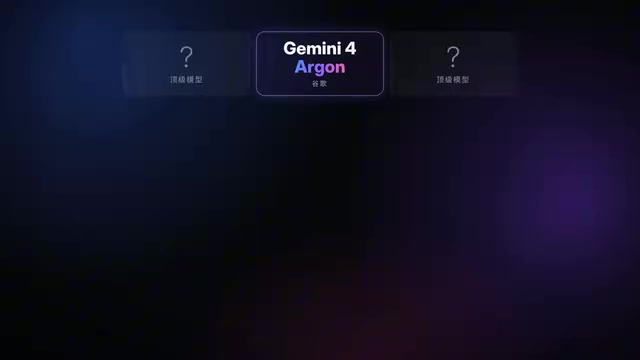
- B came from Google's Gemini 4 Argon, choosing the most packed form of expression — neon halos, glowing networks, and double helixes all crammed into 20 seconds, with the highest visual density of the three;
- C came from Anthropic's Claude Opus 5.5, starting from a single line of code and finally letting particles converge into "the future is already here," echoing the beginning and end.
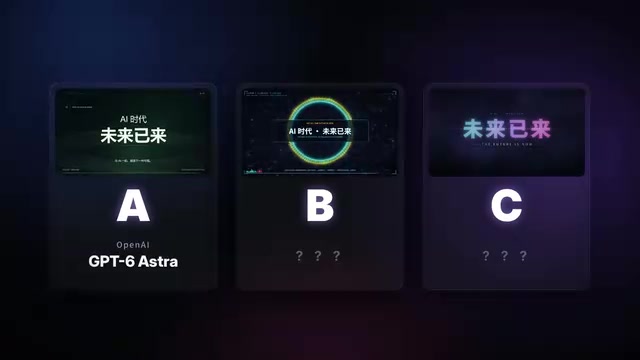
One sentence, three answers. This is exactly what makes real testing more interesting than benchmark scores — you can directly see what choices the models made, and you can judge whether you like them. Argon's B chose the "max out information density" route, stuffing as many visual elements as possible into 20 seconds. The pace is fast and the stimulation strong, but the cost is that breathing room is compressed.
The technical principle behind "using code to generate video": Here, "writing video with code" does not mean using AI to directly render pixels. Instead, the model generates HTML/CSS/JavaScript or code for Canvas, WebGL, or similar, and the browser renders the animation in real time. The model must make multiple decisions at once: choosing an animation library or native APIs, designing the timeline and easing curves, writing particle systems or graphic transformation logic, and arranging the hierarchy between text and graphics. This kind of task tests the coupling of the model's code organization ability and visual aesthetic judgment — code that runs is only the passing line, while whether the visuals grab people depends on the model's grasp of implicit aesthetics such as "visual rhythm," "negative space," and "contrast." For this reason, under the same prompt, differences in outputs across models often expose their "taste" and "decision tendencies" more than traditional text generation tasks do.
Not All-Powerful: Other Models Still Lead in These Areas
Argon's scorecard is impressive, but it didn't sweep every first place. In complex engineering, terminal operations, and scientific research tasks, other models each hold their own leads.
This round of testing was also just one problem. Tools, environment, production time, and the revision process all affect the final result, and a single test isn't enough to make a comprehensive judgment about a model.
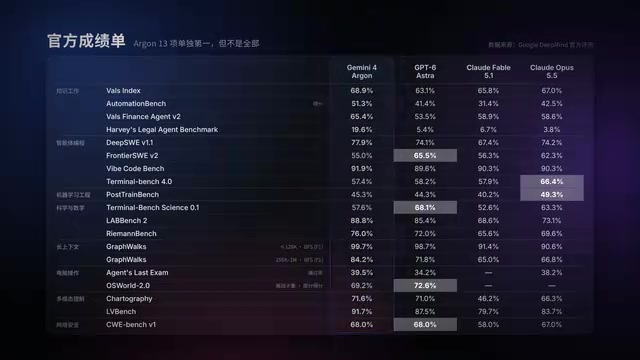
In other words, Argon's advantages in main directions like knowledge work, long context, and code generation are solid, but it doesn't crush opponents in every dimension. When choosing a model, you still need to look at the specific scenario — for automated workflows, writing web apps, and handling long documents, it may be the current optimal solution; for terminal-level operations or complex engineering reasoning, don't rush to replace the tools you already have.
Why complex engineering and terminal operations require a different skill set: Terminal operations (such as shell commands, file system operations, and process management) and complex engineering reasoning (such as refactoring multi-file codebases and troubleshooting dependency conflicts) test a model's "long-horizon planning" and "environmental awareness." These tasks have characteristics including a large state space, high error cost, the need for precise syntax and semantic understanding, and the fact that they often cannot be completed in a single generation — they must rely on multi-turn "execute-observe-correct" loops. By contrast, knowledge work and long context lean more toward "information processing," while terminal operations lean more toward "action and error correction." Therefore, a model can lead in document Q&A yet perform mediocrely when it needs to interact with real systems. When selecting a model, prioritize matching the task type rather than only looking at overall leaderboard rankings.
From Idea to Finished Work, the Path Is Getting Shorter
With the arrival of Gemini 4 Argon, one thing is becoming increasingly clear: from an idea, to a piece of code, to a work that can be played and shared, this path is becoming very short.
"The AI era — the future is already here" can now be a single prompt. The model handles drafting the style, composition, and animation, while the human handles judging whether it's good and whether it needs changes. What will truly set people apart will be your ideas, your taste, and your judgment.
At the end of the video, the creator posed a question: Of the three works, which one do you like best? Vote for A, B, or C in the comments. This also reflects a shift in how model capabilities are being evaluated today — beyond benchmark scores, creators' subjective preferences are becoming another yardstick.
Related articles

NVIDIA's 30,000 Developers Use Cursor, Code Commit Volume Triples
Cursor engineer Chris Diaz breaks down five organizational gaps blocking enterprise AI coding scale—strategy, risk tiering, governance, metrics, and operating model. NVIDIA's 30,000 developers use Cursor daily, tripling code commits while defect rates stay flat. The key: rewrite the SDLC, not add tools.

Ponytail: Giving AI Coding Agents a Senior Engineer's Mindset
Ponytail is a free GitHub tool that injects a senior engineer's mindset into AI coding agents, making them ask whether code is even necessary first. According to TamilDeck, it can compress 200 lines of AI-generated code to 30, cutting token costs, with support for Cursor rules and Claude Code skill integration—though security review still requires human oversight.

Complete Guide to Connecting Cursor AI to the GitHub MCP Server
A step-by-step guide to connecting Cursor AI to the GitHub MCP server: create a personal access token, configure mcp.json, store the token in the ENV block, and verify with a PR query.