Gemini 4 Carbon: Google's Next Frontier Model Unveiled

Google quietly launched Gemini 4 Carbon, highlighting cybersecurity and long horizon capabilities, with details still blank
Google quietly launched the Gemini 4 Carbon product page on Product Hunt, with the tagline "Google's next frontier model," Sundar Pichai as Maker, 93 upvotes, 4 comments, and 6th place for the day. The official description is just one sentence emphasizing industry-leading cybersecurity and long horizon capabilities, deliberately distinguished from a generic "safer." The article notes the "Carbon" suffix has no official explanation—possibly an internal codename or a hint at efficiency; choosing Product Hunt over a launch event marks a different rhythm, perhaps to gather signals on a small scale. With parameters, context length, benchmarks, availability, and pricing all undisclosed, it's impossible to judge whether this is a generational leap or a naming update without empirical data.
Google has quietly launched a product page on Product Hunt for a new model called Gemini 4 Carbon, with the only official tagline being a single line: "Google's next frontier model." No launch event teasers, no lengthy technical blog post, not even an explanation of the naming logic—but the "Carbon" suffix alone is enough to make anyone following large model progress stop and take a second look.
What the Product Page Reveals
Judging from the Product Hunt listing, Gemini 4 Carbon is categorized under Artificial Intelligence and Tech, with Sundar Pichai listed as the Maker. The page has received 93 upvotes and 4 comments, ranking 6th on the daily leaderboard. For a model product with no prior announcement, this level of engagement shows it has indeed caught some people's attention, but it's still a fair distance from "going viral"—4 comments means public discussion has barely begun.
The product description is equally restrained, almost stingy: "Gemini 4 Carbon is our strongest model with state-of-the-art cybersecurity and long horizon capabilities." A single sentence packs in two key information points: industry-leading cybersecurity capabilities and long horizon capabilities.
Two Keywords: Security and Long Horizon
The phrase "state-of-the-art cybersecurity" deserves to be examined separately. It doesn't say the model is "safer"—it emphasizes "cybersecurity." These two terms point in different directions in the model context. The former typically concerns alignment, refusal of harmful content, and jailbreak protection; the latter leans more toward attack-and-defense scenarios like code vulnerability identification, attack surface analysis, and threat intelligence processing. By putting cybersecurity in the most prominent position, Google hints that this generation's differentiator may not be general conversation but security-related professional tasks.
"Long horizon capabilities" is a direction that has repeatedly appeared in the frontier model race over the past two years: enabling models to maintain goal consistency over longer time spans, completing multi-step, cross-session complex tasks rather than just answering individual questions. Putting this term in a one-sentence product description is essentially declaring that Gemini 4 Carbon is positioned to "get work done" rather than "chat."
Long horizon capabilities in the agent context typically refer to a model's ability to maintain its original goal across dozens or even hundreds of steps, remember intermediate states, and recover from errors. Common ways to measure this capability include software engineering tasks like SWE-bench that require multiple rounds of editing and testing, multi-hop retrieval over long documents, and cross-session tool-calling chains. It's not the same as simply expanding the context window: no matter how long the context, if the model loses its goal midway or repeatedly backtracks, the task will still fail. So when vendors mention long horizon in their descriptions, it often implies accompanying planning, memory, and self-verification mechanisms—not just stacking token limits.
State-of-the-art cybersecurity has relatively specific referents in model evaluation. The industry commonly uses benchmarks like CyberSecEval to assess a model's tendency to generate insecure code, its upper bound for assisting attacks, and its performance in vulnerability identification, log analysis, and threat intelligence attribution. Making this a selling point typically means the model has undergone specialized post-training or tool integration in the security domain, while also raising dual-use concerns: the same attack surface analysis capability can be used for defense or misused. Vendors generally pair this with abuse monitoring and access restrictions, which is one reason such models tend to have more conservative availability than general-purpose models.
The Subtext of the Naming
The "Carbon" suffix is unusual in Google's model lineage. Previous Gemini series mostly used version numbers or capability labels for differentiation; suddenly introducing a chemical element name could be an internal project codename leaking out, or it could hint at a positioning related to "efficiency" or "foundational-ness"—carbon is the foundational element of life and materials science, and this association isn't far-fetched. However, it must be noted that the official side has given no naming explanation whatsoever; the above is merely speculation based on available information.
Another easily overlooked detail is the release channel. Frontier models typically debut at Google I/O or on the official blog, but Gemini 4 Carbon first appeared on Product Hunt—a community focused on product discovery and early user feedback. This could mean Google wants to collect real usage signals on a small scale first, or it could simply be a channel experiment. Either way, it shows this launch's rhythm differs from the past.
Product Hunt is a product discovery community centered on product launches, voting, and early user reviews, generating a daily leaderboard by vote count. Its release logic differs greatly from a Google I/O keynote or official blog: the latter does complete technical disclosure for media and developers, while the former is more like a lightweight market probe, where feedback signals are votes, comments, and bookmarks rather than benchmark scores. When frontier models first surface on such channels, it usually means the team is still collecting real usage signals and isn't ready with complete technical documentation and pricing, so the product page's wording shouldn't be treated as final specifications.
Caution Is Warranted
The only facts confirmable right now are those few lines on the product page: the tagline, one description sentence, 93 upvotes, 4 comments, 6th place. Model parameters, context length, benchmark scores, availability scope, and pricing strategy are all absent. For a positioning like "next frontier model," these blanks are precisely the most critical—how long a task chain can long horizon capabilities actually sustain? What are the evaluation criteria and comparison baselines for cybersecurity capabilities? The answers to these questions determine whether this is a genuine generational leap or a marketing-level naming update.
At a stage when the product page's comment count is still in the single digits, any judgment about "how much performance has improved" lacks basis. What's certain is that Google is pushing both "security" and "long horizon" to the forefront, indicating that the competitive focus of next-generation models is shifting from "how well it answers" to "how complex a task it can reliably complete." Whether Gemini 4 Carbon delivers on this promise will require more empirical data before conclusions can be drawn.
One-line Summary
Google quietly launched Gemini 4 Carbon, highlighting cybersecurity and long horizon capabilities, with details still blank
Paragraph Summary
Google quietly launched the Gemini 4 Carbon product page on Product Hunt, with the tagline "Google's next frontier model," Sundar Pichai listed as Maker, 93 upvotes, 4 comments, and 6th place for the day. The official description is just one sentence emphasizing industry-leading cybersecurity and long horizon capabilities, deliberately distinguished from a generic "safer." The article notes that the "Carbon" suffix has no official explanation—possibly an internal codename or a hint at efficiency and foundational positioning; choosing Product Hunt over a launch event marks a different rhythm from the past, perhaps to collect signals on a small scale. Since parameters, context length, benchmark scores, availability scope, and pricing are all undisclosed, it's currently impossible to judge whether this is a generational leap or a naming update—empirical data is needed.
Related articles
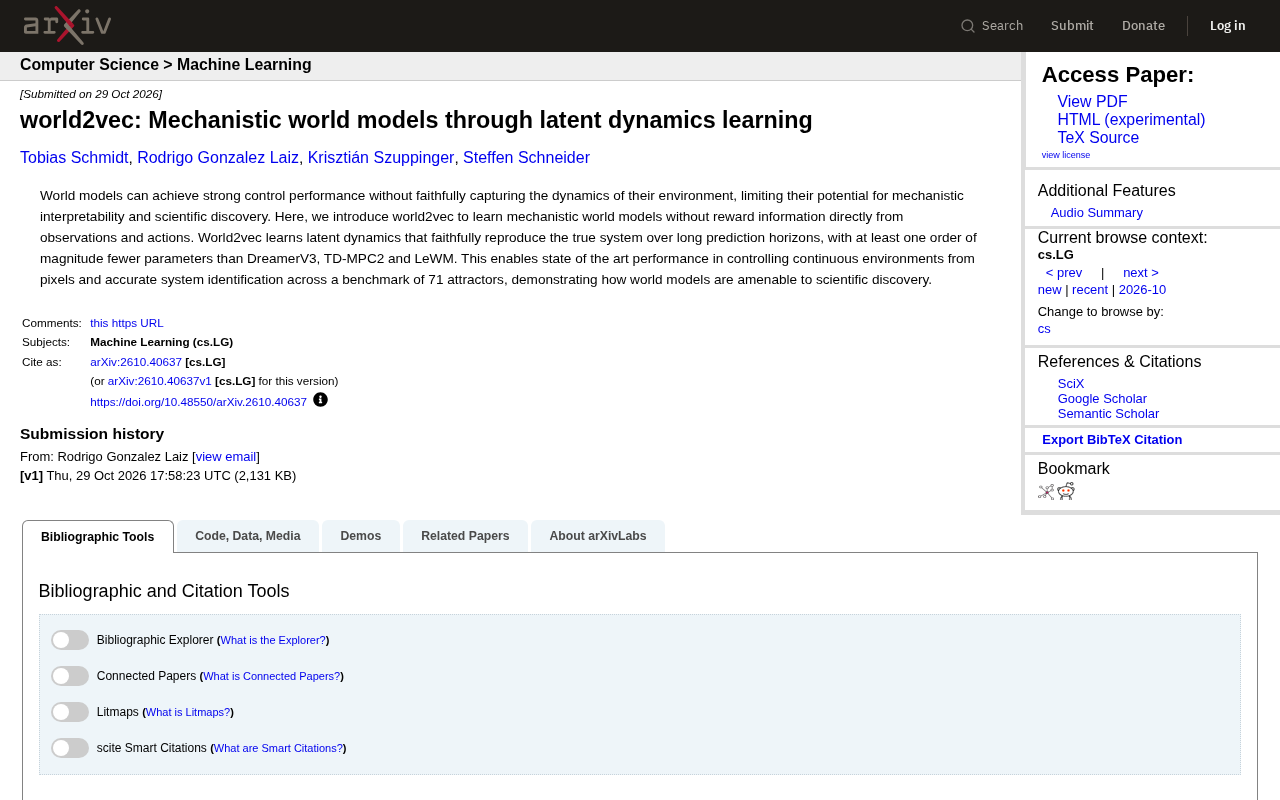
world2vec: Building Mechanistic World Models with Latent Dynamics Learning
world2vec proposes a reward-free method for learning mechanistic world models via latent dynamics, faithfully reproducing systems over long horizons with at least an order of magnitude fewer parameters than DreamerV3, TD-MPC2, and LeWM, and achieving accurate system identification on 71 attractor benchmarks.

A New KL-DRO Paradigm: Adaptive Scenario Generation Around a Learned Density Model
KL-DRO research proposes centering the KL ball on a learned density model instead of the empirical distribution, with adaptive scenario generation guiding sampling toward the worst case. Experiments show lower cost under distribution shift when records are scarce and the model can extrapolate, with comparable in-distribution cost.

ODE Samplers for Discrete Diffusion Models: Exponential Residual Flows Accelerate Generation
Discrete diffusion models lack deterministic ODE sampling? This article introduces Exponential Residual Flows (ERFs), which introduce continuous residual variables per token to construct piecewise ODEs for deterministic sampling and support consistency distillation acceleration. Superior to prior methods on code and text generation tasks.