Gemini 4 Hydrogen and Claude 5.2 Launch in the Same Week; Anthropic Banks $2.3 Billion from Account Bans
Google and Anthropic both release dense model matrices in the same week, with agent customerization as the new main thread
This week brought a dense wave of AI releases: Google launched Gemini for Carbon, Gemini 4 Hydrogen, and an input-billed Decisions API, forming a cost-competitive model matrix; Anthropic released Claude Fable 5.2 and Mythos 5.2, topped Frontier Code 2.0, and started its IPO roadshow with Q3 revenue of $7 billion. In robotics, Google's Gemini Robotics 2.5, Nvidia's Groot 2, and Ant's LinBot Touch represent fine manipulation, world models, and tactile perception. OpenAI's merchant agents gave rise to the Business to Agent concept, with Shopify and Neon data showing agents are becoming real transaction and development entities. Domestic players Alibaba, ByteDance, and MiniMax keep iterating on image and video generation.
Gemini 4 Hydrogen and Claude 5.2 Launch in the Same Week; Anthropic Banks $2.3 Billion from Account Bans
This week brought a dense wave of releases in the AI large-model space: Google rolled out multiple models at once, including Gemini 4 Hydrogen and Gemini for Carbon; Anthropic launched Claude Fable 5.2 and Mythos 5.2 and kicked off its IPO roadshow; and Alibaba, ByteDance, Nvidia, and Ant each made their own moves. Below is a thematic breakdown of the key signals from this round of updates.
Google: A Model Matrix, Not a Single Breakthrough
The most interesting thing about Google's latest releases isn't that any one model took first place—it's that Google split its models into a matrix covering different scenarios.
The flagship reasoning model Gemini for Carbon is available to developers, enterprises, and Google AI Ultra users, and excels at engineering tasks that require multi-round investigation and verification. When first announced, it ranked first on the Artificial Analysis Intelligence Index v5.0 with a score of 59, and this time it also ranked first on CursorBench 4.0, Wonder, and AlimationBench 3.0. On MKA, a multimodal knowledge-work benchmark jointly launched by Google and Artificial Analysis (featuring 200 tasks designed by industry experts), Carbon ranked second in delivery quality, with an average cost of roughly one-seventh that of the first-place Fable 5.2—a striking cost advantage.
The fast model for everyday coding and agent tasks, Gemini 4 Hydrogen, takes a different route: at the default high-thrust setting it scores 51, beating Argon's 50, and at its highest setting it reaches 54 on the Artificial Analysis Intelligence Index. It has already been integrated into products such as Google Search.
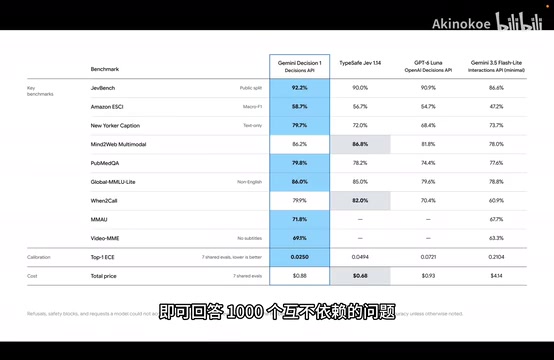
The accompanying Gemini Decisions API deserves separate attention: it lets applications quickly choose tools from given options, allocate models, or check whether content complies with rules. The underlying model, Gemini Decision 1, supports uploading the same material only once to answer 1,000 mutually independent questions. The interface bills by input and does not charge for output tokens, at roughly $0.1 per million input tokens. This pricing structure is clearly designed for high-frequency, low-latency scheduling-type calls.

Google also released the DNA sequence model Alpha Genome 2, which can predict how the same genetic variant affects gene expression across different cell types or states, identifying nearly twice as many variants that alter cellular gene expression as the previous generation; and a preview of Gemini for Health Care for medical scenarios, which can consolidate materials across electronic medical records, claims, and administrative systems, and when applying for insurance authorization, extract case evidence against underwriting policies, point out missing materials, and cite sources.
Artificial Analysis Intelligence Index is a comprehensive capability leaderboard maintained by the third-party evaluation firm Artificial Analysis. It aggregates results from multiple public benchmarks (reasoning, coding, knowledge Q&A, etc.) into a single score for cross-vendor model comparison. The index adjusts its questions and weights across versions, so scores from different versions are not directly comparable. The figures 59 and 54 cited in this article refer to results under a specific version of the index and only reflect model performance on a particular evaluation set—they are not equivalent to real-world business outcomes.
CursorBench 4.0, meanwhile, is a coding evaluation designed around usage scenarios in the Cursor code editor. It focuses on a model's ability to make multi-file changes, understand codebases, and call tools, complementing traditional algorithm-problem-style coding benchmarks. Such benchmarks are closer to how developers actually use agentic coding day to day.
Anthropic: Topping the Coding Charts While Heading to the Capital Markets
Anthropic released Claude Fable 5.2 and Mythos 5.2, which share the same underlying model. Fable 5.2 took first place in this round's Frontier Code 2.0 coding evaluation with a score of 49.1%. Even more striking were two capability demonstrations: 1,000 Fable agents spent 30 hours converting the proof of Fermat's Last Theorem into a form that computers can verify step by step—whereas an earlier research model took about 11 days under human guidance; and in a test with Diot Computers, the model, given only a written requirements description, designed the circuit boards, enclosures, and firmware for a USB conference speaker, a voice-assistant device, and a handheld electronic pet, checking component layout and manufacturing constraints on its own. Human engineers built three working prototypes from the designs without any circuit modifications.
On the capital-markets side, Anthropic kicked off its IPO roadshow, planning to offer 825 million Class A common shares at $70–78 per share (about 801 million of which are new shares issued by the company, with the rest sold by existing shareholders), and applied to list on the Nasdaq under the ticker ANT. The prospectus shows third-quarter revenue of $7 billion. The video also mentions that Anthropic earned $2.3 billion in nine months from account bans—this claim is the creator's personal interpretation, presented here as a single source, and readers can judge the methodology for themselves.
Frontier Code 2.0 is one of the frontier evaluations for agentic coding. Tasks typically require completing multi-step modifications in a real code repository, scored by whether tests pass and whether changes are correct. An absolute score like 49.1% may not look high because the problems are deliberately set to be difficult; what matters is relative ranking, not proximity to a perfect score.
IPO roadshow refers to the process in which a company introduces its business, finances, and offering plan to institutional investors before officially listing, used to determine the final offering price and subscription demand. Quarterly revenue disclosed in a prospectus is revenue recognized under accounting standards, which is not on the same level as unaudited, vaguely defined claims like "ban revenue"—the former can be cited as fact, while the latter is better treated as discussion material pending verification.
Robotics: From "Can Move" to "Can Think About the Next Step"
The information volume in robotics this week is no less than that of large models themselves.
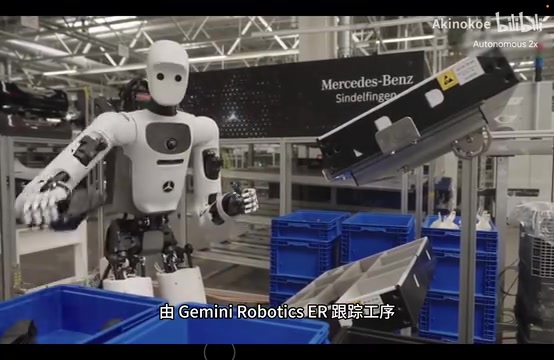
Google DeepMind released Gemini Robotics 2.5, which can control two-finger grippers and five-finger dexterous hands to perform fine operations such as tying a bow. In production-line validation at Mercedes-Benz plants in Germany and Hungary, Aptronic's Apollo 2 humanoid robot used Gemini Robotics ER to track process steps and 2.5 to control its arms, taking automotive parts from bins and placing them into trays in assembly order, with a 96% success rate.
Nvidia's second team released the robotic world-action model Groot 2, which simultaneously predicts the robot's next action and the scene after the action occurs, enabling robots to learn from human demonstrations and transfer skills across different hardware. The team also open-sourced 100,000 hours of first-person video data, model weights, and a cross-hardware adaptation solution, with a release planned for December. Ant's Robbie Ant open-sourced the tactile technical model LinBot Touch, trained on nearly 5,000 hours of real recordings, converting piezoresistive, magnetic, and visual-tactile signals into a unified representation. In real-robot demonstrations, a dexterous hand could use contact feedback to judge whether a key was fully inserted and to control the force when squeezing toothpaste.
Agents Are Becoming "Customers"
OpenAI launched a beta for Businesses in ChatGPT, allowing merchants to claim their business profiles in the Business Hub, update product prices and inventory, and view aggregated data on brand mentions and website clicks. Eligible U.S. e-commerce and online service providers can also create a Business Agent, so that when users see a merchant in a ChatGPT answer, they can directly follow up with questions about product differences or service details.
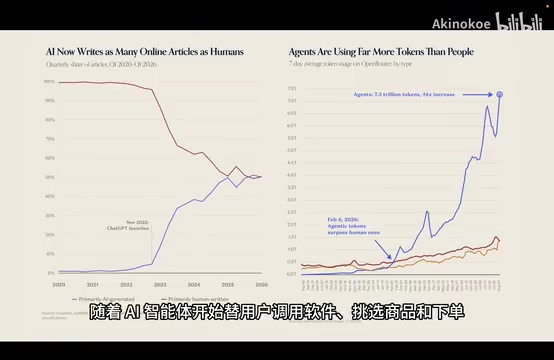
In response, some observers argue that as AI agents begin to call software, select products, and place orders on behalf of users, enterprises need to treat agents as customers too, not just people. This business model is called Business to Agent. Shopify data shows that in the first quarter of 2026, orders from AI search were nearly 13 times the same period the previous year. Similar changes are appearing in software development: about 80% of Neon's new databases are created by AI agents.
On the localization tools front, General Translation closed a total of $27 million in seed and Series A funding, led by Offer Adventures and Anderson Horowitz, respectively. Its AI tool can synchronously translate software interfaces, documentation, and videos when a product is updated, ensuring consistent terminology for the same feature across materials and adjusting interface layouts by language. One customer has already used the tool to translate its product into more than 60 languages.
Business to Agent (B2A) is a concept proposed relative to B2B and B2C: when AI agents browse products, compare specifications, call interfaces, and complete orders on behalf of humans, enterprises need to optimize product data structures, interface readability, and authorization mechanisms for agents, rather than designing pages and marketing language only for humans. This model means new traffic entry points and new competitive dimensions for merchants, and it also raises new questions about identity verification, payment authorization, and liability attribution.
Shopify's order multiples and Neon's database-creation ratio are platform-side observational data. They indicate the direction of the trend, but given differences in statistical scope and base, they should not be directly extrapolated as industry-wide proportions.
Domestic Models and Generative Tools Iterate Densely
Alibaba opened its multimodal flagship model Quantum Max Preview, which can understand images and videos, call tools, and handle complex coding, front-end design, and office tasks. Users can try it through Alibaba Cloud Token PlanAd, QuantWork, Coder, and the Qwen app. Baidu AI Cloud launched a large-model service trading platform, Ciyuansuo, which in its first month onboarded more than 100 model service resources, with average daily token calls exceeding 700 billion.
On the generative tools side, ByteDance's Seed team launched the image generation and editing model Seedream 5.5, focusing on improving stability when repeatedly editing the same image. It is said to support a hundred rounds of editing, preserving other parts of the image pixel by pixel while adjusting specified regions. The team also launched the video generation model Seedance 2.5 Flash, whose generation quality is close to the flagship Seedance 2.5 while being nearly twice as fast. It can generate videos up to 30 seconds long, with 720P text-to-video and image-to-video priced at $0.152 per second, about 34% of the flagship version.
MiniMax open-sourced the weights of its image generation and editing model H3 Damage, which can reference up to 16 images and directly generate images of about 16 million pixels through 6-step sampling.

On speech and evaluation, 11 Labs launched the recording transcription model Scratch V3 and the real-time transcription model Scratch V3 Live, covering 102 languages with a substantial drop in word error rate. The real-time version supports labeling who said what and uses context to determine whether a speaker has finished. Researchers Yang Zhilin, Yao Qizhi, and others launched the theoretical computer science evaluation benchmark TCSXM, using 100 expert-reviewed tasks to assess agents' ability to prove theorems, write solvers, construct mathematical objects, and study open conjectures, with results verified by the Lin kernel or executable programs. GPT-6 Astra ranked first on the full version with 71.9 points, but no model fully solved the 30 open conjectures in the test.
Word error rate (WER) is a common metric in speech transcription evaluation, calculated as the number of erroneous words (substitutions, insertions, deletions) divided by the total number of words in the reference text—lower is better. Models covering 102 languages typically vary widely in performance across languages, so vendor-published averages should be considered alongside specific languages and test sets.
Open weights are different from open source code: open weights mean model parameters can be downloaded for self-deployment and fine-tuning, but training data and training code may not be public, and licenses may restrict commercial use. MiniMax's open-sourcing of H3 Damage weights falls into this category, and users should check the specific license terms before use.
This Week's Observations
This round of releases reveals two main threads: first, model tiering—flagship reasoning, fast response, and specialized scheduling each play their own role, and cost structure has become a focal point of competition; second, the "customerization" of agents—as AI calls software, places orders, and creates databases on behalf of people, the assumptions underlying business infrastructure are being rewritten. As for the revenue figures attributed to account bans, in the absence of public methodology, they are better treated as market discussion rather than a settled conclusion.
One-line Summary
Google and Anthropic both released dense model matrices and new versions in the same week, with agent customerization emerging as a new main thread
Paragraph Summary
This week brought a dense wave of AI releases: Google launched Gemini for Carbon, Gemini 4 Hydrogen, and an input-billed Decisions API in one go, forming a model matrix covering flagship reasoning, fast response, and scheduling scenarios with a notable cost advantage; Anthropic released Claude Fable 5.2 and Mythos 5.2, topped Frontier Code 2.0, and kicked off its IPO roadshow with third-quarter revenue of $7 billion. In robotics, Google's Gemini Robotics 2.5, Nvidia's Groot 2, and Ant's LinBot Touch represent the routes of fine manipulation, world models, and tactile perception, respectively. OpenAI launched merchant agent features, giving rise to the Business to Agent concept, while data from Shopify and Neon show agents are becoming real transaction and development entities. On the domestic model front, Alibaba, ByteDance, and MiniMax continue to iterate on image and video generation.
Related articles

Jonathan Blow: The AI Coding Myth and the Truth About Software Quality
Game developer Jonathan Blow dissects why software engineering grows ever more complex, the real reasons AI coding is overhyped, and why tenfold productivity claims find no evidence in reality.

The Real Value of AI's Math Breakthroughs: Not in Math, but in AI Research Itself
AI's math abilities jumped from four-digit addition to Millennium Prize Problems in years, but this skill in verification-heavy problems matters more for ML research than math itself.
Why I Favor Anthropic More After Canceling All My OpenAI Subscriptions
A creator cancels all OpenAI subscriptions in favor of Anthropic's Opus 5.5 and Fable 5.2. This article analyzes the logic behind subscription decisions: how product delivery cadence affects user loyalty, and the AI industry's "mistake—comeback" competitive cycle.