Gemini 4 Launch Controversy: Real Breakthrough or Google's 'Paper Launch'?

Reddit overwhelmingly calls Gemini 4 a 'paper launch,' exposing deep distrust in Google's delivery and pricing.
A Reddit post about Gemini 4's launch accumulated 50 comments before the community overwhelmingly concluded the model was merely 'announced' rather than actually released — labeling it another Google-style 'paper launch.' Discussion focused on three dimensions: the delay between announcement and availability potentially making the model obsolete at birth; the 'introductory' $2/$10 per million token pricing raising fears of future price hikes; and a minority defending Google's long-game research advantages, though skeptically. The thread also reflected broader industry 'release fatigue,' as high-frequency model launches dull users' ability to recognize genuine breakthroughs.
Reddit Erupts: Did Gemini 4 Actually Launch?
A post titled "Gemini 4 is out: The competition has woken up" sparked heated debate on Reddit. But after accumulating 50 comments, the overwhelming community consensus was deeply ironic — Gemini 4 hadn't truly launched at all, it had merely been "announced."
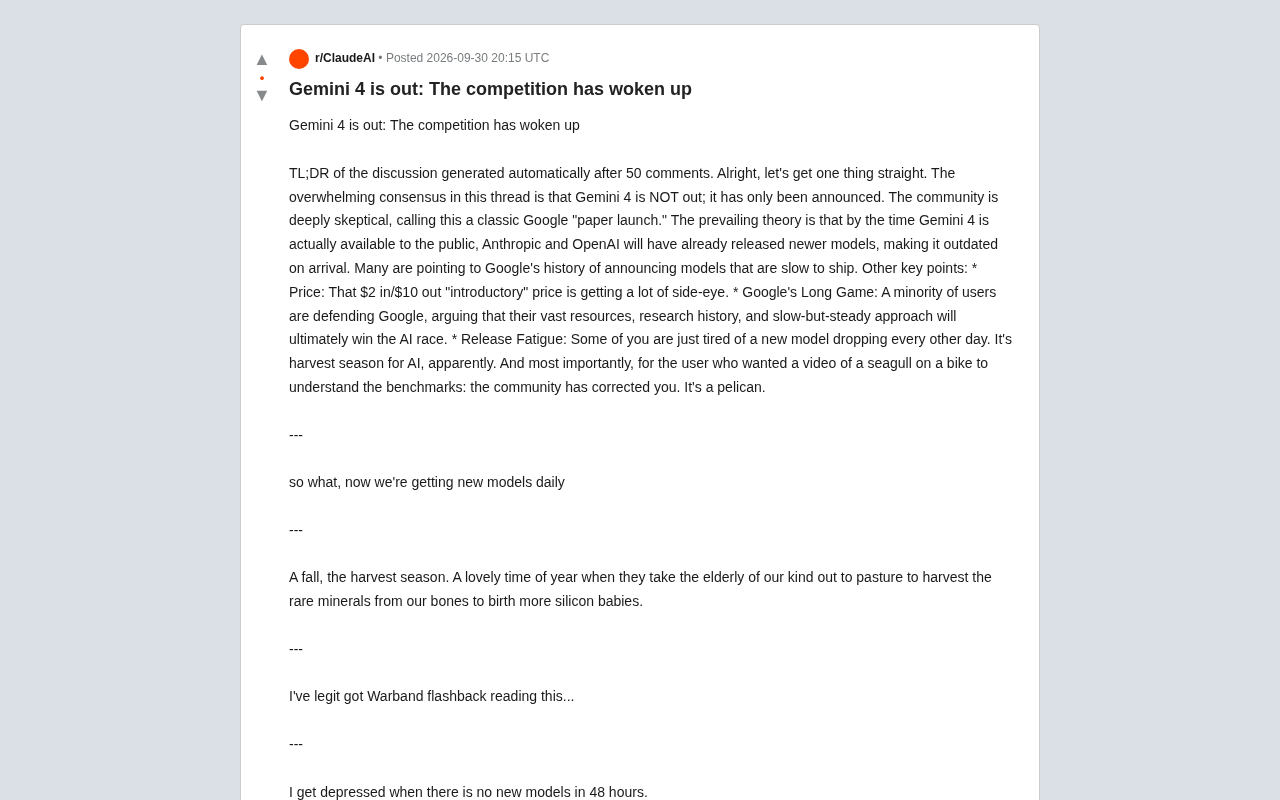
This "announced but not live" maneuver has been labeled by many users as Google's classic "paper launch." The community's skepticism isn't baseless — it's rooted in years of observing Google's product delivery patterns. This discussion reflects more than just an evaluation of a single model; it speaks to deeper doubts about Google's execution capabilities in the AI race.
Where Does the 'Paper Launch' Concern Come From?
The most central criticism in the discussion zeroes in on one issue: the gap between Google's announcements and actual availability tends to be painfully long. In an era where AI models iterate on a daily basis, that kind of delay can be fatal.
A popular sentiment in the community goes like this: by the time Gemini 4 is actually available to the public, Anthropic and OpenAI will likely have already released newer models, making Gemini 4 "obsolete at birth." This concern cuts right to Google's historical weakness — dazzling demos and benchmark scores at launch events, followed by repeated delays in actual delivery.
One user quipped: "So we're getting new models every day now?" The comment was both a jab at release frequency and a dig at the inflation of "announcement-style launches." When releases become a marketing cadence rather than a product delivery event, market trust naturally erodes.
Pricing Controversy: Does the 'Introductory Price' Hold Up?
Beyond delivery timing, pricing also came under fire. According to the post, Gemini 4's "introductory" pricing is set at $2 per million input tokens and $10 per million output tokens.
This price point drew plenty of raised eyebrows. The term "introductory price" inherently implies temporariness, and users worry it follows the classic playbook: lure developers with low prices, then raise them once adoption locks in. With model price wars intensifying across the industry, pricing transparency and sustainability directly determine whether developers are willing to bet their production environments on a given platform.
For teams building applications on top of APIs, price stability often matters more than the absolute figure. Ironically, an "introductory" label may actually make rational users more cautious rather than less.
To contextualize this pricing, it helps to know where mainstream models currently stand. Since 2024, OpenAI's GPT-4o has been priced at roughly $2.50 input / $10 output per million tokens, Anthropic's Claude 3.5 Sonnet at around $3 input / $15 output, and Meta's open-source Llama series is available through various hosting platforms at significantly lower — or even zero — cost for inference. Gemini 4's listed pricing appears roughly in line with major flagship models on paper, but the word "introductory" carries a specific cautionary precedent in the industry: AWS, Azure, and other cloud platforms have historically used introductory pricing to lock in developers, then adjusted price structures once dependency was established. For development teams that factor API costs into product margin calculations, pricing uncertainty directly affects the viability of business models — which explains why a seemingly innocuous label can trigger such strong reactions.
The Minority View: Don't Underestimate Google's Long Game
Not everyone was pessimistic. A subset of users defended Google, and their argument centered on the long game.
This camp argues that Google holds unmatched resource reserves, deep research foundations (from the Transformer paper to a string of DeepMind breakthroughs), and the strategic patience of "slow and steady." In an AI race that is ultimately a marathon rather than a sprint, these foundational advantages may ultimately carry Google to victory.
Interestingly, a self-deprecating joke emerged in the thread: "Aren't they the ones talking about pacing the frontier?" This line both echoes Google's externally communicated narrative of "restraint" while signaling that the community is only half-convinced — is slowing down a deliberate strategic choice, or simply a cover for delivery capacity that can't keep up?
'Release Fatigue': This Industry Is Moving Too Fast
A more widespread sentiment also surfaced throughout the discussion — release fatigue.
"I'd be depressed without a new model every 48 hours," one user half-joked. Another described the current wave of dense model releases as "harvest season," spinning it into a darkly comic riff: autumn is the season of harvest, when humans send their aging kin to the pasture, extract rare minerals from their bones, and birth more silicon children.
Behind the jokes lies the genuine state of practitioners and enthusiasts coping with information overload. When model launches degrade from "major event" to "every-other-day routine," people's attention spans and excitement thresholds keep rising. This isn't necessarily good for vendors — beneath the aesthetic fatigue, even genuine breakthroughs risk being drowned out in the noise.
Closing Easter Egg: Seagull or Pelican?
The discussion ended on a classic tech community meme. A user mentioned wanting to see a video of "a seagull on a bike" to understand benchmark results, and was promptly corrected by the community: it's a pelican, not a seagull.
The "pelican on a bike" is an informal grassroots benchmark for evaluating large model capabilities — particularly SVG generation and spatial reasoning — that emerged organically from the developer community. This small moment reminds us: beyond benchmark scores and marketing language, the community has its own down-to-earth ways of putting models to the test.
The "pelican on a bike" benchmark reflects a long-standing problem in AI evaluation: benchmark contamination. Widely cited mainstream benchmarks (such as MMLU, HumanEval, and GSM8K) increasingly risk having related questions bleed into training data, meaning a model's high score on these benchmarks may not reflect genuine capability. The developer community has responded by spontaneously creating "wild benchmarks" — selecting unusual tasks unlikely to appear in training sets, such as generating an SVG of a specific animal riding a bicycle, which tests both spatial reasoning and the accuracy of code generation in fine-grained detail. These benchmarks can't be systematically gamed, making them more effective probes of real-world usability. The pelican meme's popularity is, at its core, a community self-rescue response to declining confidence in official benchmark credibility.
Final Thoughts
The value of this Reddit discussion isn't in delivering a verdict on Gemini 4 — it's in honestly capturing the complex psychology of the AI community: recognition of Google's technical capabilities, distrust of its delivery execution, wariness toward its pricing strategy, and exhaustion with the industry's relentless pace.
It's worth emphasizing that all opinions in this article come from a single Reddit discussion thread. The community consensus holds that "Gemini 4 has not truly launched," and the pricing and performance information cited has not been independently verified by official sources or third parties. Readers should exercise caution. Real answers will only emerge once the model is actually live and has been put through its paces.
Related articles

AI New Grad Resume Diagnosis: How to Stand Out for ML/CV Roles?
How can AI/ML new grads optimize their resumes to get interviews? Based on a real Reddit case, this article analyzes project selection, depth display, and structure for ML/CV roles, with actionable revision advice.

OpenAI Opens Up Decision Models as Competition with Jev Heats Up
OpenAI makes its decision model widely available, directly challenging first mover Jev. We analyze the impact on the decision model competitive landscape and key considerations for developers and enterprises.

Startup Growth Secrets: Early Sales Are Not the Key
At Disrupt, experts from Lovable, Polska, and Theory Ventures said early startup growth depends not on early sales but on a repeatable sales process, a clear ICP, team development, and data-driven iteration.