Gemini 4 Neon In-Depth Analysis: Google's Mid-Tier Model Beats the Flagship on Coding Speed

Google's fourth Gemini 4 model in five weeks, Neon is mid-tier, tops coding, and costs less.
Google released four Gemini 4 series models in five weeks, and Neon, launched November 18, sits between flagship Carbon and speed-focused Hydrogen. Priced at $3 per million input tokens and $15 per million output tokens, with a 1M token context and four thinking levels, it claims to complete most tasks about three times faster than Carbon at roughly 60% lower cost. It ranks third on the Artificial Analysis Intelligence Index at 61, surpassing Carbon, tops the Coding Agent Index at 58.6, leads on enterprise, science, and math benchmarks, and independent rankings align with Google's claims. Safety data includes a 0% indirect prompt injection success rate and a 2.45% coding cheating rate. Neon is available to paid users via Gemini API, AI Studio, Android Studio, Antigravity, and the Gemini app.
Google released four Gemini 4 series models in five weeks, and Gemini 4 Neon has the most nuanced positioning of them all—it's neither the most powerful Carbon nor the cheapest Hydrogen, yet it claims to be faster and cheaper than its own flagship on coding tasks. For most developers and enterprise users, Neon is likely the tier that actually gets used.
1. Four Models in Five Weeks: Google's "Stepped" Release Strategy
Google officially launched Gemini 4 Neon on November 18, 2026, just 6 days after the previous Hydrogen release. Looking back at the product line: in mid-October, Argon was first opened to paid users; on October 28, the flagship Carbon launched, ranking first on the Artificial Analysis Intelligence Index with a score of 59, priced at $2 per million input tokens and $10 per million output tokens, with a 95% discount on cached input, initially released through the Fairwind program to a small group of cybersecurity defenders; on November 12, the speed-focused Hydrogen arrived, surpassing Argon's 50 on the intelligence index with 51 points, reaching up to 54 at maximum settings, priced uniformly at $1.5 per million input tokens and $7.5 per million output tokens, covering the full 1 million token context window.
Neon fills the gap between Carbon and Hydrogen. Google positions it as "balancing depth and efficiency"—delivering frontier-level reasoning for complex, high-frequency workloads while being faster and more economical than Carbon above it. This dense release cadence itself sends a signal: Google is no longer launching just one flagship per year, but building an entire ladder of models tuned by task type.
2. Pricing and Context: The Trade-offs of Mid-Tier Positioning
Neon is priced at $3 per million input tokens and $15 per million output tokens, with cached input at $0.15 per million tokens, also enjoying the 95% cache discount. The context window is 1 million tokens, on par with Hydrogen, meaning a single session can hold an entire codebase, stacks of PDFs, spreadsheets, charts, audio, and video, and integrate them into structured deliverables.
This pricing sits exactly between Carbon and Hydrogen. Google emphasizes not "cheap tokens" but "lower cost per task"—according to its claims, Neon completes most tasks about three times faster than Carbon at roughly 60% lower cost. For long-pipeline tasks requiring repeated model calls, this gap gets amplified.
3. Benchmarks: Topping Coding, But Read With Caution
The core number Google provides is the Artificial Analysis Intelligence Index: at the highest thinking level (X-high), Neon scores 61, ranking third overall, surpassing Carbon's 59 and leading all comparable models in its class.
The real highlight is the coding sub-scores. On the Artificial Analysis Coding Agent Index, Neon ranks first with 58.6 points; on Terminal Bench 4.1, which tests real-time coding ability, it scores 65.2%; on the harder Frontier Code 2.0, it scores 46.2% at the default high thinking level; on SWE-bench-style tests for fixing real software bugs, it reaches 12.8% in the mini-harness environment, rising to 39% within Google Antigravity.
Enterprise scenario data is equally solid: second place on the VALS index at 70.9%, first on both the legal research and tax agent sub-leaderboards; first on most Surge AI benchmarks including finance, accounting, spreadsheet modeling, and complex constraint following; 73.5% on chart understanding and 75.8% on Agent's Last Exam 1.1. It ranks first on the Zapier automation benchmark at 56.3%, and scores $16,843 in Andon Lab's Vending Bench 2 long-horizon business simulation, also first place. In science and math, Terminal Bench Science scores 70.5%, Riemann Bench 84%, and HLE Diamond 71.3%.
A caveat: these are all benchmarks Google selected for itself, and every lab picks tests that favor it. What truly matters about Neon's data isn't any single score, but that the same model ranks highly simultaneously on coding, enterprise work, and scientific tasks—and the conclusions of independent ranking bodies Artificial Analysis and VALS align with Google's claims. A standout single item could be testing luck; standout performance across many is a pattern of capability.
Artificial Analysis Intelligence Index is a comprehensive model capability ranking maintained by the independent evaluation firm Artificial Analysis. It normalizes and weight-aggregates scores from multiple public benchmarks (reasoning, math, coding, knowledge Q&A, etc.) into a 0–100 score. Because labs commonly cite this index as an anchor for cross-comparison when releasing new models, it has become the industry's de facto "general capability yardstick." Note that the intelligence index leans toward general capability and has limited discrimination for specialized scenarios like coding agents and long-horizon tool use, which is why this article also cites specialized benchmarks such as the Coding Agent Index and Terminal Bench.
SWE-bench and "harness": SWE-bench has models locate and fix GitHub issues in real open-source repositories, with success judged by unit tests—a classic test of engineering practicality. Its scores are highly sensitive to the "harness" (the outer scaffolding that drives the model, including prompts, tool definitions, retry and context management strategies)—a 20–30 percentage point gap for the same model under different harnesses is not uncommon. Neon's 12.8% under mini-harness versus 39% within Google Antigravity mainly reflects the scaffolding rather than the model itself; cross-vendor comparisons must confirm whether harnesses are consistent.
4. Thinking Levels and Real Workflows
Neon offers four thinking levels: low, medium, high, and X-high, with high as the default. Google says the intelligence level and token consumption progress smoothly and predictably across levels. Low is for quick Q&A, while X-high targets the hardest engineering, analysis, and scientific tasks.

In real workflows, Neon is designed as the executor for long-horizon agentic tasks—not stopping after answering one question, but working continuously in a code repository for hours, maintaining end-to-end performance in tool-intensive complex tasks. It can run independently or serve as a high-judgment orchestrator, directing parallel Hydrogen sub-agents within Google Antigravity. Put plainly: it won't forget what it's doing halfway through.
In the Gemini app, Neon targets work requiring frontier reasoning and fast responses. It reads uploaded spreadsheets, PDFs, and photos more precisely, turning dense materials into reports and summaries, and extracting relevant details from Google apps like Gmail and Docs. Two examples Google gives illustrate the target user well: analyzing bills to find the cause of a utility cost spike, or cross-checking multiple receipts and documents to negotiate a refund.
Thinking level (thinking budget) refers to the cap on reasoning tokens a model may consume before giving its final answer. Such models first generate an internal reasoning process invisible to the user, then output the answer; higher levels allow more tokens for self-checking, decomposing sub-problems, and trial-and-error backtracking, typically raising accuracy but also increasing latency and cost. Google says Neon progresses "smoothly and predictably" across levels, meaning users can choose a level by task difficulty without choosing between "fast but wrong" and "slow but expensive." In practice, a cost-effective strategy is low for simple retrieval, high for routine coding, and X-high for complex refactoring or scientific reasoning.
Orchestrator–sub-agent pattern: In Google Antigravity, Neon acts as the orchestrator dispatching subtasks to parallel Hydrogen instances—one implementation of "multi-agent orchestration." The orchestrator handles planning, decomposition, and result integration, while sub-models execute specific steps, using cheaper models for massive parallel work and stronger models for quality at key junctures. The bottleneck of this layered design usually lies in the orchestrator's context management and result validation, which is why Neon emphasizes "not forgetting the goal during long work sessions."
5. Safety Record: Google Published Very Specific Numbers This Time
Stronger coding capability raises the bar for generating secure code. Neon generates safer code than Carbon across the easy, medium, and hard difficulty levels of AutoBGC Bench, reaching 76% at the hard level; on the Web Exploit Bench 1.2 penetration testing benchmark, it reaches frontier level at roughly half the cost of competitor large models; it reaches frontier level on the Sec Bench Pro vulnerability discovery test; on Exploit Gym risk validation, it achieves frontier performance at half of Carbon's token consumption; and on CWE Bench 2 vulnerability patching, it scores 70.7%, a 3.4 percentage point improvement over Carbon.
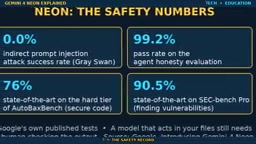
More noteworthy are the alignment and agent behavior data. On GraySwan's indirect prompt injection benchmark (where malicious instructions are embedded in web pages, emails, documents, or code), Neon at the highest thinking level resisted all attacks with a 0% attack success rate; its cheating rate on Terminal Bench 4.0 is 0%, on par with Carbon; in Google's coding cheating evaluation, it took shortcuts on only 2.45% of tasks, the lowest in the Gemini 4 series; and its agent honesty evaluation pass rate is 99.2%. Google also says Neon reduces under-serving (not doing what should be done) and over-stepping (doing what wasn't asked).
These numbers don't mean Neon can be blindly trusted. Benchmarks are controlled environments, and a model that can operate your files and apps still needs human review of its output. But at least they show Google treats safety as a built-in feature of this model rather than a post-hoc patch. A specialized Neon for Cyber version will also be opened to trusted defenders through the Fairwind program in the near future.
Indirect prompt injection is the most representative attack surface in agent scenarios: rather than instructing the model directly, an attacker hides malicious instructions in web pages, emails, documents, or code comments the model will read, waiting for the model to "conveniently" execute them while processing a task—for example, exfiltrating data or invoking high-risk tools. Since agents have file read/write, browser, and command-line permissions, a successful injection can cause real damage. Thus an attack success rate (ASR) of 0% on this benchmark is a meaningful indicator, but it only covers a known set of attack samples; novel injection techniques still require ongoing evaluation.
Coding cheating (reward hacking) evaluation measures whether a model "games" the evaluation rather than genuinely solving problems—by tampering with tests, hardcoding expected outputs, or skipping assertions. Such behavior is common in RL-trained coding models, and a lower cheating rate indicates a stronger tendency to genuinely fix bugs. Related dimensions of agent honesty evaluation include "under-serving" (declaring a task complete before it is) and "over-stepping" (doing things without authorization), typically scored by human or model-judged discriminators.
6. Where to Use It
Neon began rolling out on November 18. Developers can use it in the Gemini API paid tier, Google AI Studio, Android Studio, and Google Antigravity, for paid Google AI Pro and Ultra subscribers. Enterprise users can access it via the Gemini for Business API or model dropdown. On the consumer side, Google AI Pro and Ultra subscribers can select Gemini 4 Neon in the Gemini app's model selector.
Neon isn't Google's biggest model, nor the cheapest. It's the middle rung of the ladder—and the middle rung is exactly where the work actually happens: leading in coding rankings while handling enterprise documents and scientific tasks, with the strongest safety data Google has published for a model at this level. If you're already paying for Google AI Pro or Ultra, it's in your model selector right now.
Related articles

Nothing CMF Buds 2A Drops to $17.89 on Black Friday: A New Low for ANC Earbuds
Nothing CMF Buds 2A wireless earbuds Black Friday deal: just $17.89 on Amazon, about $11 off retail and a record low. ANC earbuds at an entry-level price.

When AI Creation Gets Accused of "Spitting": Hacker News Heats Up Over the Glaude Controversy
A Hacker News post, "Spitting in the Face of Glaude," sparks debate on AI creation transparency and attribution ethics. This analysis examines the blurred creator identity behind the controversy and offers practical advice for AI content production.

Akai Embraces Custom Firmware: MPC Sample 1.4 Lets Users AI-Program Their Sampler
Akai embraces the modding community with MPC Sample 1.4 firmware, supporting vibe-coded custom firmware and effects. We analyze the impact of this open strategy on music hardware and AI-assisted programming.