Gemini 4 Neon In-Depth Review: Near Top-Tier Performance, But Not the Cheapest
Gemini 4 Neon offers near top-tier performance but isn't the cheapest—a balanced middle choice.
Google released its fourth model in seven weeks, Gemini 4 Neon, positioned between Carbon and Hydrogen. Official data claims a coding lead, but independent evaluator Artificial Analysis ranks Neon third on the composite index, behind GPT 6.2 Astra and Claude Fable 5.2 and just one point above Carbon. At x-high it costs $6.44 per task—expensive—while the default high at $3.74 with one point less is more practical. In coding, Neon matches Claude Opus 5.5 and Fable 5.2 in score at about half the cost, but GPT 6.2 Sol costs just $1.01 per task and GPT 6.2 Astra wins on both cost and score. Neon's edge is speed and lower pricing after the discount ends, not a leap in intelligence.
Google released its fourth model in seven weeks, Gemini 4 Neon, positioned between Carbon—built for long, complex projects—and Hydrogen, which focuses on fast everyday tasks. Google's launch page naturally places Neon at the top of its charts, but independent evaluator Artificial Analysis paints a more complex picture: Neon is indeed near the top, but it doesn't lead across the board, and it isn't the cheapest option either.
Product Positioning and Core Specs
Gemini 4 Neon targets complex coding, analysis, and enterprise workflows, serving as the mid-tier model of the Gemini 4 family. To use the analogy from the video, it's like a senior colleague—not the department head, but faster to respond and cheaper to run.
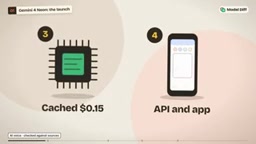
Neon supports text, image, video, audio, and PDF inputs, with a context window of 1 million tokens. For extra-long responses, Long Decode mode can stretch a single reply to 1,048,576 tokens. Users can choose thinking intensity: low, medium, high, or x-high, with high as the default. Pricing is $3 per million input tokens and $15 per million output tokens; cached input costs just $0.15 per million tokens. Developers can access it via the Gemini API and Google AI Studio, and paid Pro or Ultra subscribers can also use it in the Gemini app.
Google's Official Data: Leading Almost Everywhere
Google's launch page numbers are impressive. On the Terminal Bench 4.1 coding test, Neon scores 65.2%; on Google's internal anti-gravity test, its hallucination rate (the proportion of fabricated results) hit a new low. At the default high setting, cost per task is 32% lower than Carbon. Google also claims Neon ranks first on the Artificial Analysis coding agent index with a score of 56, and that it can reduce redundant file reads, compress long sessions, and act as a planner directing the faster Hydrogen assistant to complete tasks.
Independent Evaluation: Third Place, Slim Margins
Artificial Analysis's early results tell a slightly different story. On the composite index, Neon scores 61 at the x-high setting, ranking third behind GPT 6.2 Astra and Claude Fable 5.2, which leads with 65.
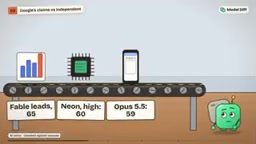
At the default high setting, Neon scores 60, while Claude Opus 5.5 at max scores 59 and GPT 6.2 Sol at max scores 57—Neon does edge ahead, but by a narrow margin. Compared with its sibling Carbon, Neon at x-high scores just one point above Carbon at high, which the site calls a "marginal improvement."
Neon shows more progress on visual tasks: on the GDP.pdf document test, it scores 33.4% at high versus Carbon's 28.4%; but at x-high it actually drops to 28.0%, suggesting that increasing thinking intensity doesn't help on this task. For presentation quality, Neon leads with an ELO score of 1771 at x-high.
The Artificial Analysis Index is a composite benchmark published by the independent AI model evaluator Artificial Analysis. It aggregates scores from multiple public evaluation sets (such as coding, math, reasoning, and vision) and computes a weighted total for cross-model comparison. The index is not a single-task test but rather an attempt to reflect a model's general intelligence level, so it is frequently cited by media and developers. Note, however, that its weighting design and choice of test sets affect rankings, and the same model's score can fluctuate under different settings (such as thinking intensity). In this article, Neon's score of 61 at x-high ranking third is based on this index.
Terminal Bench is a benchmark that evaluates an AI model's ability to execute coding tasks in a terminal environment, typically involving command-line operations, file editing, and code debugging. It simulates real development scenarios, requiring the model to complete goals within a limited number of steps and scoring based on task success rate. Terminal Bench 4.1 is a newer version; Google claims Neon scores 65.2% on it, but independent evaluations may use different versions or settings, leading to discrepancies. Such benchmarks are highly informative for assessing the practical utility of coding agents, though they are also affected by the harness.
The Cost Truth: Not the Cheapest
Performance is only half the story; the other half is cost per task. At x-high, Neon costs $6.44 per task, which Artificial Analysis calls "expensive" relative to models at the same price point. At the default high setting, it costs $3.74 per task and takes 14.8 minutes—just one point less than x-high.
Lowering the setting saves money but also lowers the score: medium scores 55 at $1.90 per task; low scores 44 at just $0.75.
Competitor comparisons are more telling. GPT 6.2 Sol at max costs just $1.01 per task for only a few points less; GPT 6.2 Astra at max costs $4 per task and scores higher than Neon x-high, winning on both cost and performance. Claude Fable 5.2 scores highest, but its cost per task is far above Neon's. The site also notes that Neon is noticeably slow per task and extremely verbose, with output volume several times the median among models.
Coding Scenarios: On Par with Competitors, at Half the Cost
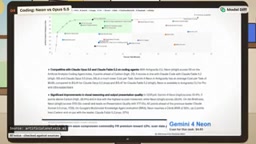
Coding is a key focus of Google's marketing. Google claims Neon ranks first on the Artificial Analysis coding agent index with a score of 56; but when the site itself tested using the anti-gravity CLI, Neon at x-high scored 59, essentially level with Claude Code running Fable 5.2 and Opus 5.5 at 58—a tie, not a commanding lead.
The difference shows up on the bill: tasks using Neon plus anti-gravity cost an average of $6.86, versus $12.61 for Opus 5.5 and a hefty $15.47 for Fable 5.2. The video's analogy fits well: two contractors install the same kitchen to the same standard, and one charges about half of what the other does.
Google's own data also reveals the importance of the toolchain: on the SWE Sweep software engineering test, it scores 39.0% in the anti-gravity environment but only 12.8% in another. The harness (the toolkit wrapping the model) has a huge impact on final performance.
Harness refers to the software framework wrapping an AI model, responsible for parsing model output, executing tool calls (such as running code or reading and writing files), and managing multi-turn interactions. The same model can perform vastly differently under different harnesses, because the harness determines whether the model can effectively use external tools, its error-recovery ability, and its task-decomposition strategy. In this article, Google data shows Neon scoring 39.0% on SWE Sweep in the anti-gravity environment versus only 12.8% in another, highlighting the enormous impact of the harness on final performance. Therefore, when comparing model capabilities, the test environment must be specified, or conclusions may be distorted.
SWE Sweep is a software engineering benchmark that simulates tasks such as fixing bugs or implementing features in a codebase, requiring the model to understand existing code, locate problems, and generate patches. It is typically based on real open-source projects and evaluates a model's problem-solving ability in complex engineering scenarios. Scores reflect task success rates but are significantly affected by the harness and model settings. In this article, Neon scores 39.0% under anti-gravity but only 12.8% in another environment, showing that toolchain compatibility is crucial.
Comparison with Carbon: Speed vs. the Discount Window
Neon's list price is 25% below Carbon's standard price ($4/$20), but Carbon currently has a discounted price of $2/$10 through November 30—until then, Carbon's per-token price is actually lower. Artificial Analysis notes that Neon's per-task cost advantage comes purely from token pricing, since Neon produces slightly more output. At x-high, it saves about 17% per task; at high, calculated at Carbon's standard price, Neon matches Carbon at less than half the cost.
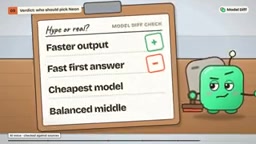
The speed gain is real: Neon outputs about 110 tokens per second versus Carbon's 57. But time to first token is 56.51 seconds (at x-high), meaning Neon thinks before it speaks.
Time to First Token is the time from sending a request to the model outputting its first token, a key metric for interactive responsiveness. For scenarios requiring real-time feedback (such as chat or coding assistance), low latency is crucial. In this article, Neon's time to first token at x-high is 56.51 seconds, meaning the model performs lengthy internal reasoning before starting to output—which may improve answer quality but sacrifices immediacy. By contrast, output speed (tokens per second) affects the efficiency of generating long answers. Neon outputs about 110 tokens per second versus Carbon's 57, meaning Neon is faster during sustained generation but has a longer initial wait. Users need to weigh latency against throughput depending on the task type.
Recommendations: Choose by Scenario
Overall, one competitor is cheaper and another scores higher, making Neon the balanced middle choice—exactly the role Google gave it. For most users, the real change in switching from Carbon to Neon is speed and a lower price after the discount ends, not a leap in intelligence.
Specific recommendations:
- Coding agents: Start with the high setting in anti-gravity, and only move to x-high when there's a clear benefit. The coding cost savings were measured at x-high, so before committing, compare the two settings on your real codebase.
- Documents, slides, spreadsheets: Neon can directly open Word, PowerPoint, and Excel files. Its presentation lead comes from x-high, while document test results come from the high setting—test with a few real documents to see which setting works better.
- Quick everyday tasks: Hydrogen at high scores 51, a clear downgrade—treat it as an assistant rather than a primary model.
- Security teams: A cybersecurity version for trusted defenders is available through Google's Fairwin program.
Neon refused only 1.98% of tasks on Terminal Bench 4.0, meaning it rarely rejects legitimate work. Whether these early results hold up after more test rounds remains to be seen.
One-line Summary
Gemini 4 Neon delivers near top-tier performance but doesn't lead across the board, with limited cost advantages—a balanced middle choice.
Paragraph Summary
Google released its fourth model in seven weeks, Gemini 4 Neon, positioned between Carbon and Hydrogen. Official data claims it leads in coding tests, but independent evaluator Artificial Analysis shows Neon ranking third on the composite index, behind GPT 6.2 Astra and Claude Fable 5.2, and just one point above its sibling Carbon. On cost, x-high at $6.44 per task is expensive, while the default high at $3.74 with just one point less is the more practical choice. In coding scenarios, Neon matches Claude Opus 5.5 and Fable 5.2 in score but costs about half as much. However, GPT 6.2 Sol costs just $1.01 per task—far less than Neon—while GPT 6.2 Astra wins on both cost and score. Neon's advantage lies in speed improvements and lower pricing after the discount ends, not a leap in intelligence.
Related articles
Gemini 4's Three Coding Models Compared: How to Choose Between Neon, Hydrogen, and Argon
How to choose among Gemini 4's Neon, Hydrogen, and Argon coding models? This article compares official positioning, API pricing and the price-increase date, coding benchmark scores from Artificial Analysis and Cursor, and summarizes developer feedback to offer scenario-based selection advice.

Gemini 4 Neon Hands-On: Crushes Opus at Coding, but the Free Agent Hides Three Major Pitfalls
Gemini 4 Neon tops the Coding Agent Index, beating Carbon and Opus 5.5 in four real code battles—but hidden reasoning tokens bill at $15 and free Tasks silently fails.

Gemini 4 Neon Released: Google's Strongest Coding Model Tops the Rankings
Gemini 4 Neon tops the Artificial Analysis Coding Agent Index with 58.6. We break down its coding agent benchmarks, 1M token context, four thinking levels, and pricing below Carbon starting in December.