Gemini 4 Neon Lands on AI Gateway: A New Choice for Coding and Agent Workflows

Gemini 4 Neon launches on AI Gateway with near-flagship quality and faster responses for coding and agent scenarios.
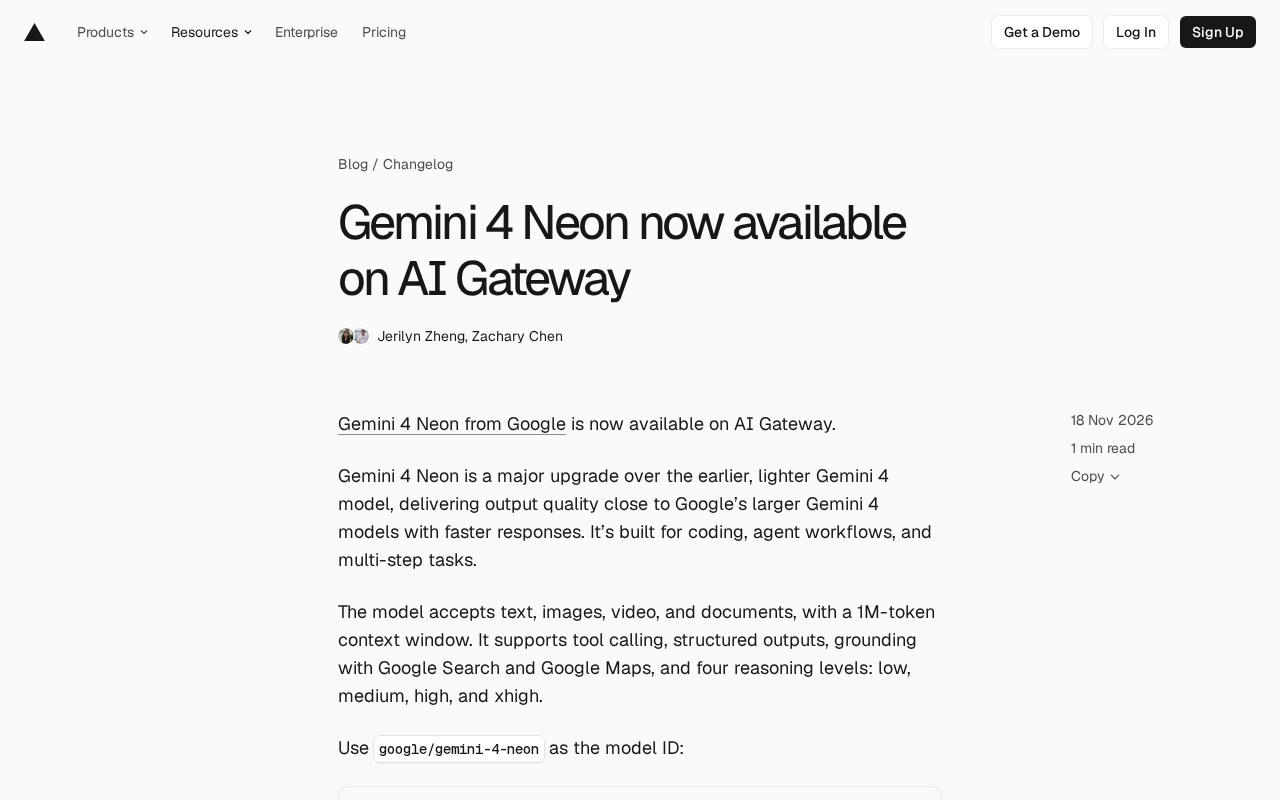
Google's Gemini 4 Neon model is now available on AI Gateway, positioned as a major upgrade over earlier lightweight Gemini 4: output quality approaches larger Gemini 4 models while maintaining faster responses. It supports text, image, video, and document input, has a 1M token context window, and offers tool calling, structured outputs, Google Search and Google Maps grounding, plus four reasoning levels: low, medium, high, and xhigh. It is officially focused on coding, agent workflows, and multi-step tasks. Developers can access it via model ID google/gemini-4-neon using AI SDK's streamText, Claude Code, or Chat Completions. The article also notes that official benchmarks and pricing have not been disclosed, and actual performance still needs verification in real scenarios.
Google's Gemini 4 Neon model is now available on AI Gateway. The model is positioned as a major upgrade over earlier lightweight Gemini 4 versions, delivering output quality that approaches Google's larger Gemini 4 models while maintaining faster response times. For developers who rely on coding, agent workflows, and multi-step tasks, this is a new option worth paying attention to.
Core Capabilities and Specs
Gemini 4 Neon covers text, image, video, and document inputs, and offers a 1M token context window. This means developers can process long documents, multimodal assets, or complex conversation histories in a single request without frequent truncation or segmentation.
At the feature level, the model supports tool calling, structured outputs, and grounding capabilities based on Google Search and Google Maps. These features are especially critical for building applications that require real-time information retrieval or geographic context.
Context window refers to the maximum total number of tokens a model can receive in a single call, covering the input prompt, conversation history, tool return results, and model output. 1M tokens is roughly equivalent to hundreds of thousands of Chinese characters or hundreds of pages of documents, allowing the model to digest a complete codebase fragment, a long meeting transcript, or multiple rounds of agent trajectories within one request without relying on external summarization or chunked concatenation. However, the longer the context, the higher the first-token latency and inference cost typically are, so in practice it is still advisable to trim irrelevant content as needed.
Grounding refers to having the model retrieve external authoritative data sources before generating an answer and base its response on the retrieval results, thereby reducing hallucinations and improving timeliness. The Google Search grounding mentioned in the article turns queries into searches and cites web results, while Google Maps grounding injects geographic information such as places, routes, and business hours. Compared with relying solely on parametric knowledge, grounding enables the model to answer questions about "today," but it also introduces dependence on retrieval quality and citations, and developers should pay attention to source attribution in the returned results.
Reasoning Levels and Use Cases
Gemini 4 Neon offers four reasoning levels: low, medium, high, and xhigh. Developers can flexibly adjust based on task complexity, trading off between latency and reasoning depth. Lower levels suit simple tasks that are sensitive to response speed, while xhigh targets multi-step scenarios that require deep reasoning.
Officially, coding, agent workflows, and multi-step tasks are explicitly listed as the model's key focus areas. Combined with the 1M token context and tool calling capabilities, it is well suited to driving code generation, automated process orchestration, and agent applications that require collaboration across multiple tools.
Reasoning effort is a common adjustable parameter in recent reasoning models; in essence, it controls the token budget or number of computation steps the model uses for internal thinking before producing a final answer. The higher the level, the more likely the model is to carry out multi-step derivation, self-checking, and error correction, making it suitable for tasks such as math, complex code refactoring, and multi-tool planning; lower levels skip or compress the thinking process in exchange for lower latency and fewer billed tokens. The four-level design allows the same model to serve both real-time completion and deep agent workloads, but the actual quality differences between levels need to be determined through business-specific benchmarks.
How to Integrate
To use this model in AI Gateway, the model ID is google/gemini-4-neon. The official example shows streaming calls via AI SDK's streamText:
import { streamText } from 'ai';

const result = streamText({
  model: 'google/gemini-4-neon',
  prompt: 'Write a TypeScript function that debounces async calls.',
});

for await (const text of result.textStream) {
  process.stdout.write(text);
}
In addition to AI SDK, the model also supports interfaces such as Claude Code and Chat Completions. To use it in Codex, Cursor, or other supported agents, refer to the official coding agents guide. Developers can also try it directly in the model playground or browse the full list of language models.
AI Gateway is a unified proxy layer between applications and multiple model providers, exposing consistent model IDs, authentication, billing, and observability interfaces externally while routing internally to different backends such as Google, Anthropic, and OpenAI. Its value lies in letting teams switch or compare multiple models with a single SDK and key, and centrally handle rate limiting, retries, logging, and cost tracking. The "provider/model" naming like google/gemini-4-neon in the article is the gateway's standardized identifier; support for interfaces such as Claude Code and Chat Completions means existing toolchains can migrate without major changes.
Trade-offs to Note
Gemini 4 Neon sits between lightweight and flagship: it is stronger than earlier Gemini 4, with output quality approaching larger models, but responds faster. This balance has practical significance for cost and latency control in production environments. However, the official details on specific performance benchmarks or pricing have not been disclosed, and actual performance still needs to be verified by developers in their own scenarios.
For teams currently selecting a coding assistant or an underlying model for agents, Gemini 4 Neon offers a new candidate. It is recommended to first run small-scale tests in the playground, then compare and evaluate it alongside AI Gateway's multi-model integration capabilities.
Related articles

Gemini 4 Neon Leak: A Potential Strong Contender Against Opus 5.5
A Hacker News thread suggests Gemini 4 Neon looks like an Opus 5.5 competitor. This article unpacks the product positioning behind this community signal, shifts in the top-model competitive landscape, and what it means for developers' model selection strategy.

Claude Fable 5.2's Self-Authored Short Film 'Fable' Sparks Discussion
A short film 'Fable,' credited to Claude Fable 5.2 for script, visuals, and directing, appears on Hacker News. This article analyzes the significance of full-pipeline AI creation, community reactions, and what it means for content creators.

Anthropic IPO Pricing: A Signal of AI Giants Going Public
Anthropic's IPO pricing draws attention. This article analyzes its potential impact on AI industry valuation, commercialization paths, and the competitive landscape, and highlights public-market expectations and challenges for AI companies.