Gemini 4 Neon Released: Tops Coding Benchmarks, Gemini 4 World Model Opens Up
Google launches Gemini 4 Neon with top coding agent value; DeepSeek web search free; regulators weigh Chinese model disclosure.
Google's AI briefing packed major updates: Gemini 4 Neon debuts with million-token context and the top coding agent index, emphasizing reasoning-speed-cost balance. The Gemini 4 world model lands in Project Genie, and coding agent Stitch Loop covers post-launch operations. Google also tightens Anti-Gravity access, leaving free users only Gemini 3.8 Flash. DeepSeek makes model-initiated web search free, shifting billing to tokens. Microsoft publishes the 2.3B-parameter on-device model IN 1.0 Instruct; Hugging Face's Harness Adapters boost coding agents from 29.4% to 62.7% on SWE Bench Pro. The White House and US Treasury discuss requiring US firms to disclose use of Chinese open-weight models, and OpenAI models have already helped design AMD's flagship GPUs.
Title
Gemini 4 Neon Released: Tops Coding Benchmarks, Gemini 4 World Model Opens Up
Meta Description
Google releases Gemini 4 Neon, topping the coding agent index with support for million-token context; Gemini 4 world model opens Project Genie; DeepSeekAd web search goes free; Microsoft unveils on-device Windows small model; White House discusses requiring US companies to disclose whether they use Chinese open-source models.
Article Content
In its AI morning briefing, Google dropped a slew of major updates at once: Gemini 4 Neon officially debuted, the Gemini 4 world model landed in Project Genie, and Anti-Gravity tightened model access permissions. Meanwhile, DeepSeek made web search free, OpenAI models began helping AMD design GPUs, and the White House discussed requiring US companies to disclose whether they use Chinese open-source models.
Gemini 4 Neon: Not the Strongest, the Most Cost-Effective
Google launched Gemini 4 Neon, explicitly targeting complex programming, enterprise analytics, scientific research, and cybersecurity tasks. Its selling point isn't a single metric but the balance between reasoning capability, speed, and cost. It supports a million-token context—a spec that's critical for long-document analysis, large codebase comprehension, and multi-turn enterprise-grade tasks.
In Artificial Analysis evaluations, Gemini 4 Neon ranked third on the intelligence index and first on the coding agent index. This combination shows Google is more focused on the cost-performance of "getting work done": not top on overall intelligence, but first in the high-frequency coding agent scenario. The model has been rolling out to the Gemini API, AI Studio, Anti-Gravity, and the Gemini app.
For developers, a million-token context plus the top coding agent positioning means it's better suited for integration into real engineering pipelines rather than just demo showcases. For ordinary users, the simultaneous launch in the Gemini app lowers the barrier to trying it out.
Million-Token Context: A token is the basic unit of text a model processes. A million tokens is roughly 700,000 English words or 1.5 million Chinese characters—equivalent to reading the entire Three-Body trilogy in one go. Long-context capability directly determines whether a model can digest a large codebase, a complete financial report, or hundreds of pages of contracts in a single call without chunking, thereby avoiding information loss across segments. However, the longer the context, the higher the memory footprint and latency during inference, so vendors often need to trade off window size against cost. Gemini 4 Neon making million-token context standard means it offers the engineering convenience of "feeding it all at once" in enterprise long-document scenarios.
World Models and Coding Agents: From Content Generation to Continuous Work
Google DeepMind's world model Gini 4 has landed in Project Genie, opening up to Google AI Ultra subscribers. While exploring, users can directly modify the environment with text, experience real-time audio and conversation, co-create worlds through the Project Genie agent, compose soundtracks, or browse and remix existing works. This marks the world model's transition from a research demo to an interactive creation tool.
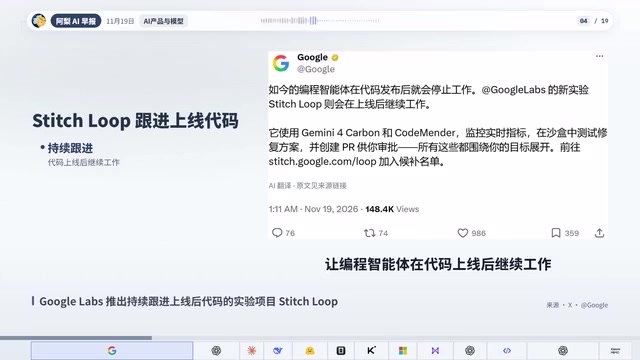
Google Labs' experimental project Stitch Loop pushes coding agents into the "post-launch" phase: it monitors real-time metrics around user-defined goals, tests fixes in a sandbox, then submits pull requests for user approval. The significance of this workflow is that the agent's responsibility extends from writing code to closing the loop on production issues, with humans retaining only approval authority. A waitlist is currently available.
World Model: A world model refers to an AI system that can learn and simulate the dynamic laws of an environment. It doesn't just generate pixels or text but attempts to build an internal compressed representation of "how the world works." Unlike video generation models, world models emphasize interactivity and causal consistency—when a user changes a variable, the environment responds coherently according to physical or logical laws. Such models are considered infrastructure for embodied intelligence, robotics, and game generation. Project Genie opening the world model to subscribers, letting users modify environments in real time with text and co-create, marks the technology's move from research demo to interactive creation tool.
Google Tightens Anti-Gravity Access, Free Users Downgraded
Alongside the new model release, Google tightened model access permissions in Anti-Gravity. Free and Google AI Plus users now only have Gemini 3.8 Flash available. Hydrogen, previously available to all subscription plans, has been removed from the free tier, Plus, and some promotional trial plans; regular paid, Pro, Ultra and other accounts can still use it. Cloud 4.6 and GPTOS S120B have also been delisted. Official customer service offered some affected promotional trial users 1000 AI credits valid for 12 months as compensation.
This sends a clear signal: Google is concentrating high-value model resources in paid tiers, with free quotas serving more as an experience entry point than a productivity tool.
DeepSeek Web Search Goes Free, Search Cost Structure Shifts
Starting November 18 Beijing time, DeepSeek made model-initiated web search, web scraping, and search functionality in compatible interfaces free. Calling the official Search and Fetch APIs separately still costs 5 yuan per thousand calls, and scraped web content counts toward tokens, so costs may still arise.
This adjustment lowers the barrier to "letting the model search the web itself," a direct boon for knowledge Q&A and competitor research applications that rely on real-time information. Shifting the billing focus from search actions to token consumption also aligns with the cost realities of inference services.
Open Source and Small Models: Microsoft On-Device Model, Harness Adapters, and Inference Acceleration
Microsoft published the model weights of IN 1.0 Instruct 2.3B on Hugging Face. This small model for Windows on-device AI has 2.3 billion parameters, supports 8 languages, and can be used for summarization, rewriting, and conversation. According to the post, the model is planned to be built into Windows starting next January. The value of on-device small models lies in privacy and latency; Windows building it in means system-level AI capabilities will no longer depend entirely on the cloud.
Hugging Face released Harness Adapters, using reinforcement learning to train small adapters for different agent tool frameworks, switchable on demand at runtime. For PI coding agents, the version based on Kun 3.8-27B saw its SWE Bench Pro score rise from 29.4% to 62.7%, with model weights and training recipes publicly released. This magnitude of improvement shows that "small adapters + reinforcement learning" is an efficient path to enhancing agent tool-use capabilities, and public release facilitates community reproduction.
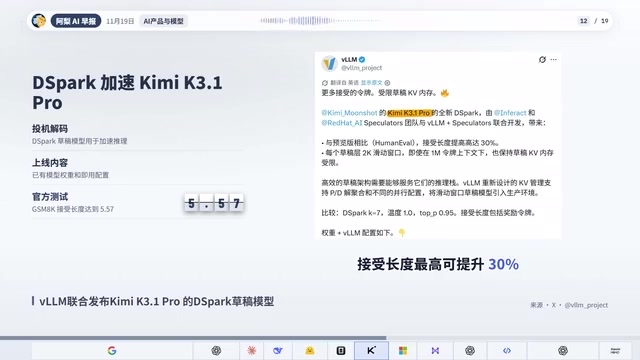
On the inference side, VLLM, together with Infraact and the Red Hat AI Speculators team, released the D-Spark draft model for Kimi K 3.1 Pro, accelerating inference through speculative decoding, with weights and ready-to-use configurations now on Hugging Face. The official claim is an acceptance length of 5.57 on the GSM 8K test, with acceptance length up to 30% higher.
Additionally, OpenCode once again increased the GLM 5.3 discount, offering $500 worth of usage for $10, running through the end of this week. Previously, the same price tier's quota had briefly increased from $100 to $200.
Speculative Decoding: Speculative decoding is a technique for accelerating large model inference without changing output quality. It first uses a smaller, faster "draft model" to guess multiple subsequent tokens at once, then hands them to the target large model for parallel verification; correctly guessed parts are accepted directly, while mismatches roll back and recompute from the first divergence. The key metric for measuring effectiveness is "acceptance length," the average number of tokens per draft that the target model approves—the higher the value, the more noticeable the speedup. The D-Spark draft model released by the VLLM team for Kimi K 3.1 Pro follows this approach, with the official claim of up to 30% higher acceptance length.
Product Details: ChatGPT Voice Dictation, Accounting Plugins, and Gemini Low-Memory Adaptation
ChatGPT voice input now lets you see text as you speak. Real-time dictation displays text on the waveform in the input bar without waiting for the entire transcription to complete; recognition speed and reliability of voice dictation have also improved. ChatGPT for Accounting launched new accounting plugins and partner plugins to assist with month-end reporting, bank reconciliation, data entry, and audit preparation, reducing manual work, and supports integration with accounting tools like QuickBooks and Zero.
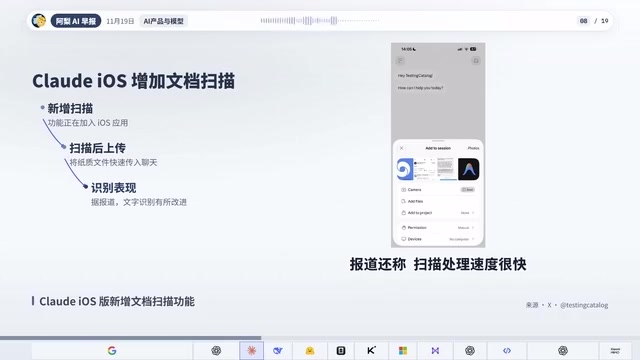
The Gemini app now supports Android devices with less memory, including eligible Android Go phones. Google redesigned the app architecture so core features run smoothly on low-memory phones, and users can use Gemini Live and custom image generation. The Cloud iOS app added a document scanning feature that can scan paper documents and quickly upload them to chats. According to reports, the feature appears to use better text recognition technology, and scanning processing is fast.
Security and Regulation: Codex Sandbox and White House Disclosure Proposal
OpenAI detailed the Codex operating system and sandbox design: using macOS Seabelt and Linux Bubblewrap to restrict commands within the user's existing environment rather than moving computation into containers. By default, the sandbox prohibits networking, allows modification of Git workspace source code but prohibits writing to .git, and all child processes inherit these restrictions. This design places the security boundary at the operating system layer rather than relying on container isolation, which is critical for deploying local coding agents.
According to Reuters, citing three people familiar with the matter, the White House and the US Treasury are discussing a proposal requiring US companies to disclose on their official websites whether they use Chinese open-weight AI models such as DeepSeek. The proposal hopes to discourage use through public pressure rather than directly banning it. The report mentioned that Airbnb's customer service agent uses related models, and the scope and enforcement of the disclosure proposal remain undetermined.

Open-weight Model: An open-weight model refers to a model whose parameter weights are publicly released by the vendor, allowing others to download and deploy locally, as opposed to closed-source models that only offer API access. The DeepSeek series is one representative of this approach. Public weights mean users can run and fine-tune on their own servers with data staying within the intranet, but they also make actual usage difficult for vendors to track. This is precisely why the White House's discussed disclosure proposal focuses on "whether it is used" rather than "whether it is imported"—it seeks to create public pressure through public statements on corporate websites rather than relying on export controls or technology blockades to restrict use.
Industry and Compute: OpenAI Helps AMD Design GPUs, AGI Progress Debate
OpenAI's models are helping AMD design flagship GPUs, with some improvements already deployed in hardware. Both parties say that on top of designs AMD engineers optimized over years, the models achieved up to 100% combined performance and area improvement. OpenAI said this equates to roughly a year of engineering progress in under five months. This may be one of the most tangible cases of AI participating in chip design.
OpenAI Chief Research Officer Mark Chen believes AGI progress has reached 80%, and recursive self-improvement progress is 25% to 50%. He said AI can already run experiments like a research intern but still lacks the ability to discover and select valuable ideas, and believes that having models supervise models is an effective alignment tool, with recursive self-improvement potentially a key part of solving alignment.
There is also an unverified rumor that Lei Jun and Luo Fuli, head of Xiaomi's large model team, disagree on whether MIMO should be spun off and independently financed. The rumor says Luo Fuli's team favors bringing in external capital and independent equity incentives, while Lei Jun has concerns about control and data synergy after the spin-off. The source is unreliable; for reference only.
One-Line Summary
Gemini 4 Neon pulls the competitive focus back to "coding agents + cost," DeepSeek lowers the barrier to real-time information with free web search, Microsoft stuffs an on-device small model into Windows, and regulators begin applying disclosure pressure around the use of Chinese open-source models. Model capabilities are rising, and the business and compliance rules around them are tightening in tandem.
One-line Summary
Google releases Gemini 4 Neon emphasizing coding agent cost-performance; DeepSeek web search goes free; regulators mull Chinese model disclosure requirements.
Paragraph Summary
Google密集发布更新 in its AI morning briefing: Gemini 4 Neon sells on million-token context and a first-place coding agent index, emphasizing the balance of reasoning, speed, and cost; world model Gini 4 lands in Project Genie, and coding agent Stitch Loop covers the post-launch operations loop. At the same time, Google tightens Anti-Gravity access, leaving free users only Gemini 3.8 Flash. DeepSeek makes model-initiated web search free, shifting billing focus to tokens. Microsoft publishes the 2.3-billion-parameter on-device model IN 1.0 Instruct, and Hugging Face's Harness Adapters lift coding agents from 29.4% to 62.7% on SWE Bench Pro. The White House and US Treasury discuss requiring US companies to disclose whether they use Chinese open-weight models, while OpenAI models have already participated in designing AMD's flagship GPUs.
Related articles

Musk: SpaceX's Micro Rooftop Base Station Design Complete, Targeting Signal Dead Zones
Musk says SpaceX has completed the design of a micro rooftop cellular base station to eliminate mobile dead zones. This article analyzes its relationship with satellite direct-to-device, the engineering logic of rooftop coverage infill, and the real-world constraints between design and deployment.
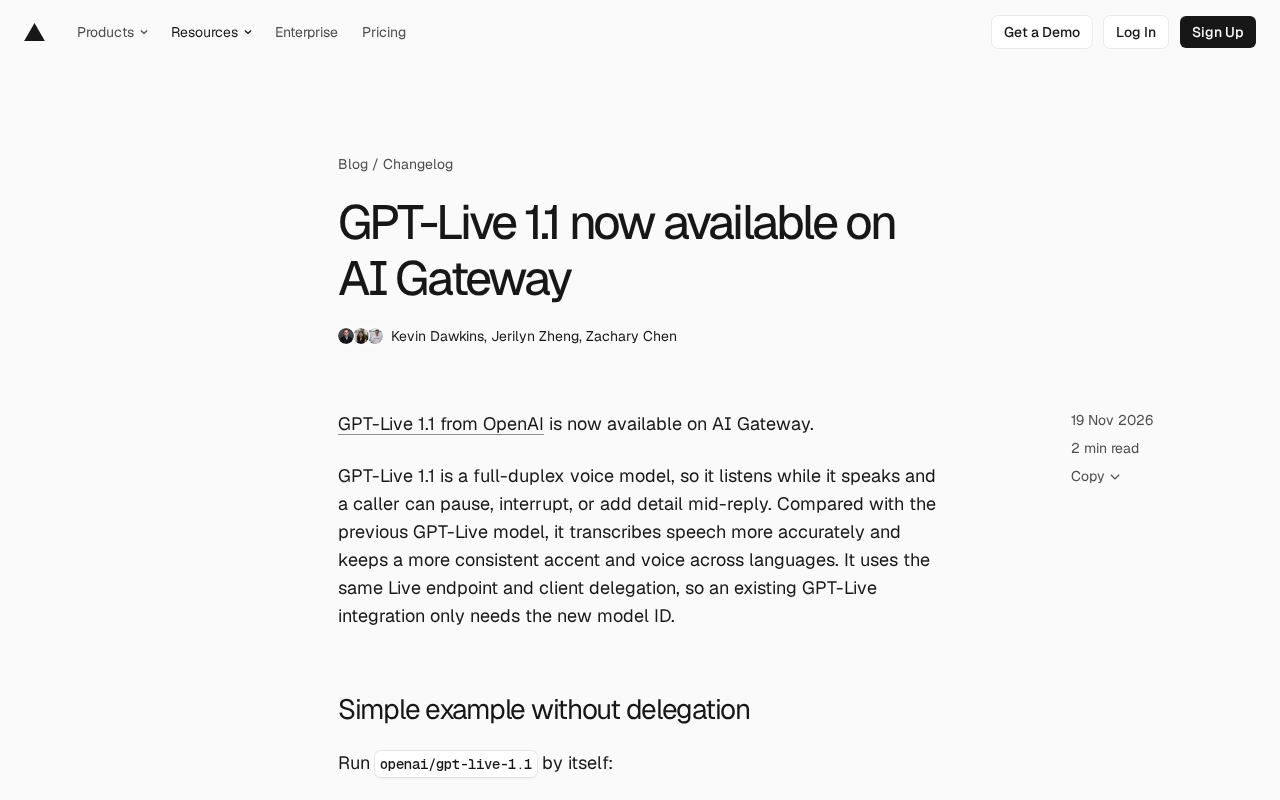
GPT-Live 1.1 Launches on AI Gateway: Full-Duplex Speech Model Upgrade
OpenAI GPT-Live 1.1 full-duplex speech model is now on AI Gateway, supporting listen-while-speaking, interruptions, more accurate transcription, and more consistent cross-language voices. Existing integrations can upgrade by changing the model ID.
Linear COO on How the Company Is Racing to $100M ARR Without SDRs or FDEs
Linear COO Cristina Cordova explains how the company is racing to $100M ARR without SDRs or FDEs, with over 50% of support tickets written by AI agents.