Gemini 4 Neon Scores 61 on Intelligence Index: Analyzing a Purpose-Built Model for Long-Running Agents

Gemini 4 Neon is a narrowed, purpose-built model for long-running agents, scoring 61.81% but with information gaps.
The article analyzes Google DeepMind's Gemini 4 Neon, which scored 61.81% on the Artificial Analysis Intelligence Index in X-High Effort mode, ranking third in the firm's independent calculations. Adapted directly from Gemini 4 Carbon, Neon is purpose-built for long-running, tool-call-intensive agent work, supporting text, image, audio, and video input with a 1-million-token context window. API pricing is $3/$15 per million input/output tokens and $0.15 for cached input, but public docs don't clarify free-tier inclusion—a decision obstacle. The article advises running controlled pilots on production-like tasks before replacing existing infrastructure.
Why a 61-Point Model Deserves Attention
On the Intelligence Index from independent third-party evaluator Artificial Analysis, Gemini 4 Neon scored 61.81% in X-High Effort mode, placing third in the firm's independent calculations. The score itself isn't earth-shattering—what's genuinely interesting is the positioning behind it. Google DeepMind's official model card explicitly states that Neon is a structural variant adapted directly from Gemini 4 Carbon, purpose-built for "long-running, tool-call-intensive agent work."
In other words, this isn't a reskinned general-purpose chat model—it's a targeted narrowing aimed at agent scenarios. For engineering teams building automation pipelines, the trade-off logic for this kind of specialized model is completely different from choosing a general-purpose flagship.
Artificial Analysis Intelligence Index is a composite capability index published by an independent third-party evaluator. Unlike vendor-reported benchmarks, it's calculated by the firm running its own standardized evaluation suite, which is why engineering teams often use it as a cross-vendor comparison reference. The index presents composite scores as percentages—higher scores mean stronger average performance across reasoning, knowledge, coding, and other tasks. Note that index scores are affected by the evaluation suite version, prompting method, and reasoning tier (such as the X-High Effort mode mentioned here); the same model can score noticeably differently across tiers, so comparisons should confirm consistent methodology.
X-High Effort mode refers to a high-intensity reasoning tier where the model invests more compute during inference (longer chain-of-thought, more sampling or search). These tiers typically improve accuracy on complex tasks but significantly increase latency and token consumption, driving up cost. For agent scenarios requiring multi-step reasoning and tool calls, high-effort tiers often deliver better task completion rates—but engineering teams need to weigh the added response time and expense.
Availability and Cost: Transparent Pricing, Opaque Free Tier
According to the video source's breakdown, Neon's integration paths within the Google ecosystem are fairly direct: the Gemini API, Google AI Studio, and Gemini for Business all explicitly list the model. But the Gemini app and anti-gravity are available only to paying Google AI Pro and Ultra subscribers.
Looking purely at API token pricing: $3 per million tokens for input, $15 per million for output, and $0.15 per million for cached input. Cached pricing is relatively cheap, which matters for agent loops that repeatedly carry long contexts.

But here's a gap the video author highlighted: neither Google's public announcement nor the model card states whether Gemini 4 Neon is included in the free API tier. For technical founders and engineering leads who need to precisely calculate early testing costs, this missing information is a real decision-making obstacle. Artificial Analysis's independent estimates give two figures—$6.45 and $3—though the video doesn't elaborate on the calculation method.
Context caching in agent loops refers to the fact that across multiple rounds of tool calls, the model must repeatedly carry the same system prompts, tool definitions, and historical context. If these tokens were recomputed each time, costs would accumulate rapidly. Cached input pricing (here $0.15 per million tokens) is far below standard input pricing precisely because this content is reused server-side, avoiding redundant encoding and forward computation. For long-running agents, cache hit rate directly determines the actual bill—engineering teams should structure prompts so that stable, unchanging portions (like tool schemas and long-term memory) sit in the prefix position to maximize cache hits.
Capability Profile: Million-Token Context and Multimodal Input
According to Google, Neon focuses on three task categories: coding, knowledge work, and scientific tasks. On multimodality, it natively accepts text, image, audio, and video input, all within a 1-million-token context window—meaning it can process very large volumes of data simultaneously.
In a head-to-head comparison of automation capabilities, Google reports that Neon achieved 56.3% on Zapier's automation bench, while Artificial Analysis ranks it third in its independent calculations. The two sources use different evaluation methodologies but point in the same direction: Neon sits in the top tier for automation tasks, though not in absolute first place.
Zapier automation bench is an evaluation benchmark from automation platform Zapier, specifically measuring model performance in real automation workflows (such as trigger condition evaluation, cross-app data transfer, and multi-step task orchestration). Unlike general academic benchmarks, it's closer to the actual needs of no-code/low-code automation scenarios, making it a strong reference for assessing the practical value of agent-class models. Note, however, that this benchmark is led by a vendor-ecosystem player, so its task distribution diverges from general capability evaluations. The 56.3% score should be cross-validated with other sources rather than used as a standalone selection criterion.
Architecture: Targeted Rework from Carbon to Neon
Google DeepMind's model card states that Neon is adapted directly from Gemini 4 Carbon, with an architecture purpose-built for long-running, tool-heavy agent work. In practice, this means it can either run fully autonomously on its own or serve as a specialized sub-agent coordinated alongside other frontier models within the same tech stack.

The video author also points out a gap in public documentation: Google hasn't disclosed more Neon-specific architectural details, so it can't explain to the engineering community how these internal structural optimizations are implemented. For teams that need to assess predictability and debugging paths, this is a black-box area requiring independent verification.
Structural variant and specialized sub-agent coordination: In the context of a model card, "structural variant" means Neon isn't a simple fine-tune—it's a targeted adjustment at the architecture level (such as attention patterns, tool-calling interfaces, and long-context management strategies) built on Carbon to suit long-running operation and high-frequency tool calls. When coordinated as a specialized sub-agent, Neon is typically invoked by an orchestration system as the executor of a particular stage, with an upper-layer scheduler assigning tasks, passing context, and aggregating results. The advantage of this architecture is that each stage can use the most suitable model; the cost is added orchestration complexity and cross-model context-passing overhead. Teams need to evaluate the engineering investment in the scheduling layer itself.
Who Should Use It, Who Should Skip It
The video draws fairly clear boundaries. The right fit is engineering teams and CTOs building complex, long-running agent workflows that need large-scale context throughput. Two groups should skip it: teams that strictly require free-tier API guarantees, and developers doing only basic single-step text prompting—the latter would only incur unnecessary infrastructure overhead with Neon.
The logic behind this split is that Neon's pricing and positioning both point to high-intensity, sustained invocation scenarios; a single simple request can't amortize its unit cost.
Implementation Advice: Run a Controlled Pilot Before Considering Replacement
The video author's core recommendation is not to rush into replacing existing infrastructure, but first to run a controlled pilot comparing Neon against your current model on tasks close to production reality.
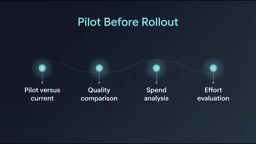
The comparison shouldn't stop at leaderboard scores—it should dig into completion quality and the time and effort required to build out the solution. Only when you've accounted for both "what you pay for it" and "the extra engineering hours you spend on it" does a replacement decision have a basis. Giving the team enough evaluation time also matters—the rework cost of a rushed migration often exceeds the price difference between the models themselves.
A Few Sober Observations
Putting the above together, Neon's profile is a "narrow but deep" specialized model: narrow in scenario, deep in the context capacity and tool-calling stamina that long-running agents require. Its 61.81% intelligence index and third-place ranking show it's competitive, but they don't constitute a reason to fully replace a general-purpose flagship.
The real concern is information asymmetry—whether the free tier covers it and the specific path of architectural optimization are two key pieces of information missing from public documentation. Until they're filled in, any procurement decision based on leaderboard scores carries an element of gamble. The video source itself also has some ambiguous statements (such as the specific methodology behind cost estimates); when making actual selections, rely on Google's official documentation and your own pilot data.
One-line Summary
Gemini 4 Neon is a narrowed, purpose-built model for long-running agents, scoring 61.81% but with information gaps.
Paragraph Summary
The article analyzes Google DeepMind's Gemini 4 Neon model. It scored 61.81% on the Artificial Analysis Intelligence Index in X-High Effort mode, placing third in the firm's independent calculations. Neon is adapted directly from Gemini 4 Carbon and purpose-built for long-running, tool-call-intensive agent work, supporting text, image, audio, and video input with a 1-million-token context window. API pricing is $3 per million input tokens, $15 for output, and $0.15 for cached input, but public documentation doesn't state whether the free API tier is included—a decision obstacle. The article advises engineering teams not to rush into replacing existing infrastructure, but to first run controlled pilots on production-like tasks, comparing completion quality and build investment rather than leaderboard scores alone.
Related articles

Gemini 4's Three Coding Models Compared: How to Choose Between Neon, Hydrogen, and Argon
How to choose among Gemini 4's Neon, Hydrogen, and Argon coding models? This article compares official positioning, API pricing and the price-increase date, coding benchmark scores from Artificial Analysis and Cursor, and summarizes developer feedback to offer scenario-based selection advice.

Gemini 4 Neon Hands-On: Crushes Opus at Coding, but the Free Agent Hides Three Major Pitfalls
Gemini 4 Neon tops the Coding Agent Index, beating Carbon and Opus 5.5 in four real code battles—but hidden reasoning tokens bill at $15 and free Tasks silently fails.

Gemini 4 Neon Released: Google's Strongest Coding Model Tops the Rankings
Gemini 4 Neon tops the Artificial Analysis Coding Agent Index with 58.6. We break down its coding agent benchmarks, 1M token context, four thinking levels, and pricing below Carbon starting in December.