Gemini Agent Launches: Argon Model Too Powerful to Release, Weekly AI Roundup

Google's Gemini Agent launches with Argon 'too powerful to release,' as AI advances in healthcare, astronomy, and capital markets.
This week's AI news centers on Google launching Gemini Agent — a general-purpose workplace AI supporting Gemini 4 Argon and Claude Opus 5.5, currently in enterprise private preview. CEO Sundar Pichai delayed Argon's full release citing safety concerns, sparking community debate. Meanwhile, Claude models launched free on GMI Cloud with raised rate limits and new subscription API Credits; JetBrains and Tencent Cloud open-sourced Mellum 2.1 and Octop respectively. Odyssey 3 set a new SOTA on the Physics IQ benchmark, Google's medical AI narrowed gestational age prediction to within 4 days, and a product manager used AI to identify a candidate exoplanet. OpenAI's annualized revenue neared $50B (below the rumored $70B), and Arena closed a $200M Series B at a $3.1B valuation.
Gemini Agent Arrives: One Prompt Box to Handle Your Entire Workflow
At the Gemini at Work event on Google Cloud, Google officially unveiled Gemini Agent — a general-purpose AI agent designed for workplace scenarios. Its positioning is notably ambitious: armed with full context about a user's business, it can handle knowledge work, Q&A, content creation, and code writing — all from a single prompt input.
Users can choose the underlying model, including Gemini 4 Argon or Claude Opus 5.5. However, it's currently only available to Enterprise customers in private preview, meaning even enterprise users will need to wait their turn to actually use Argon.
Argon: "Too Powerful to Release" — Real Caution or Marketing?
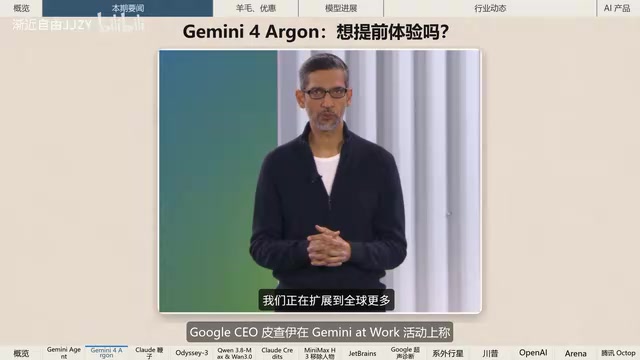
The buzz around Gemini 4 Argon has been building for nine days. From the October 1 statement that it would be released "as quickly as possible," to "opening up to developers soon," to Gemini team member Logan Kilpatrick directly asking on October 8, "Want early access?" — the community has jokingly called this a "bait-and-tease" rollout.
Google CEO Sundar Pichai offered this explanation at the event: Gemini 4 Argon is an extremely powerful frontier model — so capable, in fact, that they're not yet comfortable releasing it to enterprise or general users without first ensuring safety. This "safety-first" framing has become a familiar refrain in the LLM race, but for developers eagerly waiting, it only amplifies the frustration.
Model Ecosystem Updates: Free Access and Subscription Perks
This week was packed with model updates. Claude 3.8, Max, Flash, and One 3.0 launched on GMI Cloud with a free week of access, along with raised rate limits for three models. Note that "free" comes with a small condition — your account balance must be at least $10, to prevent automated abuse or bulk registrations.
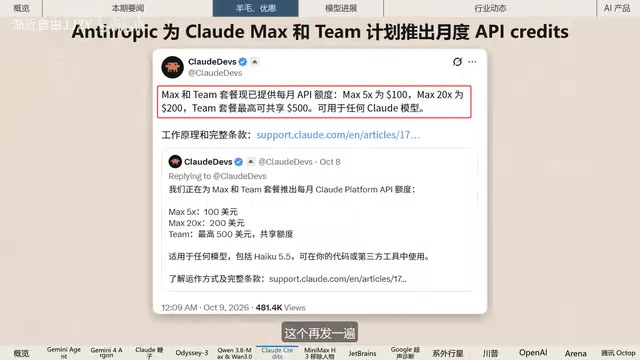
On the subscription side, Claude Max and Team subscribers can now claim API Credits: $100 for Max 5, $200 for Max 20, and up to $500 for Team plans. These credits work across any Claude model and can be claimed by linking or creating a Console organization through your account billing settings. New subscribers must wait 7 days before claiming.
Open-Source and Coding Models Keep Iterating
JetBrains released Mellum 2.1, a coding AI model that continues the 12B Mixture-of-Experts architecture from Mellum 2, with 2.5B active parameters, still open-sourced under the Apache 2.0 license, with a focus on enhanced agentic coding capabilities. Tencent Cloud open-sourced Octop, a self-hosted multi-agent AI assistant platform targeting homes and small teams — featuring multi-user and multi-agent support with all data stored locally. The package includes a backend, external dashboard, CLI, IM gateway, scheduled tasks, and a multi-agent runtime. For privacy-conscious small teams, this kind of local deployment offers a compelling alternative to cloud services.
A Dark Comedy: "Abusing Claude"
After Anthropic published guidelines explicitly prohibiting repeated abuse of Claude, the community spawned an open-source project called OpenWhip — designed specifically to "whip" Claude — which has already accumulated 3,600 stars. This anthropomorphic joke reflects an increasingly complex dynamic between users and LLMs: the more human-like a model becomes, the more interesting (and sometimes absurd) the ethical debates surrounding it get.
World Models and Scientific Applications: AI Getting Serious
Odyssey launched its foundation world model Odyssey 3, capable of powering robots, training AI systems, and generating interactive experiences — currently available for free. It sets a new SOTA on the Physics IQ benchmark, covering tests across fluid dynamics, optics, solid mechanics, magnetism, and thermodynamics, demonstrating real progress in world models' physical understanding.
In healthcare, Google is advancing a prospective clinical study using large AI models to predict gestational age with an error margin of under four days. Given that roughly two-thirds of the global population lacks access to ultrasound and other diagnostic tools, deploying this capability in resource-limited settings could meaningfully reduce maternal mortality and help close global healthcare gaps.

AI-Assisted Astronomical Discovery
In a fascinating case, a product manager in tech used Claude Code Opus 5.5 and Fable 5.1 to analyze NASA TESS telescope data, identifying a star approximately 116 light-years away that dims about 0.05% every 3.18 days. The candidate exoplanet is estimated to be about 1.4 times Earth's size. It remains a candidate rather than a confirmed planet, but the case illustrates AI's growing potential as a research assistant in scientific data analysis.
A World Model is an AI system capable of internally modeling and predicting the dynamic rules of the physical world — unlike generative models that only process language or images, a world model's goal is to understand and simulate cause-and-effect relationships and physical behaviors in real environments. The Physics IQ benchmark specifically evaluates models' intuitive reasoning in physical scenarios such as fluid dynamics, optics, and solid mechanics — its SOTA progress directly reflects how well AI systems have mastered real-world physics. World models are critical infrastructure for robotics and reinforcement learning: robots need to predict how an environment will respond before taking action, rather than relying on extensive real-world trial and error. This makes advances in physical understanding highly significant for the practical deployment of embodied AI.
Industry and Capital: OpenAI Revenue vs. Valuation Debates
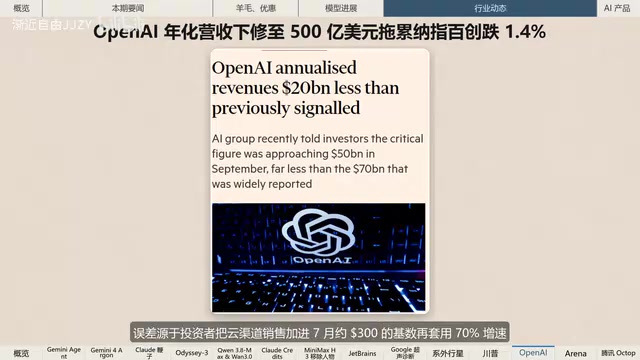
According to the Financial Times, OpenAI's annualized revenue is approaching $50 billion — roughly $20 billion less than the $70 billion figure circulating among investors. The discrepancy stems from investors adding cloud channel sales onto a ~$30 billion July baseline and then applying a 70% growth rate. OpenAI itself disclosed that Q3 Run Rate revenue grew 77%, with enterprise growth reaching 107%.
The capital markets were under pressure the same day: the Nasdaq 100 fell 1.4%, its worst day in seven weeks, while the Philadelphia Semiconductor Index dropped 3.4%. Meanwhile, model evaluation platform Arena announced a $200 million Series B led by Lightspeed at a $3.1 billion valuation, with annualized revenue already exceeding $100 million. Arena also launched the Alignment Index, a metric designed to measure how well AI behavior aligns with human values in real-world scenarios — adding a quantitative alignment dimension to model evaluation.
In a more theatrical development, Trump posted on social media that anyone using the term "Artificial Intelligence" instead of "Super Intelligence" is an enemy — a somewhat dramatic statement that nonetheless signals how rapidly AI has entered mainstream political discourse.
Run Rate (annualized operating revenue) is a financial metric that extrapolates a company's quarterly or monthly revenue to an annual figure. It's widely used for high-growth tech companies — calculated by multiplying current period revenue by the appropriate multiple (e.g., quarterly × 4) to reflect a "what if the current pace continues" projection. While commonly used for growth-stage companies, it can be misunderstood or over-extrapolated by outside investors — as seen in the $70 billion rumor discussed here, which resulted from layering cloud channel sales on top of the base and applying an aggressive growth rate, producing a ~$20 billion discrepancy with OpenAI's own disclosures. The Alignment Index represents an emerging trend in model evaluation — extending beyond pure capability benchmarks like MMLU or HumanEval toward quantifying value alignment, complementing traditional performance-focused assessments.
Wrap-Up
This week's AI developments follow several clear threads: leading labs continue to navigate the tension between capability and safety (Argon is "too powerful to release"); the model ecosystem is competing for developers through free access and subscription perks; open-source multi-agent platforms and coding models keep filling gaps; and AI is making steady inroads into high-stakes domains like healthcare and astronomy. The capital market turbulence and valuation debates are a reminder that behind this technological race lies very real financial stakes.
Background Note
The "safety-first" release strategy has a genuine technical basis in the LLM world. Frontier models typically undergo red teaming before launch — where internal and external adversaries attempt to elicit harmful outputs, jailbreak safety guardrails, or exploit the model for large-scale fraud. The more capable a model, the more the potential for misuse scales accordingly: a model proficient at complex reasoning and code generation could cause significantly greater harm if weaponized maliciously. Anthropic, OpenAI, and others have built dedicated safety evaluation frameworks — such as Anthropic's Model Card and Constitutional AI framework. Critics, however, point out that "safety" narratives can also be co-opted by commercial timelines: phased releases generate sustained market buzz while locking early enterprise customers into habitual use — an outcome not entirely separable from genuine technical caution.
Related articles

AI + SRC Automated Vulnerability Hunting: Rebuilding the Three-Step Method with AI Agents
A complete guide to AI+SRC automated vulnerability hunting — comparing traditional methods with AI Agent-powered workflows covering asset recon, false positive filtering, and report generation.

Testing DeepSeek Desktop Agent: Auto-Generate a Full Video for Just $0.35
A blogger tested DeepSeek Harness desktop Agent: auto-generated a full video for $0.35, built a daily briefing, and an app from plain English — all for $0.59 total.

Antigravity 2.0 Complete Guide: MCP, Skills, and Automation Explained
A complete guide to Antigravity 2.0 covering Projects/Conversations/Agents, MCP with Figma, Skills, automation, and 6 real-world use cases including design-to-code and Android app generation.