Gemini CLI Open-Source Release: 1000 Free Daily Calls to Gemini 2.5 Pro

Google open-sources free Gemini CLI to rival Claude Code as AI developer tool competition intensifies
Google has open-sourced Gemini CLI, a terminal agent tool offering 1,000 free daily requests with Gemini 2.5 Pro's 1-million-token context window, directly competing with Anthropic's Claude Code. Meanwhile, Anthropic's Claude models are fully integrated into GitHub Copilot, DeepMind released genomics AI model AlphaGeno, ElevenLabs launched Voice Design V3, and OpenRouter closed $40M in funding. AI developer tool competition has evolved from model capability comparisons into a comprehensive battle of ecosystems and business models.
Google Officially Open-Sources Gemini CLI: A Free Terminal Agent Tool Powered by Gemini 2.5 Pro
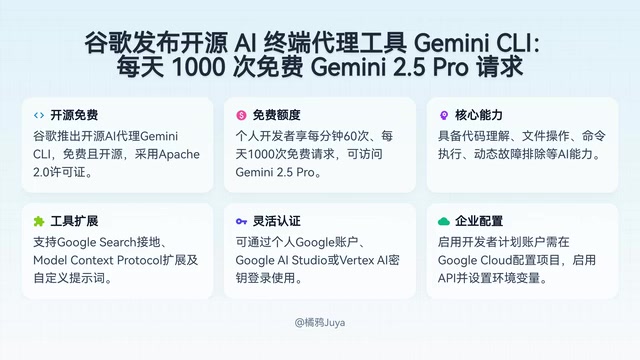
Google has officially released its open-source AI terminal agent tool, Gemini CLI, positioning it directly against Anthropic's Claude Code and bringing Gemini's large model capabilities into the developer terminal environment. The tool is completely free and open-source, offering 60 free requests per minute per account, with up to 1,000 free requests per day at no cost.
Even more noteworthy is that users get direct access to Gemini 2.5 Pro with its 1-million-token context window, meaning developers can handle large-scale codebases and complex projects in the terminal without worrying about context length limitations. A 1-million-token context window can load approximately 750,000 English words or tens of thousands of lines of code at once, covering the complete codebase of most mid-sized projects — a significant advantage when performing cross-file dependency analysis and large-scale refactoring.
Terminal Agent tools represent an emerging AI development paradigm that embeds large language model capabilities directly into the command-line interface, allowing developers to get AI assistance without leaving the terminal. Unlike traditional IDE plugins, terminal agent tools better align with the workflows of DevOps engineers and backend developers, supporting use in SSH remote connections, container environments, and similar scenarios.
Gemini CLI Core Capabilities and Configuration
Gemini CLI offers three core AI capabilities:
- Code Understanding: Deep analysis of code logic, architecture, and dependencies
- File Operations: Direct file reading, writing, and management within the terminal
- Command Execution: Intelligent generation and execution of terminal commands
Users can access the tool through a personal Google account or API key. Note that accounts with Google Developer Program enabled require additional configuration: creating a project on Google Cloud, enabling the Gemini API, configuring access permissions, and setting the environment variable GOOGLE_CLOUD_PROJECT=Your_Project_ID.
This move marks a significant play by Google in the AI developer tools space. Claude Code is a terminal AI coding tool launched by Anthropic in early 2025, which quickly gained developer favor thanks to Claude's strengths in code understanding and generation, but operates on a pay-per-token commercial model. Google's strategy of launching Gemini CLI as completely free is essentially subsidizing developer usage to capture market share and ecosystem positioning — a playbook reminiscent of Google's Android promotion strategy: attract users with free access first, then create commercial value through ecosystem lock-in. This free strategy is bound to attract a large number of developers migrating from competitors like Claude Code.
Anthropic Claude Models Fully Integrated into GitHub Copilot
Anthropic's Claude Sonnet 4 and Opus 4 have been fully integrated into GitHub Copilot. Opus 4 is Anthropic's most powerful model to date, while Sonnet 4 excels particularly in coding workflows — both support tool use and vision capabilities.
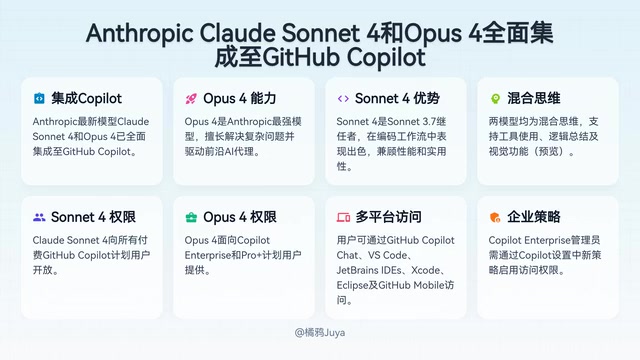
GitHub Copilot initially only supported OpenAI's Codex and GPT series models, but began gradually opening multi-model support from the second half of 2024, successively integrating Google Gemini and Anthropic Claude series. This multi-model strategy allows users to choose the best model for different tasks — for example, Opus 4 is ideal for complex architectural design requiring deep reasoning, while Sonnet 4 offers better cost-effectiveness for daily code completion and code review.
Regarding user access, Sonnet 4 is available to all paid Copilot users, while Opus 4 is exclusive to Copilot Enterprise and Pro+ users. Copilot Enterprise targets large enterprise customers with enhanced security compliance and organization-level management features. Additionally, GitHub Copilot Chat has improved attachment and context features in its public preview — users can convert large text blocks into attachments, attach up to 4 images and preview HTML files, and Copilot Spaces context storage has doubled.
On a related note, Anthropic has also introduced the ability to build, publish, and share interactive AI applications directly within the Claude app. Developers can iterate faster without worrying about scaling costs, with users authenticating the API through their own Claude accounts. This feature is currently in Beta and available to Free, Pro, and Max plan users.
More AI Developments Worth Watching
Google DeepMind Releases AlphaGeno to Decode Human DNA
Google DeepMind has released the AI model AlphaGeno for decoding human DNA. The model takes 1-million-base-pair DNA sequences as input, predicts thousands of molecular properties, and excels across multiple genomic prediction benchmarks. It's currently available via API as a preview for non-commercial research use.
AlphaGeno's naming continues DeepMind's Alpha series tradition (AlphaGo, AlphaFold, AlphaProteo, etc.). In computational biology, DNA sequence analysis has always been a core challenge — the human genome contains approximately 3 billion base pairs, with large non-coding regions whose functions remain incompletely understood. Traditional methods rely on experimental validation, which is time-consuming and costly. AlphaGeno's ability to predict using 1-million-base-pair input units means it can simultaneously analyze the complete information of a relatively large genomic segment, which holds significant implications for understanding gene regulatory networks and predicting genetic disease risk. This represents another major breakthrough by DeepMind in life sciences following AlphaFold.
Dify V1.5.0 Completely Rebuilds Workflow Debugging Tools
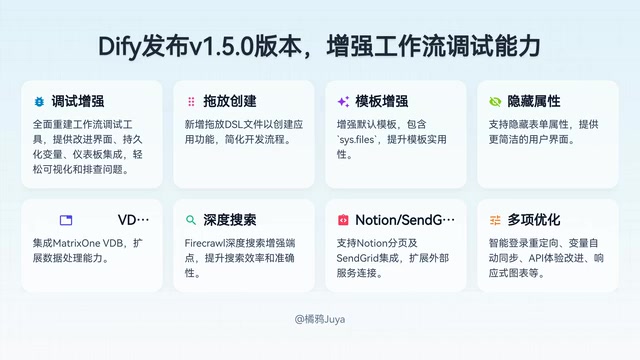
Dify released V1.5.0, completely rebuilding its workflow debugging tools to significantly boost developer productivity. The new version offers an improved interface, persistent debug variables, and enhanced dashboard integration for visualizing and troubleshooting workflow issues. Dify is an open-source LLM application development platform that allows developers to build AI workflows and Agent applications through a visual interface. Its workflow debugging tool is similar to debuggers in traditional software development but targets each node in the AI reasoning chain.
ElevenLabs Voice Design V3 Released
ElevenLabs has launched Voice Design V3, enhancing voice expressiveness across 70+ languages through prompt-based controls and supporting hundreds of localized accents. The new version allows users finer control over tone, personality, timbre, and other parameters, delivering more natural, human-like speech synthesis. ElevenLabs is one of the leading companies in speech synthesis, with technology based on deep learning text-to-speech (TTS) models. The prompt-based control mechanism introduced in V3 means users can describe desired voice characteristics in natural language (e.g., "a warm middle-aged female voice with a slight Southern accent"), and the model will generate matching speech accordingly.
Mobvoi Launches First Agentic AI Hardware Product
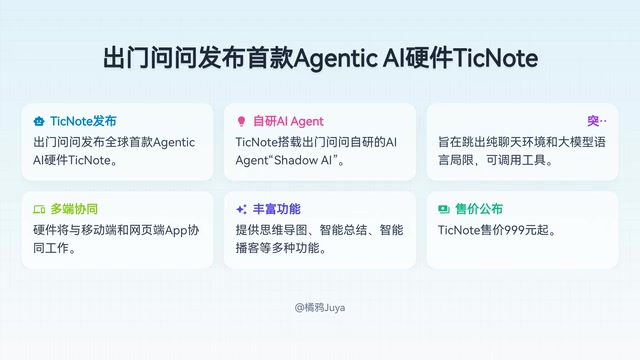
Mobvoi officially released its Agentic AI hardware product TechNote, powered by its proprietary AI Agent Shadow AI, starting at 999 yuan. TechNote breaks away from the pure chat interaction paradigm, capable of calling tools to provide mind maps, intelligent summaries, and other features — bringing AI Agent capabilities to physical hardware. "Agentic AI" refers to AI systems with autonomous planning, tool-calling, and multi-step execution capabilities. Unlike traditional Q&A-style AI, it can proactively decompose tasks and coordinate multiple tools to accomplish complex goals. Mobvoi is a Chinese company focused on AI technology, previously known for its smartwatch and voice assistant products.
LM Studio Adds MCP Protocol Support
LM Studio introduced Model Context Protocol (MCP) host support in V0.3.17, allowing users to connect MCP servers to the application and use them with local models. The team also notes that installing MCP from untrusted sources poses security risks. This update also includes support for 11 new languages and various improvements.
Model Context Protocol (MCP) is an open protocol standard proposed by Anthropic in late 2024, designed to provide AI models with a unified interface for external tools and data sources. MCP uses a client-server architecture where AI applications act as MCP hosts connecting to various MCP servers, each encapsulating specific capabilities (such as file system access, database queries, API calls, etc.). LM Studio is a desktop application that allows users to run open-source large models locally. Its MCP support means locally-run open-source models can now gain tool-calling capabilities similar to commercial cloud models, significantly lowering the barrier to building AI Agent applications.
OpenAI and OpenRouter Latest Developments
OpenAI ChatGPT has launched connector functionality outside of deep research mode. Connectors for Google Drive, Dropbox, SharePoint, and Box are now available to Pro users (with some regional exceptions), designed to bring personal or team context into daily work. This connector mechanism is essentially a productized implementation of RAG (Retrieval-Augmented Generation), allowing AI to access users' private documents stored across platforms for more personalized and accurate responses.
OpenRouter AI announced the completion of $40 million in seed and Series A funding, led by a16z and Melo. OpenRouter positions itself as a unified routing layer for LLM inference, similar to a load balancer in cloud computing. It aggregates APIs from hundreds of AI model providers, allowing developers to access all major models through a single OpenRouter endpoint while intelligently routing requests based on cost, latency, availability, and other factors. The term "Control Plane" borrows from network architecture terminology, referring to the management layer responsible for decision-making and scheduling, as opposed to the "Data Plane" that actually processes data. a16z (Andreessen Horowitz) is one of Silicon Valley's most influential VCs, and their lead investment signals strong market confidence in AI middleware infrastructure. This funding will accelerate OpenRouter's positioning in model routing and inference infrastructure.
Summary: AI Developer Tool Competition Enters White-Hot Phase
Looking at today's developments, competition in the AI developer tools space is intensifying rapidly. Google is directly challenging Claude Code with its free Gemini CLI strategy, while Anthropic consolidates its developer ecosystem through deep GitHub Copilot integration. Meanwhile, AI's application boundaries continue expanding — from genomics to speech synthesis, from hardware products to workflow tools, the entire industry is accelerating toward practical, democratized solutions.
Notably, competition in AI developer tools has evolved from pure model capability comparisons into a comprehensive battle of ecosystems and business models. Google's free strategy, Anthropic's platform integration strategy, and OpenRouter's middleware routing strategy represent three distinctly different market entry approaches. For developers, now is an excellent time to embrace these free tools and boost productivity, while also staying mindful of ecosystem lock-in risks behind tool choices.
Related articles
 Tech Frontiers
A Rare Quiet Day in AI: Recursive Self-Improvement Stirs Beneath the Surface
A rare quiet day in AI sees multiple sources go silent simultaneously. Behind the calm, Recursive Self-Improvement (RSI) research continues. What this means for the industry.
 Tech Frontiers
Reve 2 vs. Ideogram 4: A Deep Dive into Layout Control in AI Image Generation
A deep comparison of Reve 2 and Ideogram 4's layout control capabilities, covering technical approaches, real-world use cases, and industry trends for designers and creators.
 Tech Frontiers
In the Weights: Check Your Influence Score in the AI World
In the Weights is an AI influence search engine that quantifies your presence in the AI world with a score. Explore how it evaluates practitioners and what it means for digital identity.