Gemini Comes to Windows, OpenAI Makes Progress on Another Millennium Prize Problem
Gemini hits Windows, OpenAI nears a second Millennium Prize problem, and voice/vertical AI tools accelerate.
On September 11, AI made simultaneous advances across productivity tools, mathematical research, and developer infrastructure. Gemini launched on Windows with an Alt+Space shortcut, directly rivaling Microsoft Copilot. OpenAI claimed substantive progress on a second Millennium Prize problem, suspected to be the Hodge or BSD Conjecture, though details remain undisclosed. Frontier Math Tier 4 was fully solved by AI, with top scores rising from under 5% to 98% in 14 months. On the developer side, GPT-Live-1's full-duplex voice API opened, and OpenAI launched vertical ChatGPT products for finance and healthcare. DeepSeek V4.1 Flash emerged as the new open-source flagship.
The density of AI news on September 11 speaks volumes about the current pace of technological iteration. From Gemini's full arrival on the Windows desktop, to OpenAI's substantive breakthrough on a Millennium Prize math problem, to the opening of the GPT-Live-1 API — this single day showcased simultaneous advances across three fronts: productivity, scientific research, and developer tools. Here's a breakdown of the most noteworthy items from this edition's 13 stories.
Gemini Officially Arrives on the Windows Desktop
The Gemini app is now available for Windows users, who can summon it instantly with Alt+Space alongside their everyday tools. The significance of this interaction design lies in embedding an AI assistant into the shortest path of daily workflows — no window-switching or browser-opening required.
In terms of functionality, the Gemini desktop app supports polishing drafts, summarizing long documents, brainstorming, and generating custom images and videos. This signals that Google is positioning Gemini as a deeply system-integrated resident assistant on Windows, directly competing with Microsoft Copilot's strategy of owning the system-level entry point. For everyday users, the combination of hotkey summoning and multimodal generation lowers the barrier to using AI tools.
OpenAI Takes Another Step Toward a Millennium Prize Problem
According to The New York Times, following its earlier work on the Navier–Stokes equations, OpenAI says it has made substantive progress on a second Millennium Prize problem. However, OpenAI has not specified which problem it is, nor released any results — the team is still deciding how to disclose them publicly.
Speculation points most likely to the Hodge Conjecture (or the Odd Conjecture) or the BSD Conjecture, as these two are considered relatively more approachable among the seven Millennium Prize Problems. It must be emphasized that until official results are published, all of this remains conjecture. The Millennium Prize Problems are among the deepest unsolved questions in mathematics, and if AI can genuinely achieve verifiable progress on any of them, the implications for how scientific research is conducted would be profound. This is simultaneously the most exciting and the most cautiously-to-be-watched item in this edition.
The Millennium Prize Problems were established by the Clay Mathematics Institute in 2000. There are seven problems in total, each carrying a $1 million prize. The only one solved to date is the Poincaré Conjecture (proved by Perelman in 2003). The remaining six — the Riemann Hypothesis, P vs NP, the Hodge Conjecture, the BSD Conjecture (Birch and Swinnerton-Dyer Conjecture), the Navier–Stokes Existence and Smoothness problem, and the Yang–Mills Existence and Mass Gap problem — remain open. The Hodge Conjecture concerns the relationship between algebraic cycles and cohomology classes in algebraic geometry; the BSD Conjecture links the distribution of rational points on elliptic curves to the zeros of L-functions. Both have relatively well-defined algebraic frameworks, which is why outside observers consider them the most likely candidates for AI-assisted breakthroughs. For an AI system to achieve progress recognized by the mathematical community, it would need to provide not just a conclusion but a rigorous, formally verifiable proof — a fundamentally different challenge from engineering benchmark performance.
Mathematical Benchmark Saturation: Frontier Math Tier 4 Fully Solved
In a development that mirrors the Millennium Prize news, Epoch AI announced that all problems in Frontier Math Tier 4 have now been solved by AI. GPT-6 Astra cracked the last remaining unsolved problem.
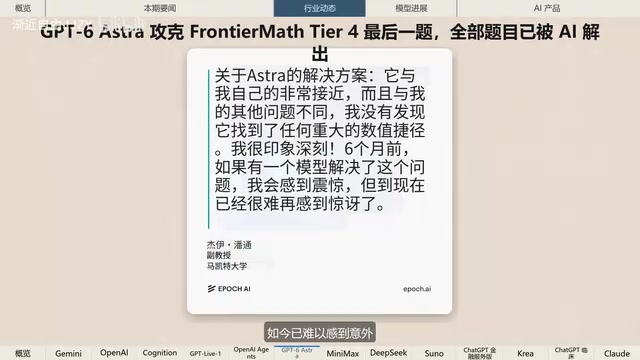
Problem author Jay Panton noted that Astra's solution closely matched his own approach, with no unexpected methods employed. He remarked that six months ago, a model solving this problem would have astonished him — now he can barely be surprised. The numbers tell the story more vividly: when Epoch launched Tier 4, the top score was under 5%; less than 14 months later, it reached 98%. Epoch has concluded that the benchmark is now saturated. Benchmark saturation means that evaluation frameworks must continuously evolve to keep pace with model capabilities — and that pace itself is a portrait of progress.
Frontier Math is a benchmark suite maintained by Epoch AI to evaluate frontier-level mathematical reasoning. Problems are designed by professional mathematicians across areas including competition math, combinatorics, and number theory, and are organized into difficulty tiers. Unlike common academic benchmarks such as MATH or GSM8K, Frontier Math problems are deliberately designed to avoid solution paths already available on the internet, reducing the chance that models answer by recalling training data. Benchmark saturation is a recurring phenomenon in AI evaluation: when state-of-the-art models approach perfect scores on a test set, that benchmark loses its ability to differentiate between models. This drives evaluation organizations to continually release harder problem sets, creating an ongoing race between model capability and benchmark design. Tier 4 went from launch to saturation in just 14 months — a timeline that itself illustrates the current pace of model iteration.
GPT-Live-1 API Opens, Full-Duplex Voice Interaction Upgraded
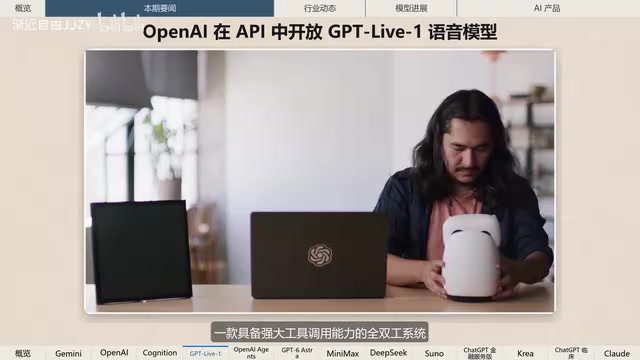
OpenAI announced that GPT-Live-1 is now available via API. It is a full-duplex system with powerful tool-calling capabilities, allowing developers to integrate ChatGPT-style natural conversation into their applications — with simultaneous speaking and listening, support for user-selected models, and an Agent Harness.
According to OpenAI, GPT-Live-1 significantly outperforms GPT Real-Time 2.1 on the benchmarks most critical for production-grade voice agents — including task completion, multi-turn conversation and turn-taking, model response speed, and tool calling. Full-duplex and low latency are the key thresholds for voice agents to enter real production environments, and this API release gives developers direct access to build voice applications that feel closer to the natural rhythm of human conversation.
In addition, OpenAI's Agents API entered public beta. Developers can use the Codex Harness to build and run cloud-based agents, with OpenAI handling orchestration, rendering, and context management — leaving developers free to focus on the agents themselves.
Full-duplex voice communication means both parties can speak and listen simultaneously, similar to a real human conversation, rather than taking turns like a walkie-talkie (half-duplex). Most voice AI systems previously detected user pauses before responding, leading to noticeable delays and difficulty with interruptions. A full-duplex architecture requires the system to monitor user input in real time while continuously outputting speech, and to adjust on the fly when interrupted — placing much higher demands on the model's streaming inference capabilities and latency control. The combination of low latency and full-duplex is the key technical threshold for evolving voice agents from "voice-enabled chatbots" into "realistic conversational partners," and is a prerequisite for practical deployment of voice interaction in production scenarios like customer service, medical consultations, and real-time assistance.
Competitive Dynamics in Coding and Open-Source Models
The model landscape was equally active in this edition. Cognition released the coding model Sway 2, achieving 50.0% on the Frontier Code benchmark — reportedly within 1 point of stronger models — at 64% lower cost. Deep Sway 1.1 scored 73 points, a few points below GPT-6 Astra, but at only one-quarter of the cost. Cost efficiency is becoming the central competitive selling point in coding models.
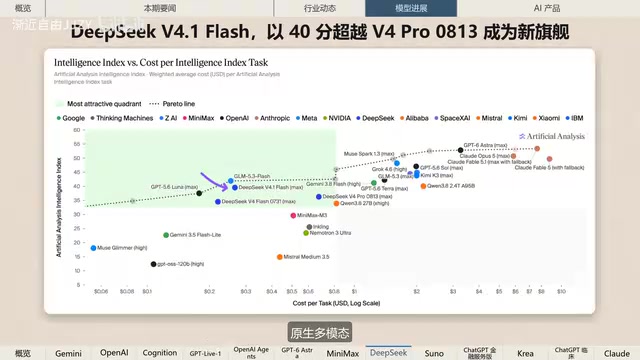
On the open-source front, Artificial Analysis evaluations show DeepSeek V4.1 Flash scored 40 on the Intelligence Index, surpassing V4 Pro to become DeepSeek's new flagship. It features native multimodal input, 8B input active parameters and 16B output active parameters, supports extended context lengths, and is released under an MIT license. In related news, MiniMax announced it has joined the NVIDIA AI Builder Program, giving developers access to over $400 in free credits and discounts, along with model infrastructure and tooling from NVIDIA, LangChain, Hugging Face, Cognition, and others.
Vertical Industry ChatGPT Deployments Accelerate
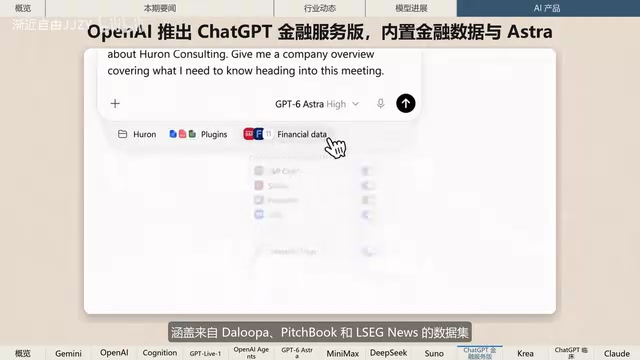
OpenAI's push into vertical domains is also worth noting. ChatGPT for Financial Services combines built-in financial data with GPT-6 Astra's reasoning capabilities, allowing teams to conduct research, build financial models, and produce customized client materials. Built-in datasets include sources from TheLoop, PitchBook, and others.
In healthcare, OpenAI launched ChatGPT for Clinicians — verified U.S. clinicians can access GPT-6 Astra Pro for free. In HealthBench Professional testing, GPT-6 Astra outperformed all other models. Meanwhile, Krea AI introduced Flux Video Edit, which enables high-precision, ultra-fast replacement of any content in video and is now open for trial. Anthropic's Claude Code also launched a new Diff panel that supports scrolling, clicking, and real-time updates, making it easier to review code while working.
Takeaways
This day's news reveals three clear storylines: AI assistants penetrating OS-level entry points (Gemini vs. Copilot-style competition); large models approaching the human frontier in mathematical research (Millennium Prize problems and benchmark saturation); and the accelerating commercialization of developer tools and vertical industry solutions. OpenAI's Millennium Prize progress has yet to be disclosed in detail and awaits official verification — but the other developments are already tangibly reshaping how developers and professional users work.
Related articles
Automattic Executives Signed Reciprocal Severance Agreements During Mullenweg's Brief Ouster
Automattic's CFO and General Counsel signed reciprocal severance agreements during Matt Mullenweg's brief ouster, covering one year's salary and accelerated equity vesting, raising corporate governance concerns.
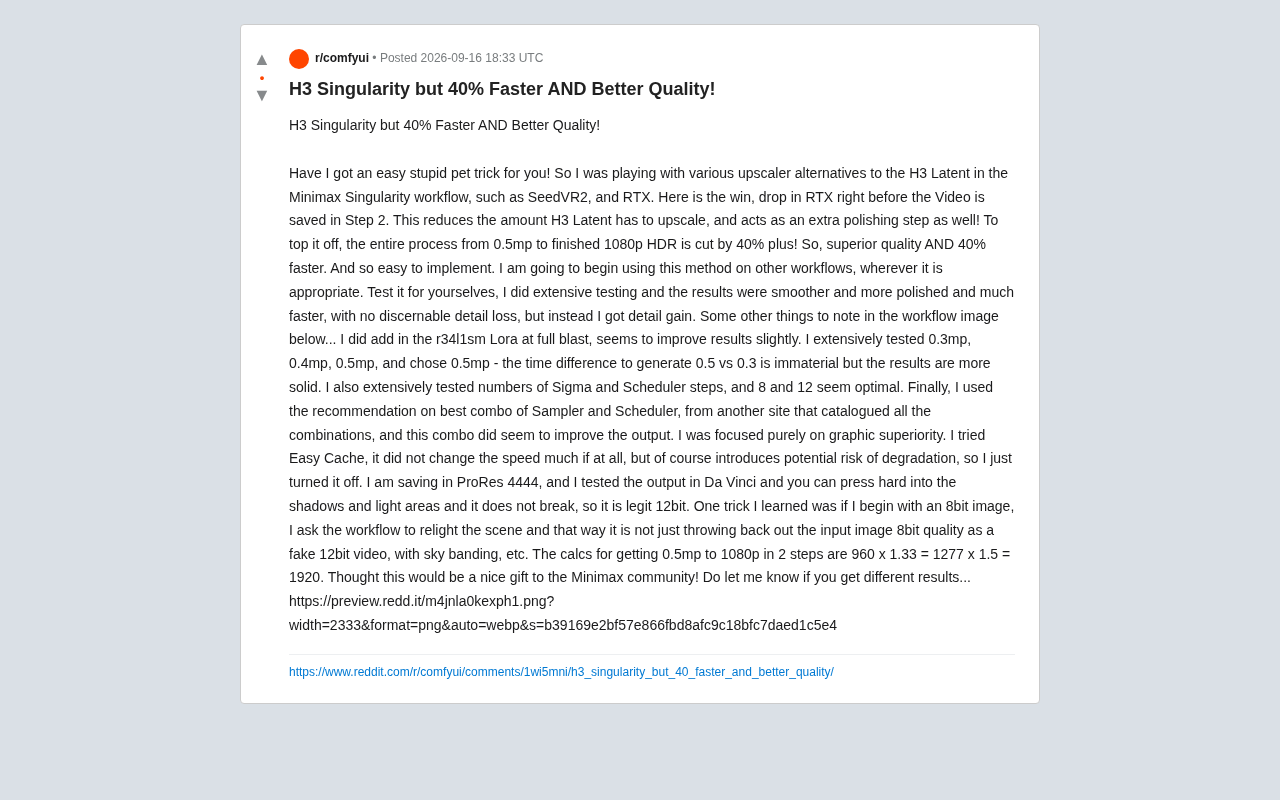
H3 Singularity Optimization: 40% Speed Boost With Better Image Quality
A Reddit user's Minimax Singularity workflow tip: insert an RTX upsampler before H3 Latent for 40%+ speed gains and better quality. Covers parameters, 12-bit output, and more.
Glyph: A Multi-Strategy Agent System for Automated Enterprise Data Catalog Annotation
Glyph is a multi-strategy LLM agent system for enterprise data catalogs that automates column description generation and sensitivity ontology tagging, grounding outputs in pipeline source code to improve accuracy.