Gemini Integrates OpenTable, Canva, and Instacart: AI Assistants Move from Search to Action

Google Gemini integrates OpenTable and other third-party apps, accelerating its shift toward Agentic AI.
Google Gemini has announced integrations with third-party apps including OpenTable, Canva, and Instacart, using Function Calling technology to shift from information retrieval to action execution. This marks the AI assistant industry's entry into the Agentic AI era, with Gemini competing fiercely against ChatGPT and Apple Intelligence for app ecosystem dominance. The future focus will be on who can connect the most services and seamlessly complete tasks for users.
Google Gemini Is Rapidly Expanding Its App Integration Capabilities
Google Gemini is rapidly expanding its app integration capabilities. The latest announcement of integrations with popular apps like OpenTable, Canva, and Instacart marks a critical shift for AI assistants — from "information retrieval" to "action execution."
Gemini's New Features: From Finding Information to Getting Things Done
Google announced on social media that Gemini now supports connections to additional third-party apps, including restaurant reservation platform OpenTable, design tool Canva, and grocery delivery service Instacart. The core philosophy behind this update is clear: Gemini is no longer just helping you find information — it's helping you complete tasks directly.
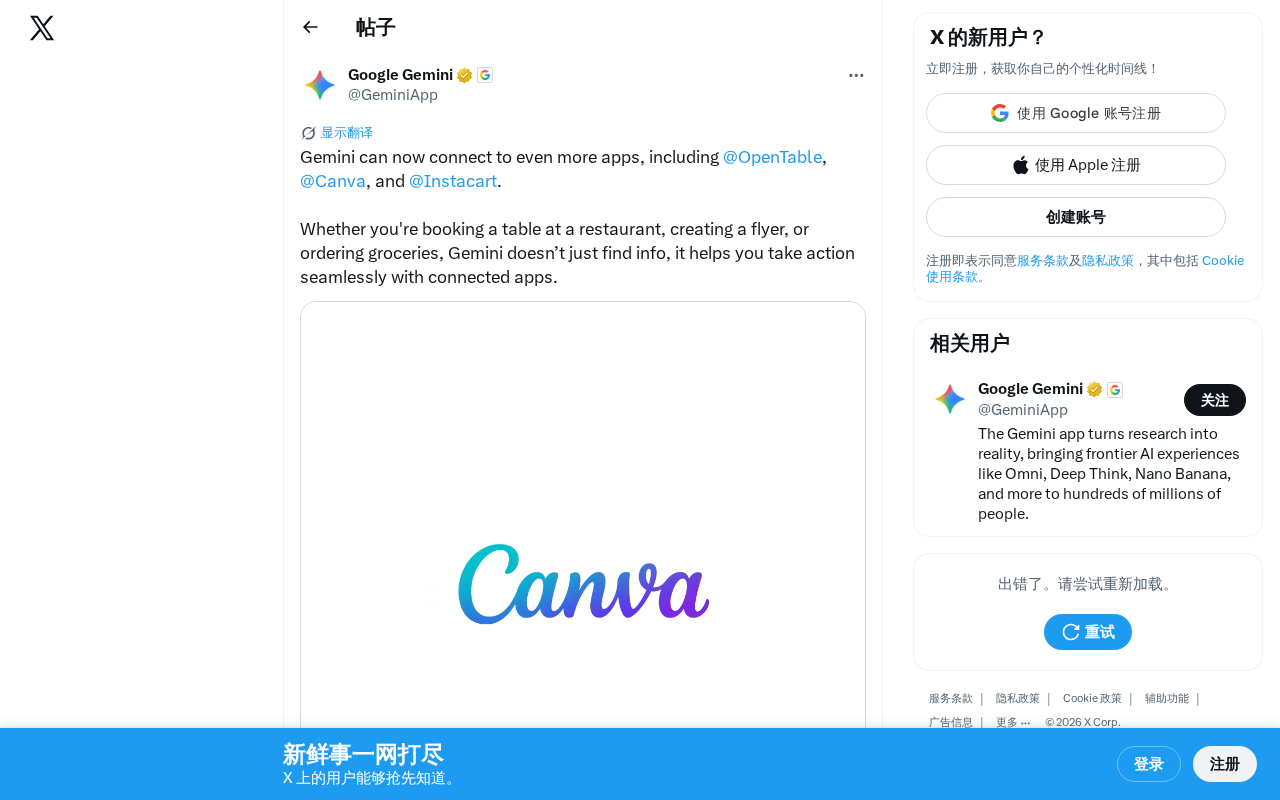
Specifically, users can now use Gemini for the following scenarios:
- Restaurant reservations: Book a table directly through OpenTable without switching apps
- Design creation: Quickly create posters, flyers, and other visual content using Canva
- Grocery shopping: Place orders for everyday groceries through Instacart
The underlying implementation relies on Function Calling technology — the Gemini model identifies "executable actions" within user intent, automatically converts natural language instructions into structured API requests for the corresponding services, and returns the execution results in natural language. The entire process is transparent to the user, who perceives it as conversing with an "all-capable assistant."
The "Action Layer" Competition Among AI Assistants: The Agentic AI Era Has Arrived
This move reflects the core trend in the AI assistant space — the evolution from conversational AI to Agentic AI.
Agentic AI refers to AI systems capable of autonomously planning, making decisions, and executing multi-step tasks, fundamentally different from traditional single-turn Q&A models. Its core architecture typically comprises three layers: task decomposition (breaking complex goals into executable steps), tool invocation (identifying and calling appropriate external APIs or services), and feedback loops (dynamically adjusting subsequent actions based on execution results). This architecture elevates AI from a "question-answering system" to a "problem-solving agent."
Previously, the value of AI assistants was primarily in information aggregation and Q&A. Now, the real differentiation lies in whether they can actually "get things done" for users. Google had already connected Gemini to multiple services within its own ecosystem (such as Gmail, Google Maps, YouTube, etc.), and this further expansion to third-party apps signals that Gemini is building a more open app integration platform.
Gemini vs ChatGPT vs Apple Intelligence: Who Will Become the Unified Gateway?
Interestingly, this strategy closely aligns with OpenAI's ChatGPT plugin ecosystem and Apple Intelligence's app integration approach. All major AI platforms are competing to become the user's "unified gateway":
- ChatGPT: Connects to third-party services through plugins and the GPT Store, using an open plugin specification based on JSON Schema
- Apple Intelligence: Deeply integrates app capabilities within the iOS ecosystem, leveraging system-level permissions for tighter native integration
- Gemini: Leverages Google's ecosystem advantages, gradually expanding third-party connections through its proprietary Extensions framework
Notably, the three platforms have significant divergences in their technical standards for app integration. Anthropic has additionally introduced the MCP (Model Context Protocol), attempting to establish a cross-platform open standard. This fragmentation of standards means developers currently need to build separate interfaces for different platforms. Whoever establishes a developer ecosystem moat first will hold a decisive advantage in this competition.
All three share the common goal of enabling users to complete complex cross-app tasks within a single conversational interface, reducing the friction of app switching.
Real-World Use Cases: What Does a Seamless Action Experience Look Like?
The value of this "seamless action" capability lies in scenario chaining. Here are a few examples:
A user could tell Gemini, "Find me an Italian restaurant suitable for a date on Saturday night and book a table for two." Gemini can not only recommend restaurants but also complete the reservation directly through OpenTable. Or say, "Design a weekend promotional poster," and Gemini can invoke Canva's design capabilities to generate the artwork directly.
The key to this experience is contextual continuity — once the AI understands your intent, it can invoke the appropriate tools to complete tasks without interrupting the conversation flow. However, achieving truly seamless cross-app contextual continuity is technically non-trivial: the system must simultaneously handle long context window management (Gemini 1.5 Pro already supports up to 1 million tokens of context), intent tracking across multi-turn conversations, cross-service authentication and permission management, and error recovery mechanisms when task execution fails. The reliability of these capabilities in complex task scenarios remains a widely acknowledged technical challenge in the industry. Compared to manually switching back and forth between multiple apps, the efficiency gains are obvious, but users should also maintain a healthy habit of verifying AI execution results.
The Future Direction of Gemini's App Ecosystem
As more apps integrate into the Gemini ecosystem, Google is positioning its AI assistant as a true "digital action hub." The future competitive focus will no longer be about whose model is smarter, but about who can connect to more services and help users complete real-world tasks more seamlessly.
For developers, integrating with AI assistant platforms could become a new channel for user acquisition — much like how "listing on the App Store" became standard practice during the mobile internet wave, "integrating with mainstream AI assistants" may become the traffic gateway logic of the next era. For everyday users, the practical value of AI assistants is evolving from "interesting toy" to "indispensable tool."
Key Takeaways
- Gemini has added integrations with three major apps: OpenTable, Canva, and Instacart
- AI assistants are shifting from information retrieval to action execution, powered by Function Calling technology for cross-app task automation
- Competition between Google, OpenAI, and Apple over AI app ecosystem gateways is intensifying, with a parallel battle over technical standards
- Users can complete restaurant reservations, design creation, and grocery shopping through a single conversational interface
- Agentic AI has become the industry's core development direction, though reliability in complex task scenarios remains an unsolved challenge
Related articles
 Tech Frontiers
A Rare Quiet Day in AI: Recursive Self-Improvement Stirs Beneath the Surface
A rare quiet day in AI sees multiple sources go silent simultaneously. Behind the calm, Recursive Self-Improvement (RSI) research continues. What this means for the industry.
 Tech Frontiers
Reve 2 vs. Ideogram 4: A Deep Dive into Layout Control in AI Image Generation
A deep comparison of Reve 2 and Ideogram 4's layout control capabilities, covering technical approaches, real-world use cases, and industry trends for designers and creators.
 Tech Frontiers
In the Weights: Check Your Influence Score in the AI World
In the Weights is an AI influence search engine that quantifies your presence in the AI world with a score. Explore how it evaluates practitioners and what it means for digital identity.