Gemini Omni 1.1 Flash Released: Generative Video Enters the Era of Control
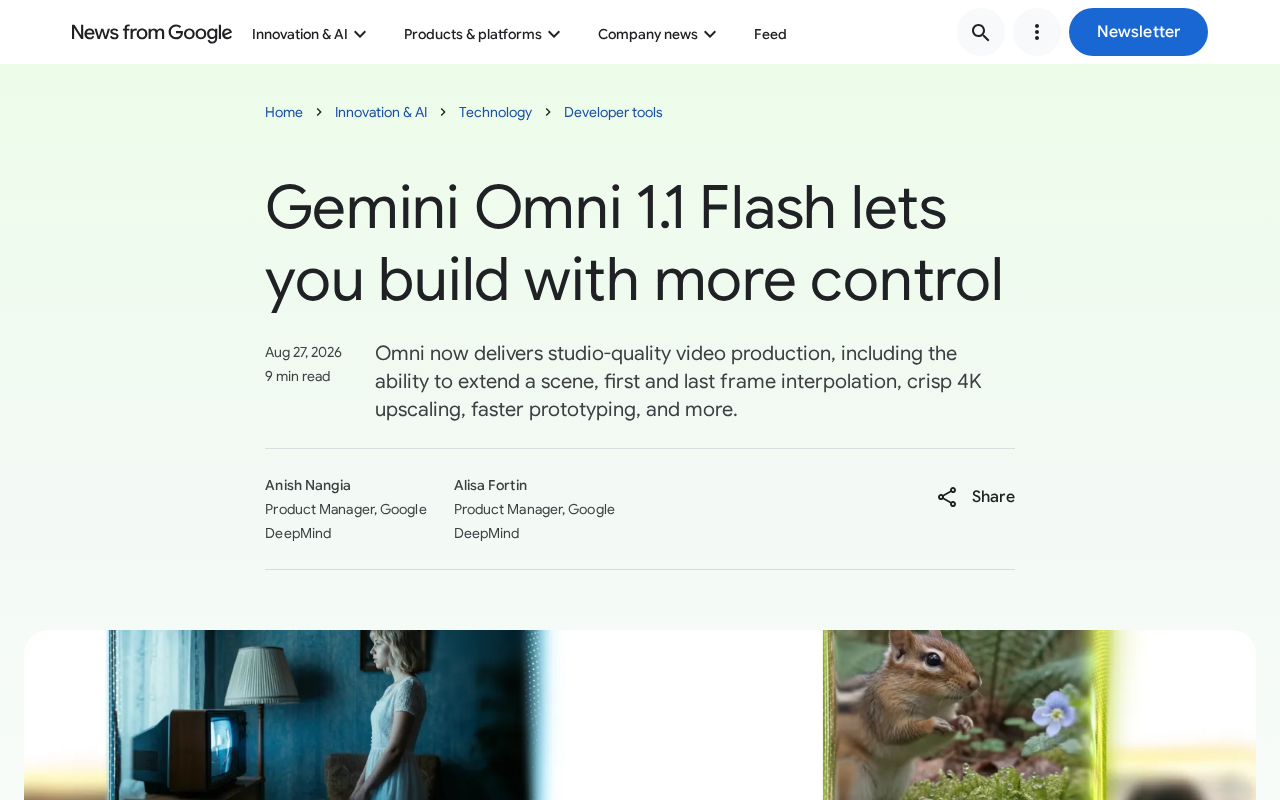
Gemini Omni 1.1 Flash brings controllable, production-ready AI video with scene extension and 4K output.
Google DeepMind's Gemini Omni 1.1 Flash upgrades AI video generation with four core features: 10-second scene extension for narrative continuity, first/last frame control for precise camera movement, 4K upsampling for professional delivery, and a 360p draft mode that's 60% faster at one-third the cost. Already integrated into Adobe Firefly, Figma Weave, and Runway, it marks AI video's shift from experimental demos to production-ready creative infrastructure.
Google Launches a Production-Grade Video Generation Model
On August 27, 2026, Google DeepMind officially released Gemini Omni 1.1 Flash, a major upgrade aimed at developers. Compared to the original Omni, which brought "real-world reasoning capabilities" to generative creation, version 1.1's core goal is to make generative video truly "production-ready" — no longer just an impressive demo, but a tool that can be embedded into professional creative workflows.
The keyword driving this transformation is control. Previously, the biggest pain point in AI video generation was the unpredictability of results: you input a prompt, the model gives you an output, but it's nearly impossible to precisely specify how the camera moves, how a scene continues, or where a frame begins and ends. This unpredictability stems from the fundamental nature of the dominant video generation architecture — Diffusion Models generate content by progressively denoising from random noise, and that randomness is both the source of creativity and the enemy of control. Omni 1.1 introduces a suite of creative control features aimed at turning "generating video" into "directing video," introducing deterministic constraints while preserving generative capability.
Developers can now access the model directly through the Gemini API in Google AI Studio, or via the enterprise-grade Gemini Enterprise Agent Platform. All Google AI Plus, Pro, and Ultra subscribers can also experience the full feature set in Google Flow.
Five Major Capability Upgrades
Scene Extension: Longer Narrative Context
The most anticipated upgrade in Omni 1.1 is Scene Extension. Previous models could only reference the last second of footage when extending video, leading to jarring transitions and content drift. Version 1.1 can analyze up to 10 seconds of preceding context, significantly improving visual consistency and narrative coherence.
The core technical challenge this addresses is the "temporal consistency" problem in video diffusion models. Current mainstream video generation models are based on diffusion architectures that work by starting from pure noise and gradually denoising to produce clear video frames. However, diffusion models are inherently designed to handle fixed-length sequences. When extending existing clips, the model can only see a limited context window, making it highly prone to "content drift" — sudden changes in character appearance, background shifts, and other inconsistencies. Omni 1.1 extends the context window from roughly 1 second to 10 seconds, essentially introducing a longer conditioning sequence during inference, allowing the model to reference richer temporal information to constrain the visual properties of newly generated frames. This follows the same technical philosophy as extending context windows in large language models.
Developers can incrementally extend videos in 10-second segments, with a cumulative total length of up to 40 seconds. This means creators can build longer continuous storylines and even "branch" new creative directions from existing clips. Google's examples include cinematic dolly-zoom shots, 360-degree orbit shots, and time-freeze effects — all maintaining shot continuity with no visible cuts. Notably, the dolly-zoom (also known as the "vertigo effect" or "Hitchcock zoom") is a classic cinematography technique — the camera pushes forward while the lens zooms out (or vice versa), creating a visual effect where the background warps while the subject remains the same size. This type of complex cinematic language previously relied entirely on physical filming and precision mechanical equipment. The fact that an AI model can now understand and generate it marks a significant advancement in generative video's grasp of "cinematic grammar."
The API call is straightforward — simply pass a previous_interaction_id through client.interactions.create to extend the previous video:
from google import genai
client = genai.Client()
interaction = client.interactions.create(
    model="gemini-omni-1.1-flash",
    previous_interaction_id=previous_video_interaction.id,
    input=[{"type": "text", "text": "Continue the scene."}],
    response_format={"resolution": "360p"},
)
First and Last Frame Control: Precise Camera Movement
The second key capability is First and Last Frame specification. Developers can define a shot's starting frame and ending frame, and Omni 1.1 will generate a continuous transitional video between the two keyframes.
The technical foundation of this feature comes from Conditional Generation. In traditional film and animation production, "keyframe animation" is a core workflow: animators only need to define poses or frames at key time points, and in-between frames are automatically filled by interpolation algorithms. The motion curve editors in Adobe After Effects, Blender, and similar tools are classic embodiments of this concept. Omni 1.1 transplants this idea into the realm of generative AI — users provide start and end frames as strong constraints, and the model performs interpolation-style diffusion denoising in the latent space between the two frames, generating physically plausible and visually coherent transitional video. This approach is far more deterministic than pure text prompts, because images inherently carry far greater information density than natural language descriptions.
Whether it's orbital camera moves, zoom transitions, or seamless looping clips, precise control can be achieved by defining the first and last frames. This essentially brings the "keyframe animation" mindset from traditional filmmaking into AI generation, shifting cinematic language from random to designable. For creators who need seamless looping videos for digital signage, social media animated covers, or game cutscenes, looping video with matching first and last frames is a high-frequency need — the practical value of this feature speaks for itself.
4K High-Resolution Output
Omni 1.1 supports upsampling final output to 1080p or 4K resolution, producing results directly usable in professional production. This fills the last gap in AI-generated video's "deliverable quality" — previously, many AI videos couldn't enter real commercial pipelines due to insufficient resolution, but 4K-level output now makes professional delivery possible.
From a technical implementation standpoint, upsampling AI-generated video from low resolution to 4K is not simple bilinear interpolation upscaling, but relies on Super Resolution technology. Modern super-resolution models are also based on diffusion architectures — they use low-resolution video frames as conditions and "hallucinate" realistic detail textures in the higher-resolution pixel space, including individual hair strands, skin textures, and architectural surface materials. For professional content pipelines, 4K (3840×2160 pixels) is the current mainstream broadcast and streaming delivery standard, with platforms like Netflix and YouTube requiring content to meet this resolution level. Omni 1.1's 4K output capability means AI-generated assets can enter these standardized pipelines directly, without additional quality compromises or cumbersome post-processing enhancement steps.
Video Reference Input
The model also supports referencing up to three seconds of video clips in multimodal input to maintain visual context and character consistency. Google's examples showcased replacing three dancer videos with custom characters (a dog, an octopus, and a bear) performing classical dance, hip-hop, and street dance respectively in complex scenes, ultimately composited into a single continuous shot with no cuts.
This capability addresses the long-standing "identity consistency" challenge in generative AI. In previous models, even when using identical text descriptions, the model would produce characters with noticeably different appearances across different generation batches — hair color, body proportions, and outfit details could all vary. By introducing short video clips as visual anchors, the model can extract character appearance feature vectors and use them as persistent constraints in subsequent generation. This is a significant breakthrough for creative applications requiring high character consistency, particularly in serialized content creation for brand IP characters and cross-scene reuse of animated characters.
Cost Optimization: 360p Draft Mode
Beyond capability improvements, Omni 1.1's consideration of engineering efficiency is equally noteworthy. Google has introduced a 360p preview mode that generates up to 60% faster than standard 720p at just one-third the cost.
The philosophy behind this design comes from the "Rapid Prototyping" methodology in software engineering. In traditional software development, engineers first build low-fidelity prototypes to validate core logic, then invest resources in polishing details once the direction is confirmed. This mindset is equally critical in visual creation. Take video ad production as an example: a 15-second commercial typically goes through dozens of creative iterations. If each iteration is generated at 720p or higher, not only does wait time increase, but API call costs escalate rapidly. According to Google's published data, the 360p mode offers a 60% speed increase and reduces cost to one-third, meaning creators can explore nearly three times as many creative variants on the same budget. This economic advantage is particularly important for marketing teams that need extensive A/B testing and film/TV previsualization (previs) teams that need to quickly validate storyboards.
Google's demonstrated "Draft Room" concept application embodies this approach: generate 3-4 draft variants at 360p, changing only one variable each time, compare them side by side, and then upscale the selected option to 4K. This "explore cheaply first, refine expensively later" workflow essentially brings iterative thinking from software development into creative production. This staged rendering approach actually has mature precedent in the film industry — VFX studios like Pixar and Industrial Light & Magic use low-resolution proxy files for editing and review during production, only enabling full-resolution rendering for final output. Omni 1.1's draft mode essentially builds this industry best practice directly into the AI generation workflow.
Ecosystem Integration: Adobe, Figma, and Runway Already On Board
Omni 1.1 was not released in isolation — it has already entered the production environments of several leading creative tools, which indirectly confirms the model's maturity. This deep integration reflects a structural trend in the AI video generation industry: evolution from "standalone application" to "platform infrastructure."
- Adobe has integrated Gemini Omni Flash into Adobe Firefly for video editing capabilities. Adobe Firefly is the generative AI brand Adobe launched in 2023, now covering image generation, video extension, design assistance, and other creative domains, deeply embedded in flagship products like Photoshop, Premiere Pro, and After Effects. Choosing to integrate an external model rather than relying solely on in-house technology indicates Adobe is adopting a "multi-model strategy" to provide users with optimal generation results.
- Figma Weave Creative Director Itay Schiff described it as "one of the strongest video models" in Weave, noting that combined with scene extension, rich reference assets, and 4K resolution, it enables teams to "truly go from generating video to directing video." Figma Weave is the AI creative toolset launched by design collaboration platform Figma in 2025, designed to integrate generative AI capabilities into UI/UX design workflows, with a user base encompassing a large number of product designers and brand teams.
- Runway Chief Creative Officer Jamie Umpherson noted that Omni Flash naturally fits users' existing habits of "starting from prompts, images, or video and then generating edits." As a pioneer in the AI video space, Runway's Gen-series models were among the earliest video generation tools aimed at creators, boasting a vast creative professional user base. Runway's choice to integrate Google's model as a supplementary option demonstrates that the industry is forming a layered architecture of "model providers + application platforms" — similar to the relationship between IaaS and SaaS in cloud computing.
- GMI Cloud VP of Marketing Louisa Guo specifically highlighted the model's accuracy — for educational and science communication content, reliability of details matters more than any single feature, and Omni makes AI video viable for this previously hard-to-serve niche. This assessment touches on a critical trust threshold for AI video generation: when generated content involves scientific demonstrations, medical visualization, or historical recreation, the accuracy of visual details isn't just about aesthetics — it's about the correctness of information delivery. The model's "hallucination" problem (generating content that looks plausible but is actually incorrect) is especially dangerous in these scenarios.
The "Production-Ready" Inflection Point for AI Video
The release of Gemini Omni 1.1 Flash marks generative video's transition from "can generate" to a new stage of "controllable, deliverable, and affordable." Scene extension, first-and-last frame control, 4K upsampling, and low-cost draft mode — these four capabilities collectively answer a core question: how to truly integrate AI video into professional creative workflows.
Interestingly, Google chose not to pursue the ultimate single-generation quality, but instead focused on developer control and engineering efficiency — which is precisely the necessary path from lab to production. This strategic choice aligns with the broader "controllability" trend in AI: just as large language models evolved from early free-form text generation to supporting structured output, function calling, and system prompts, video generation models are also undergoing a transformation from "black-box magic" to "precision tools." The ceiling of technical capability certainly matters, but what truly determines commercial value is often controllability, reproducibility, and compatibility with existing toolchains.
With deep integrations from Adobe, Runway, and other tools, AI video generation is transforming from a standalone "magic tool" into "infrastructure" embedded within existing creative pipelines. For developers, now is the window to build the next generation of creative applications. From a technology adoption curve perspective, when a technology completes the three-stage leap from "functional" to "user-friendly" to "integrable," it typically signals it's about to enter the phase of scaled adoption — and that's exactly where Omni 1.1 stands.
Key Takeaways
Related articles

OpenAI Partners with Shield: How the Astra Agent Revolutionizes IT Troubleshooting
OpenAI and Shield launch the Astra agent, which autonomously logs into computers and legacy systems to fix IT issues in real time, 35-40% faster than traditional models, with humans involved only when judgment is needed.

iPhone Duo Battery Life Tested: One Charge a Day Is Unavoidable, and the Large Screen Is the Culprit
iPhone Duo battery test: heavy use needs at least one charge a day, and about 30% remains after 6.5 hours of screen-on time. How often the large screen is unfolded is key; a MagSafe battery pack helps, and long-term degradation is also worth watching.

Kimi K3.1 Pro Open-Sourced: 2.8 Trillion Parameters Close In on Opus
Moonshot releases the open-source MoE model Kimi K3.1 Pro, with 2.8T total parameters and 104B activated, trailing Opus 5.5 by under 1 point on Terminal Bench 4.0.