Gemini Omni Officially Launches: Community Floods with Stunning Multimodal Apps Within One Week

Google launches Gemini Omni multimodal AI model, sparking a flood of community apps within one week
Google has officially released the Gemini Omni multimodal AI model, featuring native processing capabilities across text, images, audio, and video. Within just one week of launch, the community produced a wave of innovative applications, showcasing the maturity of the developer ecosystem. Built on an end-to-end native multimodal architecture, the model marks a transition of multimodal AI from tech demos to real-world deployment, though inference costs, hallucination issues, and compliance challenges remain.
Gemini Omni Is Here
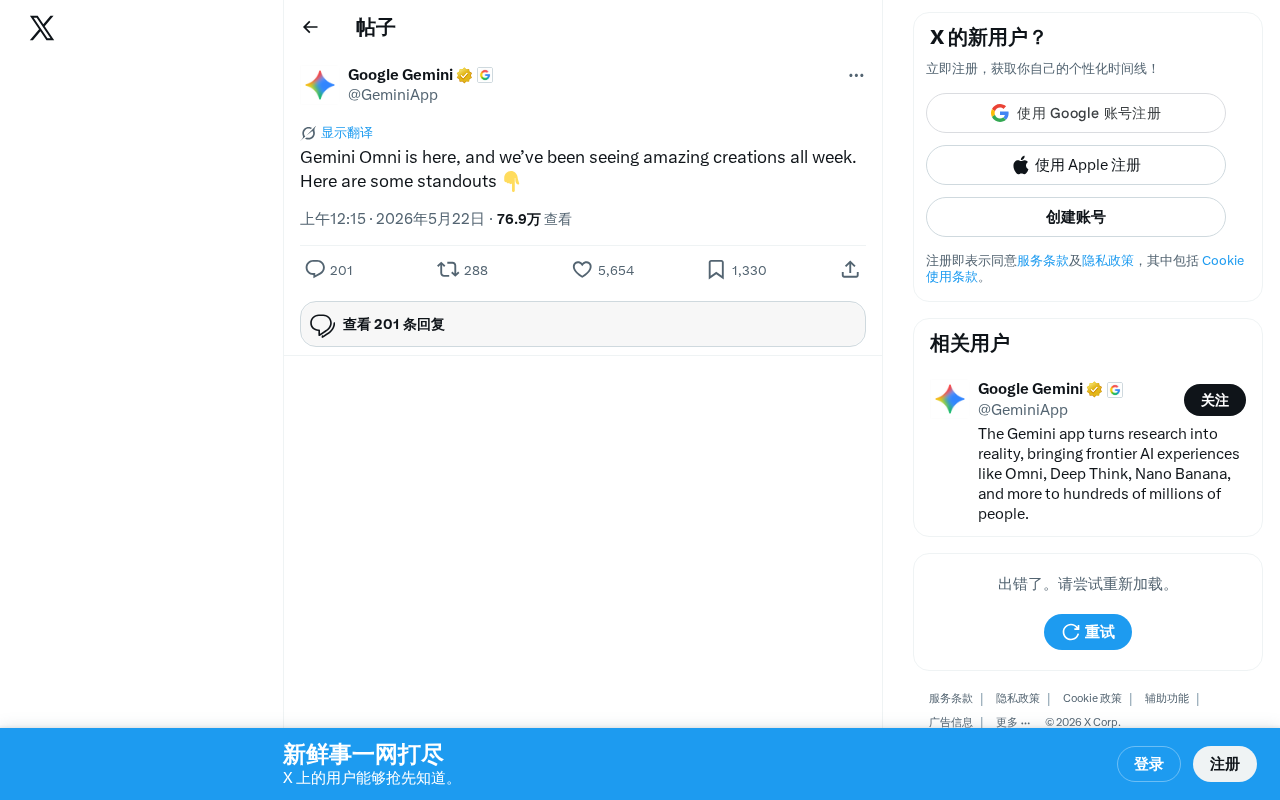
Google's Gemini Omni model has officially launched, and this multimodal AI model has attracted widespread attention from the developer and creator community within just one week of its release. Based on shares from Google's official account, the community has already produced a wave of impressive creative applications.
What Is Gemini Omni
Gemini Omni is Google's all-in-one multimodal AI model. "Omni" comes from Latin, meaning "all" — hinting at the model's comprehensive capabilities in processing text, images, audio, video, and other data modalities. Compared to previous Gemini versions, Omni delivers significant improvements in cross-modal understanding and generation.
Multimodal AI refers to artificial intelligence systems capable of simultaneously processing and understanding multiple types of data. Unlike earlier single-modality models, multimodal models encode different types of information into a unified semantic space through a unified neural network architecture, enabling cross-modal understanding and generation. Key milestones along this technology path include OpenAI's GPT-4V, Google's Gemini series, and Meta's multimodal LLaMA variants. Notably, the core philosophy behind the "Omni" architecture closely mirrors OpenAI's GPT-4o — both aim to natively support multimodal input and output within a single model, rather than stitching together multiple specialized models. This end-to-end native multimodal design offers lower latency, stronger cross-modal reasoning capabilities, and a more consistent user experience compared to cascaded architectures.
Core Capability Upgrades
Based on community feedback, Gemini Omni's core strengths are concentrated in the following areas:
- Multimodal Fusion Understanding: Capable of simultaneously processing and understanding multiple input types, enabling more natural human-computer interaction
- Creative Generation: Outstanding performance in content creation, design assistance, and similar scenarios
- Real-time Interaction Experience: Noticeable improvements in response speed and interaction fluidity
Community Creation Frenzy: An Explosion of Apps Within One Week
Judging from Google's curated "standouts," the developer community explored a wide variety of innovative uses for Gemini Omni in just one week. This rapid community response reveals several important trends:
A Maturing Developer Ecosystem
When a new model can spawn a large number of high-quality applications within an extremely short time after launch, it indicates that the AI developer ecosystem has become quite mature. Developers no longer need to start from scratch — they can quickly integrate a new model's capabilities into their existing workflows.
The maturity of the AI developer ecosystem can be measured across multiple dimensions: the completeness of SDKs and APIs, the quality of community documentation, the richness of third-party integration tools, and the average Time-to-Value — the time it takes a developer to go from first contact with a new model to producing a usable application. The emergence of numerous high-quality applications within one week demonstrates that Google's sustained investment in developer toolchains (such as Google AI Studio and Vertex AI) and documentation systems has produced significant results. It also reflects that the developer community has accumulated sufficient experience in building multimodal applications.
Multimodal Applications Entering an Explosive Growth Phase
Multimodal AI is transitioning from the "tech demo" stage to the "real-world deployment" stage. The release of Gemini Omni has further lowered the barrier to developing multimodal applications, enabling more creators to leverage AI's cross-modal capabilities to realize previously unimaginable ideas.
However, real-world deployment still faces several challenges that cannot be ignored. First is inference cost — the computational overhead of multimodal models is typically far higher than that of text-only models, making cost control in high-concurrency scenarios critical. Second, hallucination issues are harder to detect and correct in cross-modal contexts. Additionally, compliance concerns such as copyright attribution and privacy protection involving images and video are becoming increasingly prominent. These challenges mean there is still considerable distance between technical feasibility and large-scale commercialization of multimodal AI.
Industry Impact and Future Outlook
The launch of Gemini Omni is a strategic move by Google in the AI race. Against a backdrop of competitors like OpenAI and Anthropic continuously releasing new products, Google has used Omni to showcase its deep technical expertise in multimodal AI. While Anthropic's Claude 3 series also supports image input, it has not yet achieved the same level of native audio and video processing, giving Gemini Omni a temporary advantage in full-modality coverage.
For everyday users and developers, the practical significance of Gemini Omni lies in:
- Lower Barrier to Entry: An all-in-one model means users don't need to switch between multiple specialized models
- Richer Application Scenarios: Cross-modal capabilities open up more room for innovation
- More Intense Market Competition: Heightened competition ultimately benefits end users, who will enjoy better product experiences
As the community continues to explore the boundaries of Gemini Omni's capabilities, there is good reason to expect more groundbreaking application cases in the coming weeks. The era of multimodal AI is accelerating.
Key Takeaways
- Google Gemini Omni has officially launched with comprehensive multimodal processing capabilities
- A flood of innovative applications emerged from the community within one week of launch, demonstrating the maturity of the developer ecosystem
- The Omni model adopts a native multimodal architecture, achieving significant improvements in cross-modal understanding and generation
- Multimodal AI is transitioning from the tech demo stage to an explosive real-world application phase, though inference costs and compliance challenges remain
- Intensifying market competition will drive continuous improvements in AI product experiences
Related articles
 Tech Frontiers
A Rare Quiet Day in AI: Recursive Self-Improvement Stirs Beneath the Surface
A rare quiet day in AI sees multiple sources go silent simultaneously. Behind the calm, Recursive Self-Improvement (RSI) research continues. What this means for the industry.
 Tech Frontiers
Reve 2 vs. Ideogram 4: A Deep Dive into Layout Control in AI Image Generation
A deep comparison of Reve 2 and Ideogram 4's layout control capabilities, covering technical approaches, real-world use cases, and industry trends for designers and creators.
 Tech Frontiers
In the Weights: Check Your Influence Score in the AI World
In the Weights is an AI influence search engine that quantifies your presence in the AI world with a score. Explore how it evaluates practitioners and what it means for digital identity.