Gemini Omni Video Editing: The New AI Era Where Conversation Is Editing

Gemini Omni enables video editing through natural language conversation, disrupting traditional editing paradigms.
Google's Gemini Omni transforms video editing from professional timeline operations into natural language conversation. Users simply upload footage and describe their needs in everyday language, and the AI automatically handles cutting, color grading, remixing, and more—reducing the video creation barrier to nearly zero. This marks multimodal large models reaching practical maturity in closed-loop understanding and generation, posing direct competition to traditional editing software in lightweight scenarios.
Conversational Video Editing: The New Paradigm Pioneered by Gemini Omni
Google's latest Gemini Omni brings a disruptive experience to the video creation space. Users simply upload video footage from their phone's camera roll and complete video creation, remixing, and editing through natural language conversation—no timeline, no keyboard shortcuts to memorize, just say what you want and get a finished video.
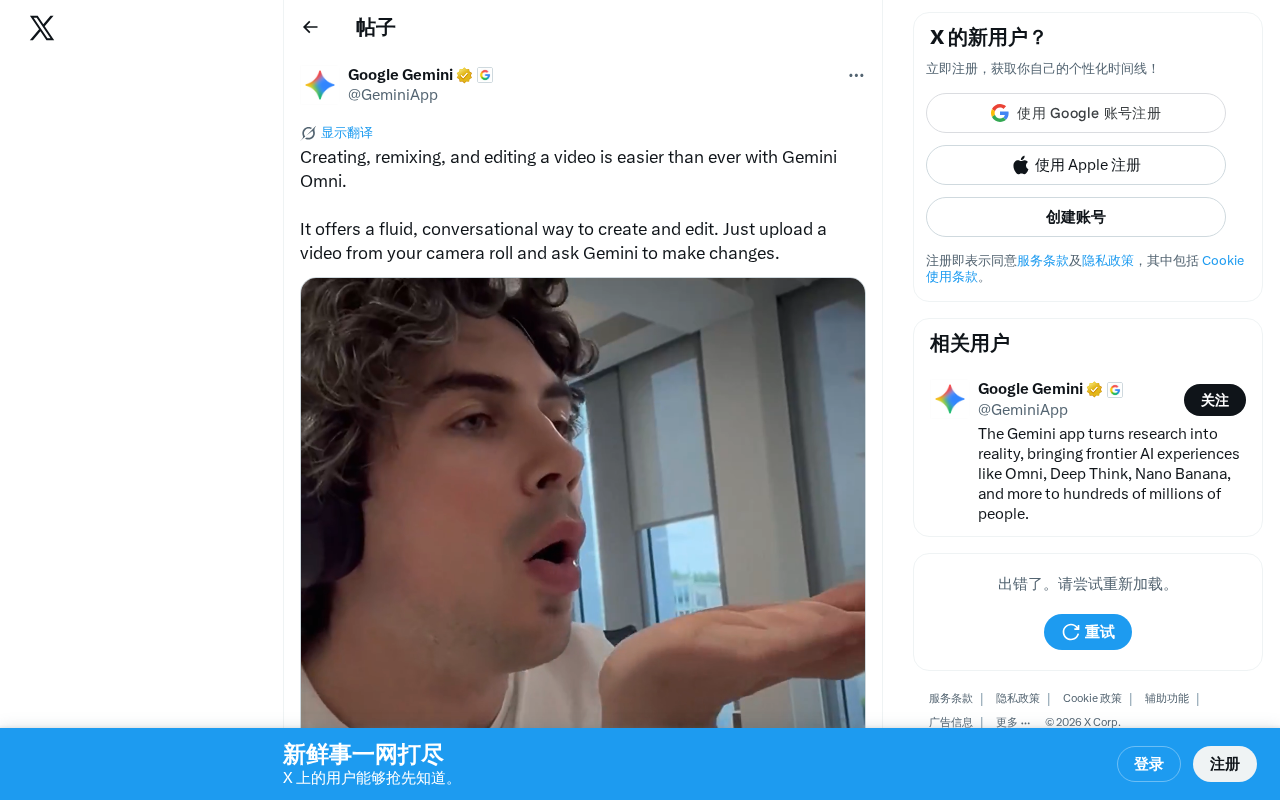
Gemini Omni Core Features: Replacing Complex Operations with Conversation
Professional video editing software like Adobe Premiere Pro, Final Cut Pro, and DaVinci Resolve are built around the core interaction paradigm of "Timeline Editing." This paradigm has remained fundamentally unchanged since Non-Linear Editing (NLE) systems became widespread in the 1990s. Users need to understand numerous professional concepts such as Tracks, Cut Points, Keyframes, Color Spaces, and master dozens or even hundreds of keyboard shortcuts. Research shows that a beginner typically needs tens of hours of learning investment to grasp the basic operations of Premiere Pro. This high barrier is a reasonable price for precise control in professional production environments, but it creates enormous friction for everyday short-form video creation scenarios.
Gemini Omni takes a completely different approach—turning editing into chatting.
You can talk to the AI as naturally as you'd talk to a friend, directly telling it what effect you want:
- "Make this video's color tone warmer"
- "Cut the first 5 seconds of empty footage"
- "Add slow motion to that last shot"
- "Combine these three clips into a 15-second short video"
This interaction style reduces the barrier to video editing to virtually zero. Even people with no editing knowledge can quickly produce decent-looking video content.
AI Video Editing Workflow: From Upload to Finished Product
Three Steps to Complete Video Editing
- Upload footage: Select one or more videos directly from your phone's camera roll
- Describe via conversation: Tell Gemini what edits you want using everyday language
- Get the finished video: The AI understands your intent, automatically completes the editing, and outputs the result
The entire process requires no understanding of technical concepts like video encoding, frame rates, or bitrates. Gemini Omni encapsulates all the complex underlying operations within the model, leaving users with nothing more than a simple chat interface.
It's worth noting that this "encapsulation" involves two independent yet necessarily coordinated core technical challenges: Natural Language Understanding (NLU) and Video Understanding. The former requires the model to accurately parse the intent, objects, and degree in user instructions (e.g., how much is "a bit" in "make it a bit warmer"? Which segment does "that last shot" refer to?). The latter requires the model to possess temporal video understanding capabilities, being able to identify scene transitions, motion states, and visual semantics of frame content. Video understanding is technically far more complex than image understanding because video is a continuous sequence of frames along the temporal dimension, requiring the model to build semantic representations across both spatial and temporal dimensions simultaneously.
Video Remixing and Creative Rearrangement
Beyond basic trimming and color grading, Gemini Omni also supports video remix functionality. You can feed it multiple clips from different scenes and describe your desired narrative rhythm or style in a single sentence, and the AI will automatically perform creative rearrangement.
The technical challenges here are far more complex than they appear on the surface. In film editing theory, Montage theory reveals the profound impact that shot sequencing has on audience emotion and narrative comprehension. For AI to perform meaningful video remixing, it needs to understand abstract concepts like "style" or "rhythm" described by the user and map them to specific editing decisions—which footage goes first, how long transitions should be, whether music beat alignment is needed, and so on. This requires the model to possess a degree of "creative reasoning" capability, not merely executing explicit parameterized instructions.
This feature is especially practical for short-form video creators and social media managers—rapid output from batch footage with a noticeable efficiency boost.
Industry Impact: What AI Video Editing Will Change
Dramatically Lowered Barriers to Video Creation
The emergence of Gemini Omni signals that video editing is transforming from a "professional skill" into a "basic tool accessible to everyone." This trajectory is familiar—AI's transformation of creative tools typically follows a predictable path: first breaking through in text (represented by ChatGPT), then spreading to image generation (Midjourney, Stable Diffusion, DALL-E), and further extending to audio and video. Each breakthrough follows a similar pattern—converting creative acts that previously required professional skills into natural language descriptions, dramatically compressing the execution cost between "idea" and "finished product." The proliferation of image generation AI has already profoundly impacted workflows in design, illustration, and advertising; the maturation of video AI will produce similar or even greater impact on short-form video creation, marketing content production, and personal documentation, since video content occupies a far greater share of current internet traffic structures than text and images.
Impact on Premiere Pro and Final Cut Pro
For traditional editing software like Adobe Premiere Pro and Final Cut Pro, Gemini Omni poses direct competition in everyday lightweight editing scenarios. However, in professional film and television post-production and scenarios requiring frame-by-frame precision adjustments, the precise control capabilities of traditional tools remain irreplaceable.
The two are more likely to form a complementary relationship: AI handles 80% of routine operations while professional tools address the remaining 20% of precision needs.
A Signal of Multimodal AI Maturity
From a technical perspective, video editing places extremely high demands on AI models. The Gemini series represents Google's core strategy in the multimodal direction—Multimodal Large Language Models refer to AI systems capable of simultaneously processing multiple data types including text, images, audio, and video. Unlike earlier models that could only handle a single modality, multimodal models encode different types of information into a unified semantic space through a unified neural network architecture, enabling cross-modal understanding and reasoning. Gemini's underlying architecture was designed from the ground up with native multimodality as its goal, rather than simply concatenating independent vision and language models. This architectural difference gives Gemini stronger semantic consistency when handling cross-modal tasks like "watching video + understanding instructions + executing operations."
The model needs to accomplish three things simultaneously: understand the user's language instructions, understand the video's visual content, and execute precise editing operations based on both. The fact that Gemini Omni can achieve this demonstrates that multimodal large models have reached a practical level in their closed-loop capability of "understanding + generation."
Conclusion
Gemini Omni brings video editing into the conversational AI era. While the currently demonstrated features still lean toward basic scenarios, the interaction mode of "upload footage + natural language conversation" will fundamentally change the cost structure of content creation as it continues to iterate. For ordinary users, producing a decent short video is becoming as simple as posting to social media.
Related articles
 Tech Frontiers
A Rare Quiet Day in AI: Recursive Self-Improvement Stirs Beneath the Surface
A rare quiet day in AI sees multiple sources go silent simultaneously. Behind the calm, Recursive Self-Improvement (RSI) research continues. What this means for the industry.
 Tech Frontiers
Reve 2 vs. Ideogram 4: A Deep Dive into Layout Control in AI Image Generation
A deep comparison of Reve 2 and Ideogram 4's layout control capabilities, covering technical approaches, real-world use cases, and industry trends for designers and creators.
 Tech Frontiers
In the Weights: Check Your Influence Score in the AI World
In the Weights is an AI influence search engine that quantifies your presence in the AI world with a score. Explore how it evaluates practitioners and what it means for digital identity.