Gemini Robotics 2 Explained: Full-Body Control, Multi-Robot Coordination, and On-Device Deployment

Google DeepMind's Gemini Robotics 2 brings full-body humanoid control, multi-robot coordination, and on-device deployment.
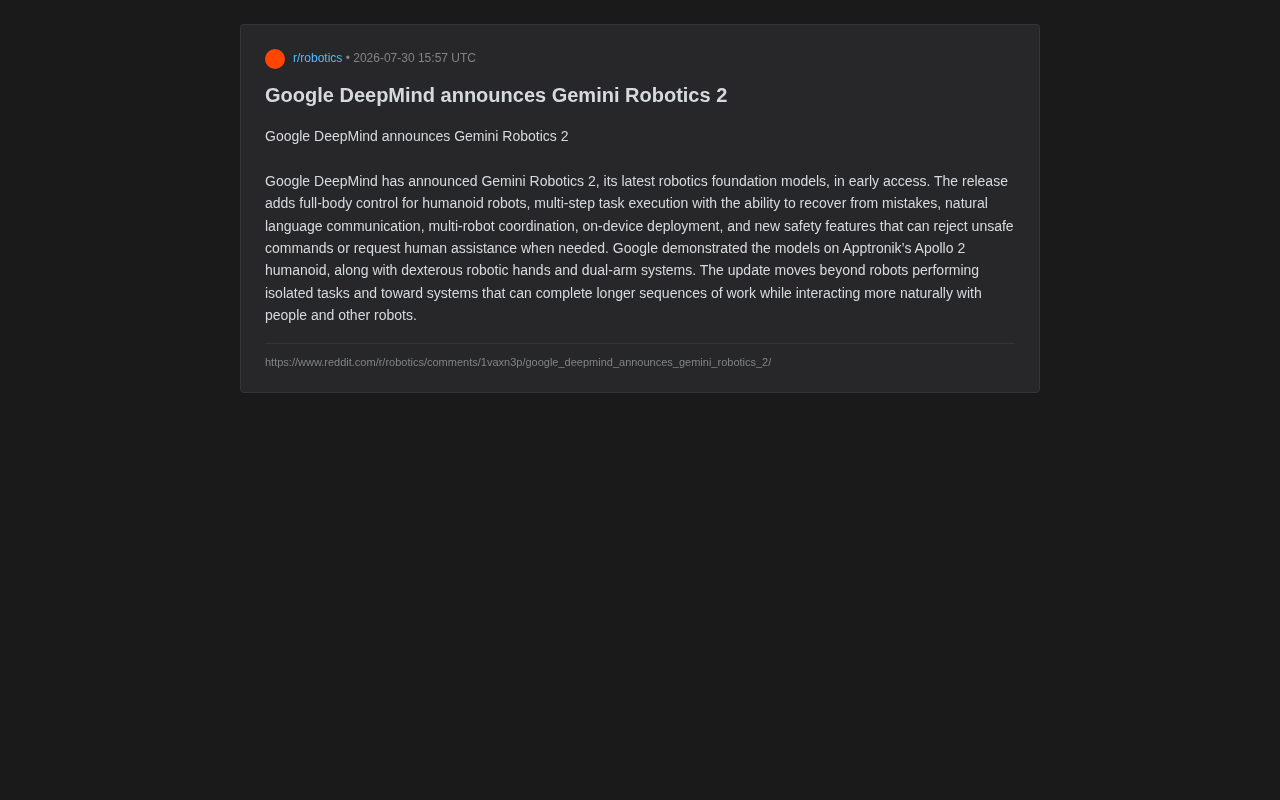
Google DeepMind has launched Gemini Robotics 2, a next-generation robot foundation model now in early access. Key advances include full-body control for humanoid robots (demonstrated on Apptronik's Apollo 2), multi-step task execution with error recovery, natural language interaction, multi-robot coordination, and on-device deployment for low-latency operation. The model also features built-in safety mechanisms that can refuse dangerous commands and request human assistance when uncertain.
Gemini Robotics 2 Officially Unveiled
Google DeepMind recently announced its latest-generation robot foundation model, Gemini Robotics 2, now available in early access. Compared to its predecessor, this update achieves breakthroughs across multiple key dimensions, marking a new phase where general-purpose robot intelligence is evolving from "executing single tasks" to "completing complex, long-sequence work."
A Robot Foundation Model refers to a general-purpose AI model pre-trained on large-scale data that can generalize across various robotic tasks. Unlike traditional robot programming, where control logic is written separately for each task, foundation models borrow from the large language model (LLM) paradigm—learning universal representations from massive datasets, then adapting to specific scenarios through fine-tuning or prompting. This paradigm emerged from the successful validation of Google's RT-2, RT-X, and similar projects in 2022-2023, which proved that Vision-Language-Action (VLA) models could directly map semantic understanding to physical robot actions. Gemini Robotics 2 is the latest iteration of this technical approach.
What makes this release most noteworthy is that it's no longer limited to having robots perform isolated actions. Instead, it builds a system-level capability for long-duration autonomous work and natural collaboration with humans and other robots. This reflects DeepMind's strategic intent to deeply inject large model reasoning and planning capabilities into the physical world.
Core Capability Upgrades: Full-Body Control and Dexterous Manipulation
Gemini Robotics 2 introduces full-body control capability for humanoid robots for the first time. This means the model no longer just controls a robotic arm or end effector—it can coordinate an entire robot's torso, limbs, and balance posture to perform complex movements closer to human motion.
Full-body control is a long-standing challenge in robotics, involving the simultaneous coordination of dozens of degrees of freedom (DoF) in joint movements while maintaining dynamic balance and avoiding collisions. Traditional approaches rely on inverse kinematics (IK) and optimization-based trajectory planning, requiring precise physical models and extensive manual parameter tuning. In recent years, the combination of reinforcement learning (RL) and imitation learning has made end-to-end full-body control policies possible—where models directly map sensor inputs to torque outputs for all joints without explicitly modeling each component. This is especially critical for humanoid robots, since bipedal walking is inherently a highly unstable dynamic system where any slight control delay or torque deviation could cause a fall.
In demonstrations, Google deployed the model on Apptronik's Apollo 2 humanoid robot, while also showcasing dexterous robotic hands and dual-arm system operations. Apptronik is a robotics company headquartered in Austin, Texas, spun out of the University of Texas Human Centered Robotics Laboratory. Its flagship Apollo series humanoid robots stand approximately 1.7 meters tall, weigh about 73 kilograms, and are designed as general-purpose humanoid labor. Apollo 2, as the second generation, features improvements in joint torque density, sensor integration, and battery life. Apptronik's business strategy is to provide standardized hardware platforms open to third-party AI companies for deploying different control brains—this decoupled "hardware platform + AI brain" model is becoming an industry trend. The combination of full-body control and dexterous manipulation gives robots the potential to handle precise tasks in real-world environments.
Multi-Step Task Execution and Error Recovery
Another important advancement is multi-step task execution, with the model now capable of recovering from errors. Traditional robots often fail entire workflows when one step in a long task chain goes wrong. Gemini Robotics 2 can identify execution deviations and self-correct, significantly improving system robustness in unstructured environments.
From a technical perspective, multi-step task execution requires three core capabilities: task decomposition, state monitoring, and re-planning. Implementation typically relies on a hierarchical architecture: a high-level planner decomposes natural language instructions into sub-goal sequences, mid-level policies handle motion generation for each sub-goal, and low-level controllers execute precise joint actuation. Error recovery requires the model to possess a "world model"—a continuous predictive capability for the physical environment's state that triggers re-planning when actual states deviate from expectations. This stands in stark contrast to traditional industrial robots' "open-loop execution," which simply halts and reports errors when deviations exceed tolerance, requiring human intervention to restart.
This "fault tolerance" capability is one of the critical thresholds for robots to become practical. The real world is full of uncertainty—failed grasps, dropped objects, and blocked paths are all common occurrences. The ability to autonomously recover means robots can continue working with far less human intervention.
Innovations in Collaboration and Deployment
Natural Language Interaction and Multi-Robot Coordination
Gemini Robotics 2 supports natural language communication, allowing users to communicate instructions to robots using everyday language, while robots can report execution status in more natural ways. This lowers the barrier for human-robot interaction, enabling non-specialists to operate complex robotic systems.
Natural language interaction for robots has evolved from keyword matching and slot filling to end-to-end semantic understanding. Early systems required users to issue fixed-format commands (e.g., "pick up red block"), while modern VLA models can understand ambiguous, context-dependent natural expressions (e.g., "put that thing over to the side"). This is enabled by the semantic representation capabilities of large language models—the model encodes language instructions into high-dimensional vectors, which are fed into the policy network alongside visual observations to directly generate actions. The Gemini series' inherent multimodal capabilities (simultaneously understanding text, images, and video) provide a natural advantage for this deep fusion, enabling robots not only to understand instructions but also to interpret references and implicit intent within those instructions based on visual context.
Furthermore, the model introduces multi-robot coordination capability. Multiple robots can collaborate to complete the same task, opening up possibilities for scenarios requiring scaled deployment such as warehouse logistics and smart manufacturing. Multi-robot coordination is a classic problem in distributed artificial intelligence, with core challenges including: task allocation (who does what), conflict avoidance (spatial and resource competition), communication protocols (bandwidth and latency of information sharing), and fault tolerance mechanisms (task reassignment when a robot fails). Gemini Robotics 2's innovation lies in using large language models as a "shared cognitive layer"—multiple robots describe their own states and intentions through natural language, coordinated by a central model or decentralized protocol, dramatically reducing the engineering complexity of multi-robot systems. When robots can not only understand human intent but also coordinate with each other, overall operational efficiency undergoes a qualitative transformation.
On-Device Deployment Reduces Latency
Notably, Gemini Robotics 2 supports on-device deployment. This means some model capabilities can run directly on the robot itself without continuous reliance on cloud connectivity.
On-device deployment faces enormous engineering challenges: compressing models with tens of billions of parameters to run on the limited computational resources available on a robot. Key technologies include model quantization (reducing FP32 precision to INT4/INT8), knowledge distillation (training smaller models using large model outputs), sparse pruning, and the use of dedicated inference chips (such as NVIDIA Jetson series or Google's custom edge TPU variants). For robots, on-device inference response latency typically needs to be kept under 50 milliseconds for smooth real-time control, while cloud-based inference often incurs 100-500 milliseconds of latency due to network round trips—unacceptable for fast grasping, balance adjustments, and similar scenarios.
On-device deployment brings three major advantages: lower response latency, stronger data privacy protection, and operational reliability in network-constrained environments. Typical deployment scenarios such as factory floors, underground warehouses, and outdoor construction sites often have unstable network coverage—on-device capability is a hard engineering requirement for robot products transitioning from the lab to real-world deployment.
Safety Mechanisms: Refusing Dangerous Commands and Requesting Human Assistance
As robot capabilities strengthen, safety issues become increasingly critical. Gemini Robotics 2 incorporates new safety features: when the model determines an instruction is unsafe, it can proactively refuse to execute; when encountering situations beyond its capabilities or involving risk, it can request human assistance.
Robot safety is highly related to the "alignment" problem in large language models, but adds the dimension of physical-world irreversibility—errors in text generation can be deleted and redone, but dangerous robot actions can cause personal injury or property damage. Therefore, embodied AI safety mechanisms typically include multiple layers of protection: intent-level safety review at the instruction layer (refusing commands like "throw the knife at the person"), collision detection and force constraints at the planning layer, and torque limits and emergency stop hardware switches at the execution layer. The "request human assistance" design borrows from the "Human-in-the-Loop" philosophy, proactively returning decision-making authority to humans when model confidence falls below a threshold, rather than forcibly executing potentially risky actions.
This ability to "know what it doesn't know" reflects DeepMind's cautious approach to general robot safety. Equipping robots with mechanisms to autonomously refuse dangerous commands and seek human intervention when necessary is foundational to building trustworthy physical AI systems. This design philosophy is consistent with the "controllability" and "auditability" principles emphasized in the current AI safety field.
Industry Significance and Future Outlook
Overall, the release of Gemini Robotics 2 represents a systematic upgrade in robot foundation models. It integrates the language understanding and task planning capabilities of large language models with physical execution capabilities including full-body control, dexterous manipulation, and multi-robot coordination, driving robots' evolution from "single-point tools" to "general-purpose collaborative partners."
The model is still in early access and has some distance to go before large-scale commercialization. However, from its demonstrated capability roadmap, it's clear that Embodied AI is becoming the next strategic frontier for tech giants. Beyond Google DeepMind, major players in this space include: NVIDIA (Isaac platform and Project GR00T humanoid robot foundation model), Tesla (Optimus humanoid robot), Figure AI (Figure 02 in partnership with OpenAI), 1X Technologies (backed by OpenAI), Physical Intelligence (Pi model), and others. In China, Huawei, Unitree Robotics, Agibot, and others are also advancing rapidly. The core of competition lies in who can first achieve a "data flywheel"—deploying robots in real scenarios to collect data, continuously improving models, and feeding improvements back into better deployments to form a positive cycle.
Google's collaboration with hardware manufacturers like Apptronik also indicates that hardware-software synergy will be the mainstream development path for the future robotics industry. This division of labor model—"AI companies provide the brain, hardware companies provide the body"—is similar to the relationship between Android and multiple phone manufacturers in the smartphone era, and is expected to accelerate the maturation of the entire ecosystem.
For the industry as a whole, the combination of "long-sequence tasks + natural interaction + multi-robot coordination + safety constraints" proposed by Gemini Robotics 2 may become an important benchmark for evaluating next-generation general-purpose robot systems. What it demonstrates is not just breakthroughs in individual technologies, but the establishment of a systems integration paradigm—future robotics competition will no longer be about individual algorithm superiority, but a comprehensive contest of model capabilities, deployment engineering, safety mechanisms, and ecosystem collaboration.
Related articles

Bunzee 3.0 Review: Using MCP Protocol to Bridge the Full Pipeline from Idea to Code
Deep dive into how Bunzee 3.0 uses MCP protocol to inject complete context into AI coding tools — from market analysis and PRDs to wireframes and designs — solving the context gap problem.

AI Video Generation Makes 'Interdimensional Cable' Real: When a Sci-Fi Gag Becomes Reality
AI video generation technology turns Rick and Morty's Interdimensional Cable into reality. Explore how absurd AI content reshapes the creative industry and redefines value in the free content era.

Replayable A2A Jury: How to Trace Multi-AI Agent Decision Influence Chains
Deep dive into the Replayable A2A Jury project, exploring decision tracing and influence attribution in multi-agent collaboration systems, covering explainability, influence tracking, and debugging.