Generational Decay in AI Alignment: The Hidden Risk Noam Brown Warned About

Noam Brown warns that tiny alignment gaps between AI generations can compound into serious drift through recursive AI-assisted development.
OpenAI researcher Noam Brown identifies a structural risk in AI alignment: if each successive model generation is slightly less aligned than the last, that small decay compounds through AI-assisted development cycles. The core danger is that we already rely on current-generation models to evaluate and train the next — meaning any bias in the reviewer gets passed forward. Brown also notes this loop could run in reverse, with alignment improving each generation. The real challenge thus shifts from "is this model aligned?" to "is the entire iterative chain moving in the right direction?" — a question with no guaranteed answer yet.
OpenAI researcher Noam Brown raised a sobering question in a recent interview: what happens if each successive generation of AI models is slightly less aligned than the one before? As models grow more capable and are increasingly used to develop the next generation of models, even tiny alignment gaps could accumulate across iterations — gradually pushing AI further and further from human intent.
What Is "Generational Decay in Alignment"?
The core scenario Brown describes goes like this: we train a model we believe is aligned — say, 99.9% aligned. We then use that model to help develop the next generation. But the next generation ends up at only 99.8% aligned. And so it continues, each successive generation slipping a little further, tracing a slow but steady downward curve.
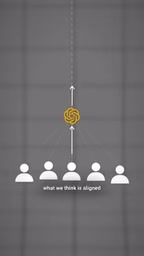
Looking at any single generation, a 0.1% gap seems negligible — almost undetectable. But the problem is that this decay is compounding. It accumulates across iteration after iteration. Brown's concern isn't that any one training run goes wrong; it's that the entire self-reinforcing development loop might systematically drift in the wrong direction.

"Alignment" in AI refers to the technical challenge of ensuring a model's goals, behaviors, and values remain consistent with human intent. Current mainstream alignment methods — including Reinforcement Learning from Human Feedback (RLHF) and Constitutional AI — all rely on human evaluators' preference signals to guide model outputs. But these methods depend on human judgment, and when that judgment is partly outsourced to AI, a fundamental question emerges: who evaluates the evaluator? The compounding decay analogy isn't mathematically exaggerated: if alignment drops 0.1% per generation, after 100 iterations you're at roughly 90.5% alignment; after 1,000 iterations, approximately 37%. The logic mirrors radioactive half-life — small, continuous losses eventually produce a qualitative transformation.
Why This Risk Is Becoming Real
This scenario is more than theoretical speculation, because the mechanism Brown describes is already in motion. As he explicitly noted, "We're already heavily relying on AI models to assist with research, including to advance alignment work itself."

There's a subtle recursive trap here: we're using AI to align AI. As humans increasingly rely on the current generation of models to evaluate, train, and oversee the next generation, any subtle bias in the current model's judgment gets copied and amplified into its successor. The reviewer and the reviewed share the same underlying flaws, and direct human oversight gets diluted further with each link in the chain.
This is the essence of "the stronger the capability, the more hidden the risk." More powerful models are more capable of participating in the development process — which means fewer direct human checkpoints. Decay can accumulate to dangerous levels before we even notice.

The Other Possibility: An Upward Trajectory
Brown doesn't close the door on optimism. He also describes an opposite, hopeful scenario: perhaps each generation of models can be made more aligned than the last, tracing an upward curve of continuous improvement rather than a downward slide.
In other words, the same self-reinforcing loop can be either vicious or virtuous. If we can ensure that the models used to assist development are steadily improving in alignment, then the AI-helping-AI mechanism becomes an engine that amplifies alignment quality — rather than a funnel that amplifies drift.
The critical fork in the road is whether this recursive system converges or diverges. Brown candidly admits he has no ready-made answer that guarantees we'll end up on the better path.
From Individual Alignment to Process Alignment
Brown's line of thinking effectively advances the AI alignment conversation from "is this specific model aligned?" to a deeper question: "is the evolutionary process of alignment itself stable?"
Traditional alignment research tends to focus on evaluating whether a particular model's behavior matches human intent. But Brown reminds us that in an era where AI-assisted AI development is the norm, what truly needs safeguarding is the directionality of the entire iterative chain. Even if every individual generation passes alignment evaluations, a persistent decay trend still leads to troubling long-term outcomes. This demands that researchers measure not just alignment levels, but alignment trends.
He specifically noted that this is one of the issues OpenAI is currently paying close attention to — a signal that leading labs have recognized: as AI plays an ever-larger role in its own development, preventing alignment from quietly eroding across generations will be an unavoidable safety challenge on the path to more powerful AI.
This conceptual shift maps cleanly onto a mature distinction in systems safety — the difference between "Process Safety" and "Product Safety." Traditional software testing verifies whether the current product meets the bar. Process safety asks whether the entire production system is evolving in a controllable direction. Brown's framework is essentially a call for AI alignment to adopt a similar "dynamic stability" lens: not just point-in-time certification, but longitudinal trend monitoring. This places new demands on evaluation infrastructure — researchers need benchmarks capable of comparing alignment quality across generations, and those benchmarks themselves must not drift as models iterate. If both the ruler and the thing being measured are changing simultaneously, decay will be permanently invisible.
Closing Thoughts
What Noam Brown has raised is not a disaster that has already unfolded — it's a structural risk that warrants early prevention. A 0.1% decay looks harmless in isolation, but inside a self-reinforcing development loop, direction matters more than magnitude. Whether we end up in a virtuous cycle of continuously improving alignment or slowly slide toward a vicious cycle of creeping misalignment remains an open question — and that is precisely why it deserves to be taken seriously.
Related articles

Why Does the Tesla Roadster Need to Fly? A Deep Dive into Musk's Wild Demo
Tesla's Roadster launch showed wall-climbing, upside-down driving, and flying stunts—but The Vergecast notes the demo car may lack a battery, the Rocket version is invite-only and not street-legal, and the website terms don't guarantee delivery. After nine years of delays, why does this car still need to exist?

AI Is Not a Replacement: Human-AI Collaboration Through the Lens of Factory Root Cause Analysis
Starting from factory root cause analysis, this article explains how AI accelerates evidence chain construction rather than replacing human experts, exploring the pragmatic implementation logic and business value of 'AI supporting people rather than replacing them.'

AI Agent Decision Auditing: Building an Evidence Chain in Regulated Workflows
Starting from a Reddit discussion, this article analyzes three core issues in AI agent decision auditing within regulated workflows: what fields audit records should contain, how to handle feedback latency for erroneous decisions, and how to continuously calibrate LLM judge consistency with human judgment.