GetAppNiche: A Market Intelligence Tool for Validating App Ideas with Data

GetAppNiche helps indie developers validate app ideas with market data before writing code.
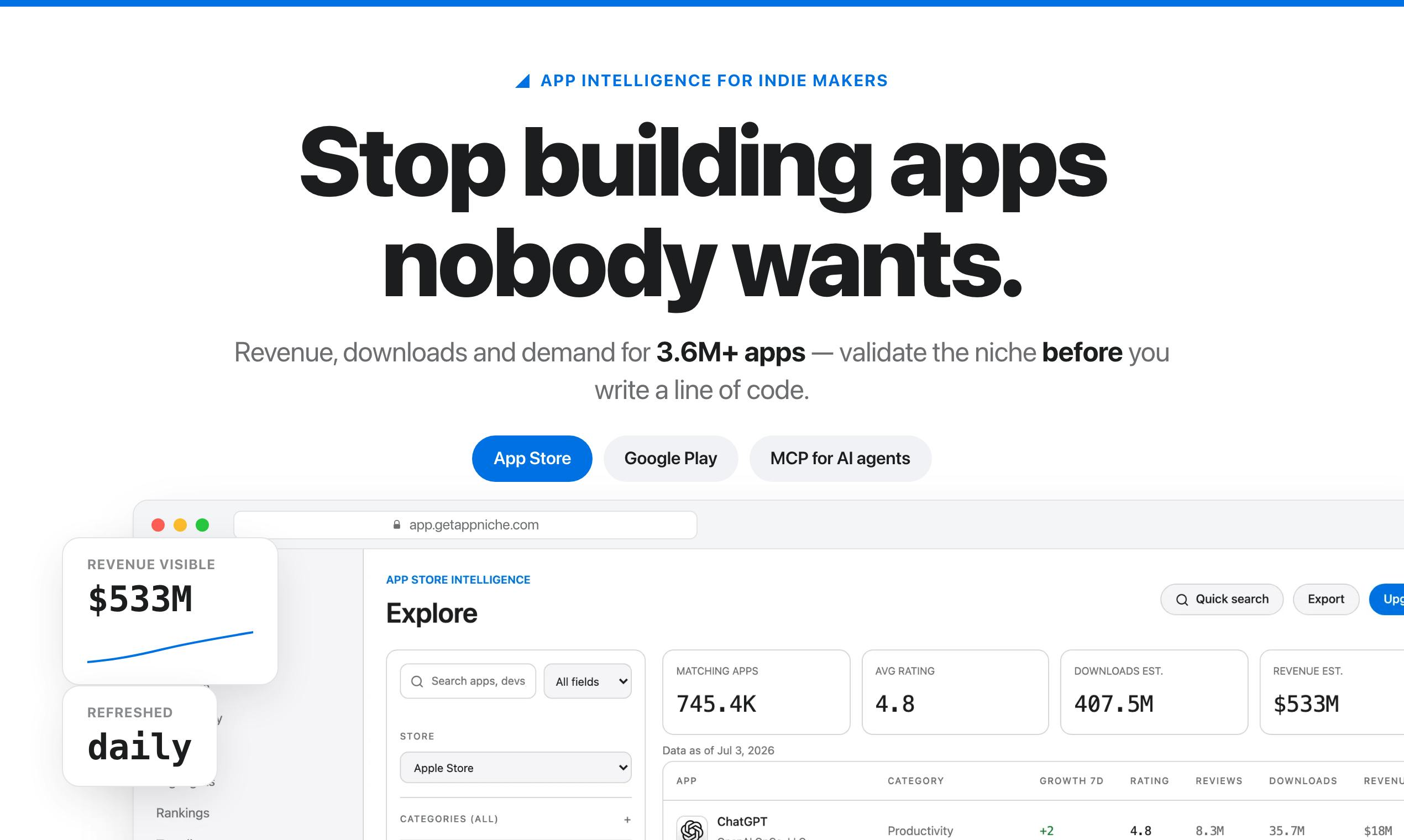
GetAppNiche is a market intelligence tool that turns the App Store and Google Play into a queryable database of 3.6 million apps. It offers revenue and download estimates, ASO keyword analysis with difficulty scores, competitor ad tracking, and user complaint mining. Its standout feature is MCP (Model Context Protocol) integration, letting developers query market data directly from AI assistants like Claude or Cursor. While still early-stage, it targets a real gap in affordable market validation for indie developers in the Vibe Coding era.
The Indie Developer's Pain Point: Building a Ship in the Dark
For every indie developer and product manager, few things are more frustrating than this: spending months meticulously building an app, only to discover after launch that there's no market demand. As GetAppNiche's tagline on Product Hunt puts it — "Stop building apps nobody wants."
Most app ideas "die in the dark": long development cycles with zero market validation. Developers often kick off projects based on gut feeling or passion, lacking objective insight into market size, competitive landscape, and monetization potential. The severity of this problem is well-documented: CB Insights research shows that the number one reason startups fail (roughly 35%) is "No Market Need." This pattern holds true in the app world too — according to Statista, the combined total of apps on the App Store and Google Play exceeds 5 million, yet the vast majority have fewer than 1,000 monthly active users and earn less than $500 per month. While Eric Ries's MVP (Minimum Viable Product) methodology from The Lean Startup is widely accepted, many indie developers still skip market validation in practice and jump straight into full-feature development. GetAppNiche aims to solve exactly this core problem — before you write your first line of code, it "turns the lights on" so you can see the entire market clearly.
What Is GetAppNiche: A Market Intelligence Tool for Developers
GetAppNiche is a market intelligence tool for developers that turns the App Store and Google Play into a queryable database. The product recently launched on Product Hunt, categorized under Analytics, SaaS, and Developer Tools, built by Yaroslav Mykhailov.
It's worth noting that the App Store and Google Play, as the world's two dominant app distribution platforms, maintain highly closed data ecosystems. Apple and Google never publicly disclose precise download counts or revenue figures for individual apps, citing competitive and user privacy concerns. Apple stopped publicly reporting total App Store download numbers in 2018, and Google only shows vague download ranges on Google Play pages (e.g., "1M+" or "10M+"). This information asymmetry has spawned an entire third-party app analytics industry — one that relies on cross-referencing and modeling from multiple signal sources including app store ranking fluctuations, review growth velocity, SDK installation tracking, ad spend monitoring, and consumer research panels.
GetAppNiche's core value lies in data-driven market validation. Rather than spending months developing an unvalidated idea, you can first use data to answer a few critical questions: How big is this niche? How much do the top apps make? How intense is the competition? What are users complaining about with existing products?
Core Features at a Glance
Based on official descriptions, GetAppNiche offers a fairly comprehensive market insight toolkit:
- 💰 Revenue & Download Estimates: Covering over 3.6 million apps across both the App Store and Google Play. This is the most direct indicator for assessing a niche's commercial value.
- 🔍 Dual-Store Database Explorer: Browse both stores like a database, with filters for growth rate, pricing model, app category, and more.
- 🎯 ASO Keyword Analysis: Provides App Store Optimization (ASO) keywords with difficulty scores, plus daily ranking tracking to help developers craft user acquisition strategies.
- 🕵️ Deep Competitor Reconnaissance: View competitors' ad campaigns, creator partnerships, and complaint points from user reviews — these "negative reviews" often reveal exactly where product opportunities lie.
- 🔌 API & MCP Integration: Seamless integration with AI coding assistants, detailed below.
Highlight: MCP Integration for the AI Era
GetAppNiche's most noteworthy innovation is its support for API + MCP (Model Context Protocol). According to the official description, you can directly "ask Claude or Cursor to find niches for you."
MCP (Model Context Protocol) is an open-source communication standard released by Anthropic in late 2024, designed to give AI large language models a unified way to connect with external data sources and tools. Think of MCP as the "USB port" of the AI world — just as the USB standard enables plug-and-play for peripherals, MCP lets various data services and tools be called by AI models in a standardized way. In the MCP architecture, data providers (like GetAppNiche) expose their capabilities as an "MCP Server," while AI applications (like Claude or Cursor) act as "MCP Clients" that initiate requests. Developers only need to implement an MCP Server once to be accessible by any AI client that supports the MCP protocol, eliminating the need to build separate plugins for each AI platform. The MCP ecosystem is expanding rapidly, with hundreds of open-source MCP Servers already covering scenarios like database queries, file system operations, and API calls.
This means developers don't have to manually sift through data on a web interface. Instead, they can issue market research requests in natural language from within their familiar AI coding environment (like Cursor) or conversational assistant (like Claude). For example, you could ask: "Find me a productivity app niche with fast-growing downloads but low competition," and the AI can call GetAppNiche's data to deliver real-time analysis.
This design aligns with the current trajectory of the AI tool ecosystem — packaging specialized data capabilities as AI-callable tools, integrating what was once tedious market research into developers' everyday workflows. As "Vibe Coding" grows increasingly popular, plugging market validation into AI assistants undoubtedly lowers the barrier for indie developers to make sound decisions.
"Vibe Coding" is a concept coined by Andrej Karpathy in early 2025, referring to a development approach where developers describe requirements in natural language and let AI coding assistants (like Cursor, GitHub Copilot, Windsurf, etc.) automatically generate the code. In this mode, developers act more like product managers or architects, primarily responsible for describing "what to build" and "why," while delegating the "how" to AI. This trend is profoundly reshaping indie developers' workflows: development cycles that once took months can now be compressed to days or even hours. But this also introduces a new challenge — when development costs plummet, the quality of "what to build" decisions becomes more important than ever. If the direction is wrong, even AI-generated code at blazing speed won't save the final product from failure. This is precisely why market validation tools like GetAppNiche become especially valuable in the Vibe Coding era.
Real Problems GetAppNiche Solves
From a product logic perspective, GetAppNiche addresses several critical nodes along the indie developer's path to commercialization:
Idea Validation: Assessing Market Ceiling
With revenue and download data, developers can evaluate a market's ceiling before starting a project. A niche where the top app earns millions per year versus one with negligible overall revenue clearly warrant very different levels of commitment.
Competitive Analysis: Mining Opportunities from Negative Reviews
Examining competitors' ad campaigns, creator partnerships, and user complaints is essentially "opportunity mining." User grievances often point to unmet needs — and that's exactly where a new product can find its entry point.
User Acquisition Strategy: Actionable ASO Optimization
ASO (App Store Optimization) is the core strategy for mobile apps to acquire organic traffic, similar in principle to SEO (Search Engine Optimization) for websites. In the App Store, approximately 65% of app downloads originate from search behavior, meaning keyword rankings directly determine an app's visibility and customer acquisition cost. Key ASO elements include: keyword placement in app titles and subtitles, description optimization, screenshot and preview video conversion optimization, rating and review management, and behavioral signals like download volume and retention rates.
GetAppNiche's keyword difficulty scores provide a comprehensive assessment of a search term's search volume, the quantity and quality of currently competing apps, and the likelihood of a new app ranking for that term. Combined with ranking tracking, developers can formulate practical ASO strategies after product launch. For indie developers, finding "long-tail keywords with moderate search volume but low competition" is the key strategy for punching above their weight — far more effective than blindly stuffing popular keywords.
A Sober Assessment: Limitations of an Early-Stage Product
It's important to be objective: as of this writing, GetAppNiche's metrics on Product Hunt are quite modest — 4 upvotes, 1 comment, ranked #17. This indicates it's still in its early stages with limited market awareness.
Additionally, tools in this category share an inherent limitation: app store revenue and download figures are fundamentally "estimates." The App Store and Google Play don't disclose precise revenue data, and third-party tools model their estimates from signals like chart rankings and review growth. Different tools use different estimation methodologies with varying degrees of accuracy, which is why data for the same app can differ significantly across platforms. These numbers are therefore better suited for comparative analysis and trend identification rather than precise financial planning.
This space also has established players like Sensor Tower and data.ai (formerly App Annie). Sensor Tower was acquired by ION Analytics in 2024 at a valuation of approximately $1 billion, with clients including Netflix, Uber, and Tencent. data.ai claims to cover data on over 10 million apps, serving the vast majority of the world's top 100 publishers. These enterprise-grade tools typically charge annual fees ranging from several thousand to tens of thousands of dollars, primarily targeting large gaming companies, advertising platforms, and investment firms. This pricing strategy objectively leaves clear market space for tools aimed at indie developers and small teams. In recent years, mid-tier competitors like AppMagic, Appfigures, and AppFollow have also been serving small and medium-sized customers through more flexible pricing and focused feature sets. For GetAppNiche to break through, its AI-native MCP integration and indie developer-friendly pricing strategy may be its key differentiators.
Conclusion: Data-Driven Idea Selection Deserves Every Developer's Attention
GetAppNiche embodies a pragmatic product philosophy: validate before you build. For indie developers with limited resources and high costs of failure, replacing intuition with data is the rational choice for improving success rates. Its support for the MCP protocol demonstrates how traditional data tools can reposition themselves in the AI era — no longer an isolated website, but a capability module that AI assistants can call upon at any time.
Regardless of whether this product ultimately gains a firm foothold in the fiercely competitive market intelligence space, the "data-driven idea selection" approach it advocates is worth serious consideration by every creator preparing to build a new app. In the Vibe Coding era, the cost of producing code is approaching zero, while the cost of "what to build" decisions keeps rising — and that may be exactly where tools like GetAppNiche find their greatest value in this moment in time.
Related articles
Claude 3.8 Quietly Goes Live: PRO Users Get First Access via Gradual Rollout
Claude 3.8 quietly launches via gray release, with PRO users getting first access. Community feedback, rollout strategy, and how to check if you have the update.

The Aging Brain Doesn't Forget — It Blends Memories Together
New research reveals aging-related memory issues aren't about losing information but blending memories together. Declining hippocampal pattern separation makes similar experiences hard to distinguish.

Claude 5.1 Leaked on Launch Day: 275,000-Word System Prompt Exposed, Revealing the Truth Behind AI
Anthropic launches Claude 5.1 dual-version flagship with doubled performance and 75% cost cuts, but hackers leak its full 275,000-word system prompt, revealing AI's engineered persona.