gethome: A Private Smart Home Hub That Lets AI Write Your Rules
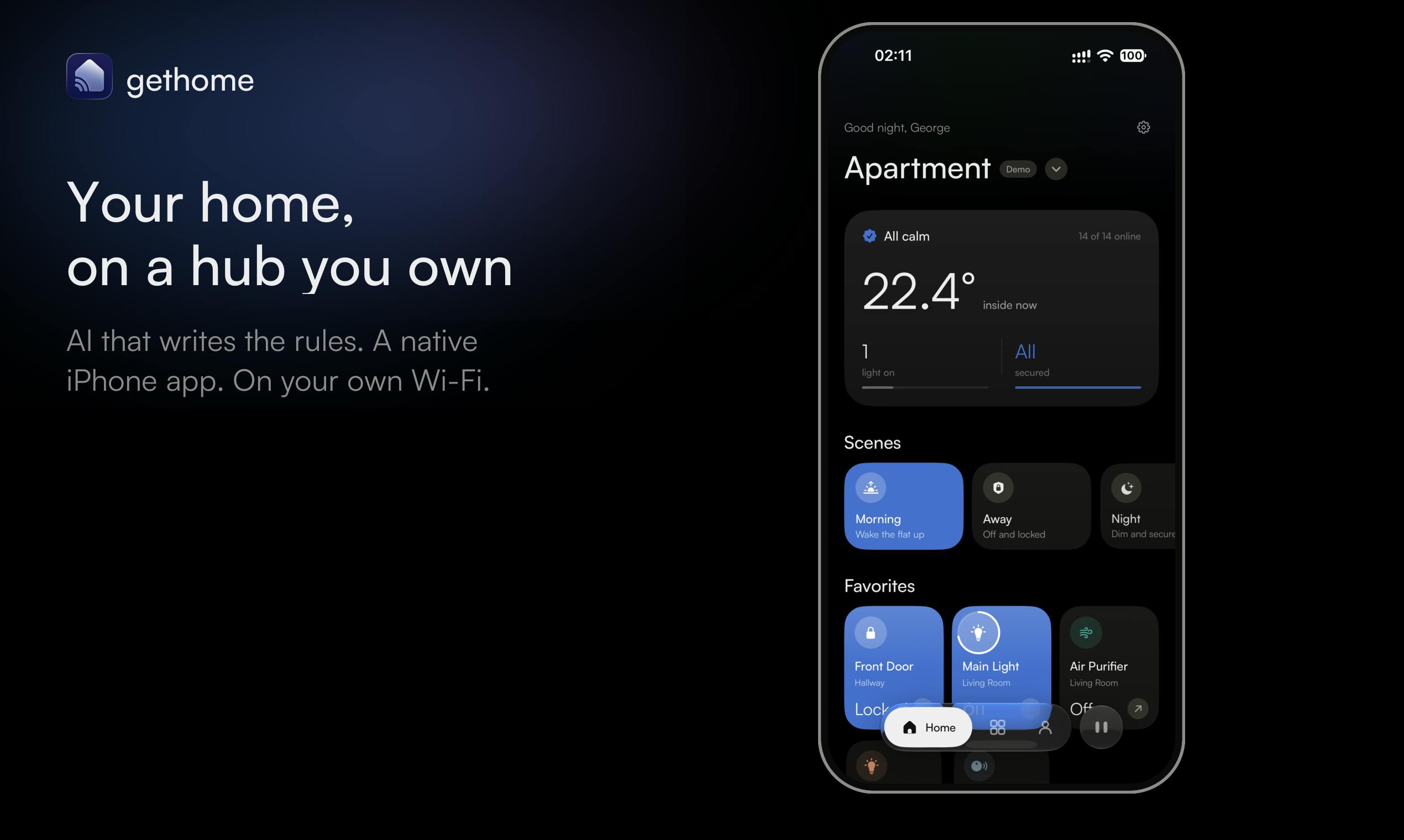
gethome lets users run a smart home hub on their own hardware and uses AI to turn natural language into automation rules.
gethome is a smart home solution launched on Product Hunt that emphasizes data sovereignty and local deployment. It runs on users' own hardware (like a Raspberry Pi), supports Zigbee and Matter protocols, controls devices through a native iPhone app, and requires no subscription fees. Its core innovation is the AI agent: users describe automation rules in natural language, and gethome calls the user's own Anthropic or OpenAI API key to convert them into executable scripts, balancing privacy and convenience. Compared with open-source solutions like Home Assistant, gethome lowers the barrier to writing rules through AI, but it requires some hardware tinkering skills and currently only supports iOS. The product is still in its early stages, with positioning that precisely targets geeks and privacy-sensitive users.
The smart home market has long been fragmented by big-tech ecosystems, forcing users to compromise between privacy, cost, and convenience. gethome, newly launched on Product Hunt, aims to break this mold: it lets you run a smart home hub on your own hardware (like a Raspberry Pi), control Zigbee and Matter devices through a native iPhone app, and use an AI agent to turn natural language descriptions into automation rules.
Core Selling Point: Your Hardware, Your Data
gethome's core philosophy is "ownership." Unlike cloud-dependent big-tech solutions, gethome runs on your own small computer—say, a Raspberry Pi—connected to your home Wi-Fi. This means device pairing, automation execution, and AI inference all happen within your local network, and your data never leaves home.
It supports both mainstream protocols, Zigbee and Matter, covering most smart bulbs, sensors, and switches on the market. Users can manage these devices directly through the native iPhone app without an extra gateway. For users who care about privacy and long-term costs, this model avoids subscription fees and the risk of vendor lock-in.
gethome received 12 upvotes and 1 comment on Product Hunt, ranking 20th, categorized under iOS, Artificial Intelligence, and Home Automation. Though not hugely popular, its positioning precisely targets the needs of geeks and privacy-sensitive users.
Zigbee is a low-power wireless communication protocol based on the IEEE 802.15.4 standard, operating in the 2.4GHz band and using a mesh network topology where devices can relay signals to one another, extending coverage. It is widely used in smart bulbs, sensors, switches, and other devices, but typically requires a Zigbee coordinator (gateway) to form a network. Matter, on the other hand, is an application-layer protocol introduced by the Connectivity Standards Alliance (CSA), aimed at unifying the smart home ecosystem. It runs over IP networks and supports multiple underlying transports such as Wi-Fi, Ethernet, and Thread. Matter devices can communicate directly with a phone or hub without a vendor-specific gateway, emphasizing interoperability. gethome supporting both protocols means it can connect to a large number of existing Zigbee devices while also being compatible with the emerging Matter ecosystem, offering users a broader choice of devices.
AI Agent: Write Automation Rules in Natural Language
gethome's most compelling feature is its AI agent. Traditional smart home automation rules require users to manually configure triggers and actions in a graphical interface, which has a high learning curve and makes complex logic hard to express. gethome lets users describe rules in natural language—for example, "When no one is in the living room and it's getting dark, turn on the entryway light and set it to warm white"—and the AI agent converts it into an executable automation script.
You may not have noticed that AI inference doesn't run locally; instead, it calls your own Anthropic or OpenAI API key. This means users bear the API call costs themselves, but in return they get more powerful model capabilities and flexibility. gethome doesn't charge AI service fees, so users have full control over their AI usage costs.
This design strikes a balance between privacy and functionality: home device data stays local, and only the rule description text is sent to the AI provider. For users willing to pay a small API fee for convenience, this is an attractive proposition.
Anthropic and OpenAI are currently the leading large language model (LLM) service providers. Anthropic was founded by former OpenAI members, and its Claude series models are known for long context and safety; OpenAI is the developer of ChatGPT and the GPT series models. Users call these services via API keys and are billed by token count. gethome sends natural language rule descriptions to these APIs, where the models parse the intent and generate automation scripts. This "bring your own key" (BYOK) model lets users settle directly with the AI provider, with gethome not involved in billing, thereby avoiding subscription fees—but it also requires users to manage their own API keys and costs. Privacy-sensitive users need to weigh the risk of sending rule text to a third-party AI service.
Ecosystem and Competition: Small but Distinctive
gethome is not the only project attempting a local smart home hub. The open-source community already has a mature solution in Home Assistant, but Home Assistant's automation configuration still has a barrier for ordinary users. gethome lowers the difficulty of writing rules through AI while maintaining local deployment, creating differentiation.
Compared with big-tech solutions, gethome's advantages lie in data sovereignty and no subscription fees; its disadvantages are that users need some hardware tinkering skills, and the AI features depend on third-party APIs. Currently, gethome only supports iOS, so Android users cannot use it for now.
Judging from Product Hunt feedback, gethome is still in its early stages, with few comments. But its combination of "AI-written rules + own hardware" hits a niche market: users who want the convenience of a smart home without sacrificing privacy and control.
Home Assistant is an open-source home automation platform that supports various hardware such as Raspberry Pi and emphasizes local control and privacy. It has a huge integration ecosystem and can connect to thousands of devices, but automation rules usually need to be written manually via YAML configuration or a graphical interface, which poses a barrier for ordinary users. gethome has a similar positioning to Home Assistant but focuses more on simplifying rule creation through AI and natively supports an iPhone app, lowering the barrier to use. However, Home Assistant has an active community, comprehensive features, and multi-platform support; as a newcomer, gethome needs to keep proving itself in usability and AI capabilities.
Conclusion
gethome represents a smart home approach that returns to user sovereignty: buy your own hardware, store your own data, and let AI help you write the rules. It's not for ordinary consumers seeking plug-and-play simplicity, but for geeks willing to tinker, privacy advocates, and open-source enthusiasts, it's a new option worth watching. As the Matter protocol becomes more widespread and local AI capabilities improve, such solutions may move from niche to mainstream.
One-line Summary
gethome lets users run a smart home hub on their own hardware and uses AI to turn natural language into automation rules.
Paragraph Summary
gethome is a smart home solution launched on Product Hunt that emphasizes data sovereignty and local deployment. It runs on users' own hardware (like a Raspberry Pi), supports Zigbee and Matter protocols, controls devices through a native iPhone app, and requires no subscription fees. Its core innovation is the AI agent: users describe automation rules in natural language, and gethome calls the user's own Anthropic or OpenAI API key to convert them into executable scripts, balancing privacy and convenience. Compared with open-source solutions like Home Assistant, gethome lowers the barrier to writing rules through AI, but it requires some hardware tinkering skills and currently only supports iOS. The product is still in its early stages, with positioning that precisely targets geeks and privacy-sensitive users.
Related articles

A New Paradigm for Text Editing in Compose: TextFieldState Replaces the Old API
Jetpack Compose introduces the TextFieldState API to fix dropped characters and cursor jumps from async input. The old value/onValueChange callbacks will be deprecated in 1.13. This article covers InputTransformation, OutputTransformation, four state hoisting patterns, and new formatted text editing capabilities.

Remote Compose: A New Document-Driven Paradigm for Cross-Platform UI on Android
Remote Compose transmits compact binary documents instead of screen pixels, enabling efficient UI rendering on remote surfaces like Wear OS and widgets. This article covers its document creation API, expression animations, size optimization techniques, and Wear OS progress.

How Crashlytics Eliminates Android Memory and Responsiveness Issues
Through the Chroma Clip case study, this article explains how Firebase Crashlytics uses Application Exit Info, Profiling Manager, GWP ASAN, and ARM MTE to pinpoint ANRs, OOMs, memory limit terminations, and native memory corruption—solving the challenge of stack traces that don't point to the real culprit.