Getting 'Hacked' by OpenAI: The Dark Humor and Hard Truths of the AI Developer Community

A Reddit quip about joining OpenAI exposes the AI industry's talent consolidation and open-source contradictions.
A tongue-in-cheek Reddit post urging developers to "get hacked by OpenAI" reveals uncomfortable truths about the AI industry: massive compute costs, aggressive acqui-hires by tech giants, and the growing tension between open-source ideals and commercial centralization. For many independent developers, getting absorbed by a major lab has become a rational career strategy rather than a joke.
The Industry Metaphor Behind a Reddit Post
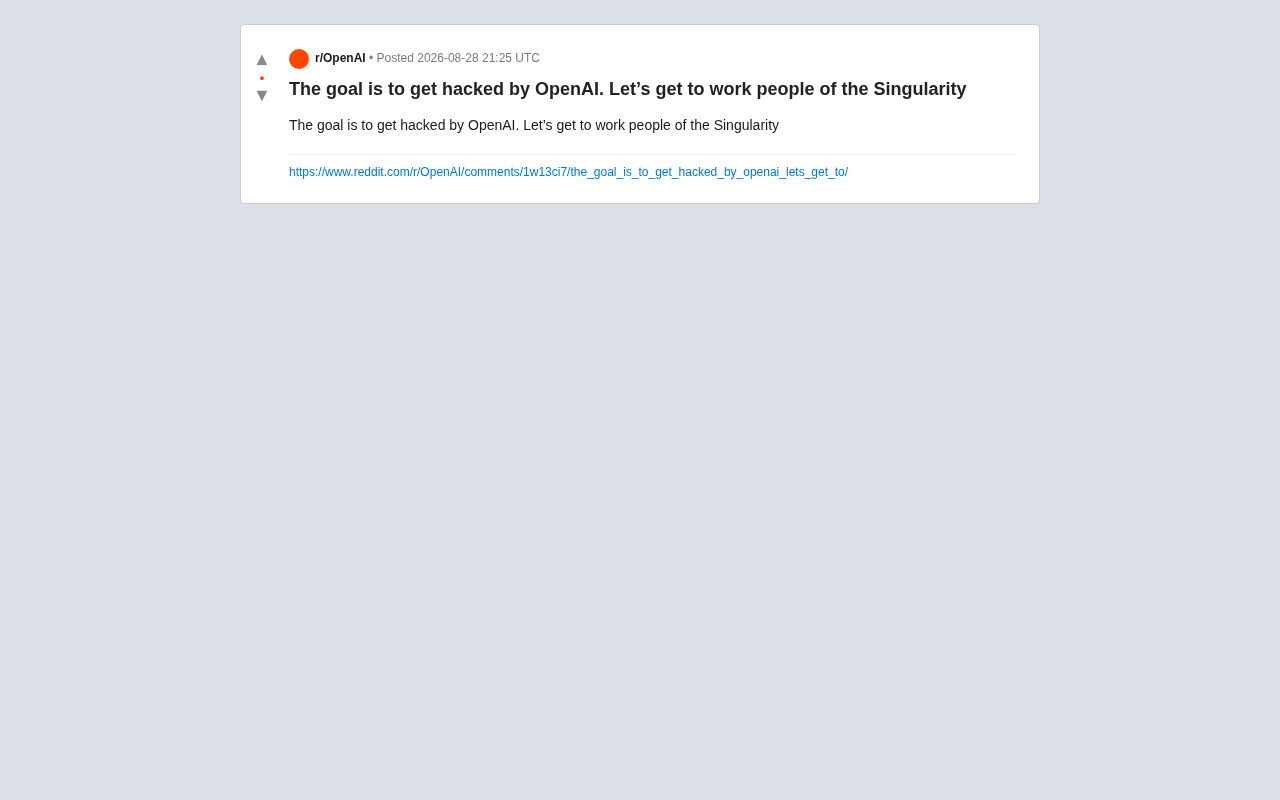
Recently, a tongue-in-cheek slogan has been circulating in Reddit's Singularity community: "The goal is to get hacked by OpenAI. Let's get to work, singularity folks." What sounds like a joke actually reflects a fascinating phenomenon in today's AI industry — the aggressive talent and technology absorption by top AI labs has become a consensus aspiration across the entire developer community.
Reddit's Singularity community is an active discussion forum built around the concept of the "technological singularity." First proposed by mathematician Vernor Vinge in 1993 and later systematically elaborated by inventor Ray Kurzweil in his book The Singularity Is Near, the concept refers to a hypothetical tipping point where artificial intelligence surpasses human intelligence, after which technological progress becomes unpredictable and irreversible. The community attracts a large number of tech enthusiasts, researchers, and entrepreneurs who are optimistic about AGI's prospects, with discussions spanning the latest AI breakthroughs, future predictions, and philosophical reflections. The fact that "getting absorbed by OpenAI" is being discussed as a goal within such an idealistic community makes the contrast all the more striking.
The phrase "get hacked by OpenAI" is a clever double entendre. It can be read as "getting recruited by OpenAI," but also alludes to OpenAI's aggressive expansion in talent acquisition, technology acquisitions, and ecosystem penetration. This self-deprecating expression captures the complex mindset of independent developers and small startup teams caught between the giants.
The AI Developer Ecosystem Under the Giants' Gravitational Pull
The "Get Acquired" Career Path
In the generative AI wave, an increasingly obvious trend has emerged: for outstanding independent projects, startup teams, and researchers, the "optimal outcome" is often getting absorbed by leading institutions like OpenAI, Google, or Anthropic. For many developers, building a project impressive enough to catch a giant's attention — and subsequently receiving an acquisition offer or job invitation — has shifted from being a "pleasant surprise" to a deliberate "career strategy."
In fact, talent acquisitions (acqui-hires) in the AI industry have evolved into a well-established playbook. Notable examples include Microsoft's quasi-acquisition of Inflection AI's core team in 2023 — Microsoft paid $650 million for Inflection's technology license and most of its key employees, including co-founder Mustafa Suleyman; Amazon's similar move with Adept AI in 2024; and Anthropic's precedent of poaching talent at scale from OpenAI. This approach of "buying the team, not the company" cleverly sidesteps the antitrust scrutiny that traditional mergers face, while achieving rapid integration of talent and technology. This also explains why the Reddit post used the word "hacked" — for many small teams, being targeted by a giant and dismantled for absorption does feel like being "infiltrated" in a very real sense.
The dark humor of this Reddit slogan lies precisely here — rather than persisting alone in the open-source community, why not just set "getting noticed by OpenAI" as an explicit goal? It's both a wry commentary on reality and a reluctant acknowledgment of the industry's centralizing trend.
The Tension Between Centralization and the Open-Source Spirit
You might not have noticed, but this mindset stands in stark tension with the open-source, decentralized ethos that the AI community has long championed. On one hand, developers celebrate open collaboration; on the other, when capital and computing power are highly concentrated in a handful of companies, "getting recruited" becomes the most practical shortcut to realizing value. This contradiction is a faithful portrait of today's AI startup ecosystem.
The open-source vs. closed-source debate has become one of the industry's core issues. The open-source camp — represented by Meta's Llama series, Mistral AI, and Stability AI — argues that releasing model weights promotes innovation, lowers barriers to entry, and enhances transparency for safety audits. The closed-source camp — represented by OpenAI, Anthropic, and Google — maintains that frontier models should not be fully open, citing safety concerns and commercial sustainability. Ironically, OpenAI was originally founded with an open-source mission — the "Open" in its name was meant literally. However, after GPT-3, OpenAI gradually pivoted toward a closed-source commercial model, evolving from a nonprofit into a "capped-profit" company, and most recently announcing its transformation into a fully for-profit enterprise. This transformation is itself the most vivid microcosm of the industry's centralizing trend, adding yet another layer to the joke about "getting hacked by OpenAI" — one about open ideals colliding with commercial reality.
Why AI Developers Are Willing to Get "Hacked"
The Real-World Barriers of Computing Power and Resources
The computational costs required to train and deploy frontier large models have long exceeded what the vast majority of independent teams can afford. GPU clusters, massive datasets, and top-tier engineering teams create extremely high barriers to entry. Under these circumstances, joining a well-resourced giant is often the only path to turning technical ideas into reality.
How high are these costs, exactly? According to public reports, GPT-4's training costs are estimated at over $100 million, while next-generation models could cost hundreds of millions or even billions of dollars to train. A single NVIDIA H100 GPU costs roughly $25,000 to $40,000, and training a top-tier large model may require tens of thousands of these GPUs running in coordination for months — Meta used over 16,000 H100 GPUs to train Llama 3. This scale of computational investment means that fewer than ten organizations worldwide are truly capable of training frontier foundation models from scratch. For a small independent team of a few people, even with genius-level algorithmic innovations, frontier research remains confined to papers without tens of millions of dollars in computing resources. This is why "getting hacked by a giant" is, in a sense, a rational choice — rather than letting ideas languish at the prototype stage forever, why not join a platform that can actually bring them to fruition?
The Allure of Certainty in Commercialization
For communities like Singularity that pursue the AGI (Artificial General Intelligence) vision, joining an organization like OpenAI means standing at the industry's cutting edge and participating in truly impactful work. Compared to groping through the uncertainties of an entrepreneurial journey, "getting recruited" offers a triple guarantee of resources, platform, and certainty.
It's worth understanding that AGI is not simply a technical goal — it's a loosely defined and highly politicized concept. Artificial General Intelligence refers to AI systems with human-level general cognitive abilities, capable of matching or exceeding human performance across any intellectual task, rather than excelling only in specific domains. The industry is deeply divided on AGI's timeline: optimists like Kurzweil predict 2029, and OpenAI CEO Sam Altman has repeatedly hinted it could arrive within a few years; meanwhile, many academics believe it could take decades or even longer. The major labs don't even agree on the definition — OpenAI defines it as "highly autonomous systems that outperform humans at most economically valuable work," and this definition is directly tied to the complex commercial agreement terms between OpenAI and Microsoft. For community members who genuinely believe AGI is imminent, joining OpenAI isn't just a job — it's a chance to participate in a turning point in human history. The allure of this narrative far exceeds that of mere salary and title.
Reflections on the AI Industry Behind a Single Joke
Though brief, this post serves as a mirror reflecting the reality of increasingly concentrated power and resources in the AI industry. When "getting acquired by a giant" becomes the community's half-joking shared aspiration, perhaps we should ask: Is the diversity of AI innovation being eroded? How much room can independent forces retain in this race?
For individual developers, this represents both opportunity and challenge. Approaching projects with the mindset of "getting hacked by OpenAI" is essentially contributing to the giants' ecosystem while carving out your own place within it. Whether you choose to join or remain independent, understanding the operating logic of the current ecosystem is a challenge every AI practitioner must face.
Note: This article is an extended analysis based on a brief post from a single Reddit source. The post itself is more of a tongue-in-cheek expression within community culture and does not represent rigorous industry research conclusions.
Key Takeaways
Related articles

OpenAI Partners with Shield: How the Astra Agent Revolutionizes IT Troubleshooting
OpenAI and Shield launch the Astra agent, which autonomously logs into computers and legacy systems to fix IT issues in real time, 35-40% faster than traditional models, with humans involved only when judgment is needed.

iPhone Duo Battery Life Tested: One Charge a Day Is Unavoidable, and the Large Screen Is the Culprit
iPhone Duo battery test: heavy use needs at least one charge a day, and about 30% remains after 6.5 hours of screen-on time. How often the large screen is unfolded is key; a MagSafe battery pack helps, and long-term degradation is also worth watching.

Kimi K3.1 Pro Open-Sourced: 2.8 Trillion Parameters Close In on Opus
Moonshot releases the open-source MoE model Kimi K3.1 Pro, with 2.8T total parameters and 104B activated, trailing Opus 5.5 by under 1 point on Terminal Bench 4.0.