Getting Started with AI Agent Development: A Complete Guide from Concept to Practice

A complete beginner's guide to AI Agent development, from core concepts to real-world implementation.
This guide covers the fundamentals of AI Agent development, explaining how Agents differ from traditional AI tools through autonomous decision-making via the ReAct paradigm. It explores three practical scenarios — automated marketing, intelligent customer service with RAG, and investment analysis with reflection capabilities — along with multi-agent collaboration mechanisms and LLM selection strategies for building production-ready Agent systems.
Why AI Agents Are Replacing Traditional AI Tools
Today's AI tools — whether for image generation, copywriting, or content creation — have dramatically improved efficiency for individual tasks, but they all share a common pain point: they can't function without continuous human involvement.
Take social media management as an example. Today you need to generate images, tomorrow you need to write copy, and the day after you need to design assets — every step requires you to sit at your computer and operate manually. Even with AI tools, you're still trapped in a cycle of repetitive labor. As the analogy goes: when we use AI tools, "human effort is something you can never escape."
This is precisely where the core value of an Agent lies — it can take over entire workflows, transforming you from an executor into a commander. You only need to provide the target instructions, operating guidelines, and available tools. The rest — analysis, decision-making, and execution — is handled autonomously by the Agent.
AI Tool "User" vs. Agent "Commander"
There's a critical mindset shift here. With traditional AI tools, you decide when and what features to use. In an Agent architecture, your role is that of a "commander" — you lay out all the weapons in front of the Agent: "here's a Gatling gun, a mortar, an aircraft, and a cannon" — but when to use which tool is decided by the Agent through its own reasoning.
This autonomous decision-making capability is what fundamentally distinguishes Agents from ordinary automation scripts. From a technical perspective, an Agent's autonomous decision-making is built on the ReAct (Reasoning and Acting) paradigm. Proposed by Google and Princeton University in 2022, this framework enables large language models to alternate between "reasoning" and "acting" — first thinking about what operation the current situation requires, then invoking the appropriate tool to execute it, and then reasoning about the next action based on the execution results. Traditional automation scripts follow preset if-else logic trees where all branches are predefined by developers. Agents, powered by a large model's semantic understanding capabilities, can make reasonable judgments when facing unforeseen situations — similar to human improvisation. This fundamental difference determines that Agents can handle task complexity far beyond what traditional scripts can manage.
Three Typical Real-World Scenarios for AI Agents
To make these concepts more concrete, here are three real business scenarios demonstrating the practical value of Agents.
Scenario 1: Automated Marketing Content Production
The first case involves automatic copywriting generation for social media marketing accounts. By setting up a "social media expert" role and providing a public account link, the Agent autonomously completes a series of actions:
- Searching the web for similar content from competitors
- Crawling and analyzing these materials
- Generating original copy based on preset requirements

Throughout the process, the Agent needs to call multiple external APIs — tools for fetching public account information, web search tools, content generation tools, and more. The key is that the timing and combination of these tool calls are determined by the Agent based on task requirements.
Technically, the Agent's ability to call external tools is known as Function Calling or Tool Use. OpenAI pioneered the standardization of this capability in 2023: developers describe available tools' names, parameters, and purposes to the model in JSON Schema format, and the model autonomously determines during reasoning whether to call a specific tool, generating structured call requests. This mechanism allows Agents to break through the inherent capability boundaries of large models — models aren't great at real-time data retrieval, precise calculations, or system operations, but by calling search APIs, database interfaces, computation tools, and other external services, Agents can accomplish virtually any type of digital task. In this marketing content production case, it's Function Calling that enables the Agent to seamlessly switch between different tools like "search competitor content," "crawl web pages," and "generate copy."
Scenario 2: Embeddable Intelligent Customer Service System
The second scenario addresses a common enterprise sales pain point: new sales representatives who aren't familiar with products, don't understand the content instructors have taught, and haven't mastered proven conversation techniques.
The solution is to build an intelligent customer service Agent with an external local knowledge base. By importing complete chat records from top-performing salespeople, the Agent mimics the communication style of experienced sales staff for product promotion.
The "external local knowledge base" mentioned here is powered by RAG (Retrieval-Augmented Generation). RAG works in three steps: first, unstructured data such as company documents and chat records are split into semantic segments, converted into high-dimensional vectors through Embedding models (like OpenAI's text-embedding or open-source BGE models), and stored in vector databases (like Pinecone, Milvus, or ChromaDB). When a user asks a question, the system similarly converts the question into a vector and retrieves the most relevant knowledge segments using algorithms like cosine similarity. Finally, the retrieved context and user question are fed together into the large model to generate an answer. This architecture solves both the training data cutoff date limitation of large models and the "hallucination" problem (where models generate plausible but factually incorrect answers), ensuring the customer service Agent's responses are grounded in real enterprise knowledge and historical conversation experience.
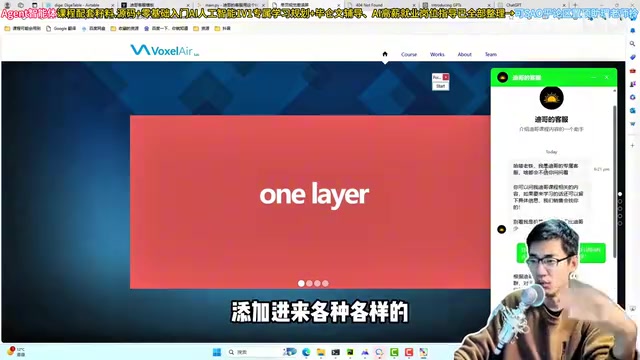
Going further, this customer service Agent can also integrate external tools for automated workflows:
- Real-time assessment of customer purchase intent during conversations
- Automatic logging to a form once a high-intent customer is identified
- Timely notification to human sales staff via SMS or messaging apps for follow-up
Ready-made templates for the front-end customer interaction interface module are available and can be embedded into any website or app — developers simply follow the process to get up and running quickly.
Scenario 3: Investment Analysis Agent with Reflection Capabilities
The third case best demonstrates the "intelligent" nature of Agents — investment research and analysis.
Analyzing a company's investment value requires not only examining historical price trends but also considering the day's news and public sentiment. If done manually — searching dozens of web pages and analyzing them one by one — it could take an entire morning. An Agent can do this automatically on a set schedule: crawling company-related news, analyzing the impact of news on stock price trends, and synthesizing insights from multiple sources to draw conclusions.
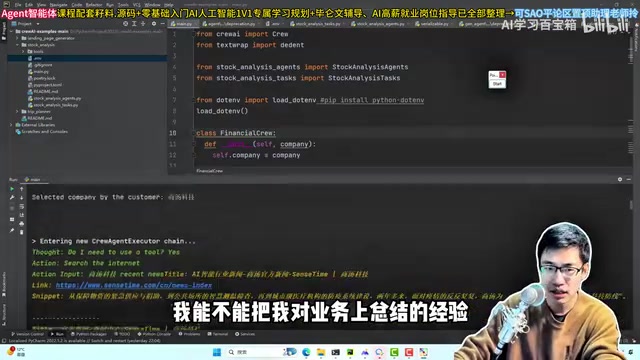
The highlight here is the Agent's reflection and memory capabilities. When it discovers that conclusions drawn from a particular search engine contradict actual conditions, it proactively reflects on data source quality and switches to alternative search APIs. This "getting smarter with use" self-optimization is an advanced feature of Agent architecture.
From a technical perspective, reflection capability stems from research frameworks like Reflexion. In these architectures, the Agent performs self-evaluation of results after task execution, storing successful and failed experiences as natural language in long-term memory (typically implemented as vector databases or structured logs). When similar tasks arise again, the Agent retrieves historical experience to optimize decisions. Meanwhile, short-term memory typically relies on the large model's Context Window, storing reasoning chains and intermediate results from the current session. This layered memory system — short-term memory for immediate reasoning, long-term memory for accumulating lessons learned — simulates the working memory and long-term memory mechanisms of human cognition. This is precisely why the investment analysis Agent can "remember" which data sources are more reliable and which analytical paths are more effective after multiple runs, truly achieving the effect of getting smarter with use.
Single-Agent and Multi-Agent Collaboration Mechanisms
The cases above mostly fall under "single-agent" applications. But when task complexity increases, multi-agent collaboration becomes necessary.
Understanding Multi-Agent Architecture Through Software Development Workflows
Taking a software company's development process as an example, when a client proposes an app requirement, three roles need to collaborate:
- Product Manager Agent: Understands and breaks down client requirements, outputs a feature list
- Developer Agent: Implements specific code based on the feature list
- Tester Agent: Verifies whether the code meets product requirements
The key is that these three agents are not isolated from each other — they communicate and interact. When the Developer Agent determines that a certain approach is infeasible, it provides feedback to the Product Manager Agent, which then adjusts the business plan accordingly. Through iterative negotiation, they ultimately produce a product that meets expectations.
This mechanism of "mutual communication and coordination" among multiple agents enables Agent systems to handle complex tasks far beyond the capability of any single agent. In engineering implementation, multi-agent collaboration needs to solve two core problems: communication protocols and task orchestration. Currently, mainstream development frameworks include Microsoft's AutoGen, CrewAI, and LangGraph. Taking CrewAI as an example, developers can define each Agent's Role, Goal, and Tools, then use Process definitions to specify collaboration patterns between Agents — sequential execution, hierarchical delegation, or free discussion. The core challenge of multi-agent systems lies in avoiding "infinite loop" conversations and task deadlocks between Agents, typically addressed by setting maximum iteration counts, introducing an arbitrator Agent, or defining clear termination conditions. Understanding these underlying mechanisms helps developers design efficient and stable multi-Agent collaboration systems in real-world projects.
The Core Architecture of Agents: Large Language Models as the Decision-Making Brain
Whether single-agent or multi-agent, the Agent's "brain" is always a Large Language Model (LLM).
The large model serves as the decision-maker in the Agent — determining which tools to use and how to decompose complex requirements into multiple executable subtasks. There are two mainstream options for model selection:
- Commercial APIs (e.g., GPT series): Better performance, stronger reasoning capabilities
- Locally deployed models: Slightly weaker capabilities, but superior in data privacy and cost control
The choice between these two approaches involves far more than just "performance quality" — it requires multi-dimensional trade-offs. Commercial APIs (such as GPT-4o, Claude 3.5 Sonnet, Gemini Pro) offer advantages in powerful reasoning capabilities and Function Calling stability, but carry data privacy risks (sensitive information must be uploaded to third-party servers), accumulating API call costs (which can reach thousands of dollars per month in high-frequency scenarios), and network latency issues. Local deployment solutions (such as running Llama 3, Qwen2.5, or Mistral open-source models via Ollama) completely eliminate data leakage risks, with inference costs limited to hardware depreciation and electricity — ideal for high-frequency calling scenarios. In recent years, the maturation of quantization techniques (such as GGUF and AWQ) has enabled 70B-parameter models to run on consumer-grade GPUs, significantly lowering the hardware barrier for local deployment. In practice, hybrid architectures are also common — using high-performance commercial APIs for core decision-making while handling auxiliary tasks with smaller local models, finding the optimal balance between effectiveness and cost.
Developers can flexibly choose the appropriate model solution based on their business privacy requirements, budget constraints, and performance needs.
Agents as a Universal Business Design Mindset
From content marketing to intelligent customer service, from investment analysis to software development, these cases reveal a core insight: Agents are not tools exclusive to any specific industry — they represent a design mindset that can be embedded into any business process.
What truly determines an Agent's value isn't how complex the technology is, but how deeply you understand business experience — you need to impart your business expertise and judgment logic to the Agent to create a truly scenario-specific "personal proxy." This aligns closely with the concept of Domain-Driven Design in software engineering: technical frameworks are universal, but domain knowledge is the core competitive advantage. An excellent Agent designer essentially makes tacit business experience explicit — transforming the "intuition-based" judgment rules of seasoned practitioners into an instruction system that Agents can understand and execute.
For beginners, the good news is that the entry barrier is decreasing. Structured development paradigms, ready-made front-end templates, and rich external API integrations mean that building a functional Agent is no longer an unattainable technical challenge. Understanding the concepts, clarifying business objectives, and following the process to practice — this is the best path for starting from scratch.
Key Takeaways
Related articles

Transformer²: Achieving Co-Design of Robot Morphology and Control with a Unified Architecture
Deep dive into how Transformer² uses a unified Transformer architecture to integrate robot morphology design and motion control into one model, enabling task-driven end-to-end co-design for embodied AI.

Tutorial: Installing Tailscale on a Jailbroken Kindle to Create a Private Network Node
Learn how to deploy Tailscale on a jailbroken Kindle, turning an idle e-reader into a private network node. Covers cross-compilation, power optimization, and risk considerations.
Tutorial: Installing Tailscale on a Jailbroken Kindle to Create a Private Network Node
Learn how to deploy Tailscale on a jailbroken Kindle to turn an idle e-reader into a private network node. Covers cross-compilation, power optimization, and risk considerations.