Getting Started with AI Agent Development: A Complete Learning Path to Building Intelligent Applications from Scratch

A complete beginner's roadmap to AI Agent development using LangChain, from core concepts to hands-on projects.
AI Agents represent the next evolution of software — moving AI from answering questions to autonomously taking action. This article explains what sets Agents apart from traditional AI tools, outlines the market opportunity (42.8% CAGR), and presents a structured LangChain-based learning path covering RAG, memory, tool use, and a full capstone project.
Why AI Agents Are the Next Form of Software
When most people think about artificial intelligence, they picture chatbots like ChatGPT — systems that understand and generate natural language to provide information or entertainment. But is that really the final form AI will take?
Bill Gates offered a clear answer on his personal blog: existing software is still quite clunky, and the future of software is intelligent agents (AI Agents). He believes that within five years, everyone will have their own intelligent assistant, and every piece of software we use today is worth rebuilding through the lens of Agents. This will be the biggest computing revolution since we moved from typing commands to clicking icons.
Gates paints a compelling picture: instead of switching between different applications to draft documents, build spreadsheets, or send emails, you simply tell your device what you want in everyday language. This kind of intelligent system — one that can execute specific tasks and take action on a user's behalf — is the core value of Agents. It marks AI's evolution from saying things to doing things.
What is an AI Agent? An AI Agent is an AI system capable of perceiving its environment, making autonomous decisions, and taking actions to achieve specific goals. Unlike traditional language models that operate in a simple question-and-answer format, an Agent has a complete "perception → decision → action" loop: it interacts with the external world through Tool Use, maintains context via a Memory module, and uses Planning capabilities to break complex tasks into executable sub-steps. Technically, modern Agents typically use a large language model (LLM) as the decision-making "brain," combined with reasoning paradigms like ReAct and Chain-of-Thought, enabling them to reason step by step, self-correct, and ultimately complete tasks in complex scenarios.
The Fundamental Difference Between Agents and Traditional AI Tools
Traditional AI tools are usually confined to specific applications and only respond when given explicit instructions. What sets AI Agents apart is their initiative and autonomy:
- They can proactively offer suggestions before a user even makes a request
- They can execute tasks across multiple applications
- They continuously improve how they interact with users over time
- They can remember user activity, recognize behavioral intent, and detect patterns
Take travel planning as an example: a sufficiently intelligent Agent doesn't just know your itinerary — it can make recommendations based on your preferences for new destinations or your habits when revisiting familiar ones, and even book your favorite restaurants directly. This kind of deep personalization used to require paying a travel agent.
The Market Explosion and Career Opportunities in AI Agents
The data makes it clear: Agents are on an explosive growth trajectory. According to Grand View Research, the autonomous AI and agent market reached $3.9 billion in 2022 and is projected to expand at a compound annual growth rate of 42.8%. Another report shows the autonomous AI agent market growing from roughly $5 billion to $29 billion, at a similarly high rate of 43%.

The implications are significant. Mastering Agent development today is comparable to learning web development in the PC era or mobile app development during the smartphone boom. When Apple launched the App Store, developers who learned Objective-C early captured a massive opportunity. Agents are at a similar historic inflection point right now.
According to Indeed, AI-related roles pay on average 20–30% more than traditional tech positions, with jobs involving AI Agent development standing out in particular. As the foundational infrastructure — large models, compute — matures, value will shift to the application layer, and demand for Agent developers will grow explosively.
From Stanford's Smallville to ChatDev: The Promise of Multi-Agent Collaboration
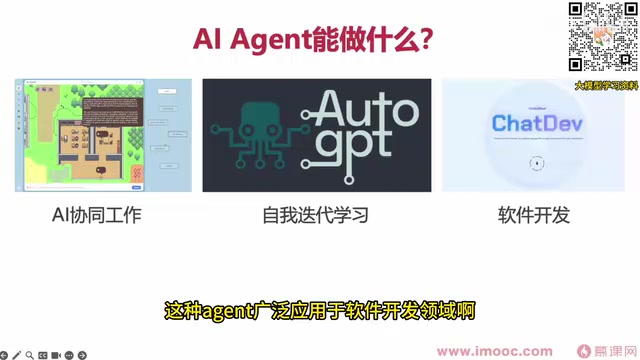
Multi-agent collaboration has already demonstrated capabilities that go far beyond what a single agent can achieve. Stanford University's "Generative Agents" research built a virtual town populated with 25 AI characters — widely known as the "Stanford Smallville" project. Each character has an independent Memory Stream, a Reflection mechanism, and action-planning capabilities, allowing them to simulate realistic human social behavior such as spontaneously organizing parties and spreading gossip. This research showed that when multiple Agents work together, complex emergent behaviors arise that no single Agent could produce alone.
ChatDev, developed by a Chinese research team, applies this idea to software engineering. By assigning role-play personas (AI characters acting as CEO, CTO, programmer, etc.), it creates an automated software development pipeline that goes from a plain-language description to runnable code — validating the enormous potential of multi-agent collaboration in professional domains.
The Real Barriers to Learning AI Agent Development
Despite the bright outlook, getting started with Agent development is genuinely challenging. There are three main obstacles:
Resource scarcity: Agent development is a relatively new field. Quality Chinese-language resources are rare, and English-language materials update so rapidly that staying current is a full-time job. Over 60% of beginners identify finding high-quality, up-to-date learning materials as their number-one challenge.
Fragmented knowledge: Agents draw from an extremely broad range of topics — large models, tool use, vector databases, AI engineering — all scattered across different domains with no unified, structured overview, making it exceptionally hard to build a complete mental model.
Lack of hands-on practice: Very few resources offer true project-based learning, and validating theoretical knowledge in real-world application scenarios is even harder to find.
Beyond these barriers, most courses on the market either focus purely on "how to use the tools" or lean toward "using AI to build a business model," with little integration of theory and hands-on coding. That leaves learners who genuinely want to build AI application products without much to work with.
A Systematic Learning Plan Built Around LangChain
To address these gaps, this course is designed with a deliberate structure: it translates and synthesizes a large volume of English-language primary sources, using the LangChain framework as the central through-line, with all teaching code strictly following official implementations.
What is LangChain? LangChain is one of the most widely adopted AI Agent development frameworks available today. Released by Harrison Chase in late 2022, it quickly became a star open-source project (surpassing 80,000 GitHub stars in a remarkably short time). Its core value lies in standardizing the integration of LLMs with tools, data sources, and workflows, providing key abstraction layers including Chains, Agents, Memory, and Retrieval — so developers don't need to build complex prompt management or tool-calling logic from scratch. Its ecosystem also includes LangSmith (for debugging and tracing) and LangServe (for one-click deployment as an API service), forming a complete toolchain from development to production. LangChain has become one of the de facto standards for enterprise-grade AI application development.

A Three-Part Course Structure
The course is organized into three major sections, spanning approximately 10 to 11 chapters:
Part One: Understanding the AIGC Industry. Starting with the history of large model development, this section uses platforms like Hugging Face to introduce mainstream large models and their limitations, then introduces fine-tuning and LangChain as solutions. It helps learners build a solid understanding of the industry landscape and provides guidance for frontend and backend developers looking to transition into AI.
Part Two: Deep Dive into the LangChain Framework. Through LangChain's seven core modules, learners systematically master the foundational theory of AIGC development — covering local environment setup, the Model I/O concept, prompt template applications, building external knowledge bases ("LLM long-term memory"), Retrieval-Augmented Generation (RAG), text chunking, and vector databases.
RAG Explained: RAG (Retrieval-Augmented Generation) is the core technical approach to solving the "knowledge cutoff date" and "hallucination" problems in large language models. It works in two phases: Offline, private documents are split into text chunks, converted into high-dimensional vectors by an embedding model, and stored in a vector database (such as Chroma or Pinecone); Online, when a user asks a question, the system first retrieves the most semantically relevant text chunks from the vector database, then feeds those chunks along with the question to the LLM to generate a response. Vector databases use Approximate Nearest Neighbor (ANN) algorithms to understand semantic similarity — recognizing that "automobile" and "car" are related — rather than relying on simple keyword matching. This gives RAG systems true semantic retrieval capability and significantly lowers the cost of deploying enterprise-grade private knowledge base AI applications.
Part Three: Hands-On Project Work. From requirements analysis, product design, and architecture to development and deployment, learners walk through the complete lifecycle of a real project, with extensions into digital human and intelligent voice application scenarios.
Capstone Project: A Feng Shui Fortune-Teller AI Agent
The hands-on centerpiece of the course is a uniquely creative project: building an Agent that takes on the persona of a traditional Chinese feng shui and fortune-telling master (inspired by the character Chen Xiazi from the novel Ghost Blows Out the Light). This Agent has a complete set of capabilities:
- A distinct personality that can hold natural conversations with users
- Tool-calling abilities, such as real-time web search for current information
- Integration with external channels like email and SMS
- Continuous learning in a specific knowledge domain
- Real-time Text-to-Speech (TTS) audio output
- Dynamic responses based on perceived user emotion
TTS Explained: TTS (Text-to-Speech) is the technology that converts AI-generated text into natural-sounding speech in real time — an essential component for building voice-capable AI Agents. Modern TTS technology (such as the OpenAI TTS API, Microsoft Azure Cognitive Speech, and ElevenLabs) is built on end-to-end deep learning models and can produce remarkably natural-sounding voices, supporting multiple languages, voice styles, speaking rate adjustment, and even emotional control. In an Agent system, TTS works together with ASR (Automatic Speech Recognition, i.e., speech-to-text) to create the complete "voice input → text processing → voice output" interaction loop. This enables an Agent to communicate with users in real time in a way that closely resembles natural human conversation, greatly expanding its applicability in use cases like intelligent customer service, voice assistants, and educational companions.

This project is fundamentally different from "chatting directly with ChatGPT" or "calling an API." It covers the complete chain from requirements analysis and architecture design to production-ready engineering. Once you finish, you can apply the same methodology to virtually any business scenario.
Who Should Learn AI Agent Development
This course is a strong fit for several types of learners: application developers interested in AI-powered products, product managers working in the AI space, entrepreneurs looking to innovate in AI-driven business scenarios, and frontend or backend developers looking to transition into AI. The course is Python-based — prior programming experience is helpful, but beginners can follow along as well.
The course includes a Q&A section and a learning community, with ongoing support from the instructor and teaching assistant team. AI isn't replacing people — it's replacing people who don't know how to use AI. In an era of accelerating technological change, proactively building AI Agent development skills may be the most practical step you can take to position yourself at the frontier of the industry.
Key Takeaways
Related articles

Disaster and Glory of the Apollo Program: The History We Must Revisit Before Returning to the Moon
From the fatal Apollo 1 fire to Apollo 8's daring lunar orbit to Apollo 11's successful landing—revisiting the disasters, fears, and compromises of the Apollo program and their lessons for today's return to the Moon.

Netflix Trust Exercise Turns Into Firing Trap: Where Are the Boundaries of Corporate Trust?
A Netflix employee was fired after sharing private info in a trust exercise. We analyze the risks of corporate trust exercises and how employees can protect themselves.

AMD CDNA5 Architecture Deep Dive: Technical Evolution and the AI Computing Competition Landscape
Deep analysis of AMD's CDNA5 architecture covering Chiplet packaging upgrades, HBM memory evolution, and low-precision compute optimization, examining how AMD challenges NVIDIA's AI chip dominance.