Getting Started with Claude Code: A Complete AI Coding Tool Comparison & Practical Guide

A comprehensive guide comparing Claude Code against Copilot, Cursor, Trae, and Codex for AI-assisted development.
Claude Code is Anthropic's locally-deployed CLI coding assistant built on MCP, capable of reading entire project codebases and automatically fixing runtime errors. This guide traces the evolution of AI coding tools from Copilot to Cursor to agentic coding, and provides a hands-on comparison of Claude Code, Trae, Codex, and Cursor — concluding that model quality is the ultimate differentiator.
What Is Claude Code
Claude Code is a locally-deployed coding assistant developed by Anthropic. Unlike traditional conversational AI coding tools, it doesn't require logging into any website — you simply install it locally and it's ready to use, integrating directly into your existing development environment for real project work.
Claude Code uses a command-line interface (CLI) architecture built on Anthropic's MCP (Model Context Protocol) standard. MCP is an open protocol that allows AI models to communicate with local file systems, terminal environments, and external tools in a standardized way — and this is the technical foundation that enables Claude Code to "read your entire project." Unlike web-based conversational AI, local deployment means your code and context never need to be uploaded to cloud servers, which offers inherent data security advantages, especially important for enterprise developers.
As a command-line tool, Claude Code does have some operating system requirements, but it's compatible with most mainstream systems. Its real-world capabilities far exceed what most people expect — which is the core reason it has spread so rapidly through the developer community.
The Fundamental Difference from Conversational Coding
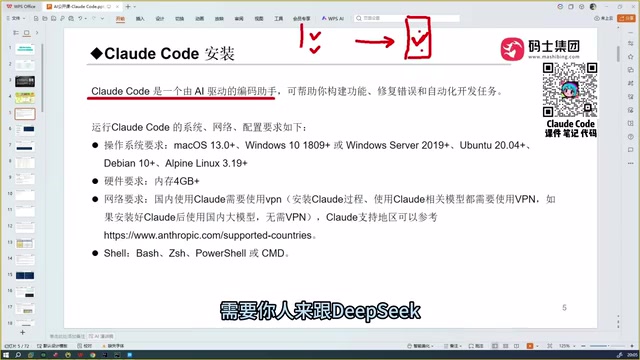
Many developers are used to conversational coding with DeepSeek or ChatGPT, but there's a fundamental difference between the two approaches.
Conversational AI can only give you a code snippet. You then have to manually copy it back into your project, run it yourself, and verify whether it works or throws errors — often requiring multiple rounds of back-and-forth before you get something reasonably functional.
The more critical bottleneck is the context window limitation. Conversational AI coding tools are constrained by the "context window" — the maximum amount of text the model can process in a single interaction. Early GPT-4 versions supported only around 8K tokens, and even as modern models have expanded to 128K or even million-token ranges, fitting hundreds of complete files into a single conversation still poses significant challenges in terms of both cost and accuracy. These tools simply cannot read your project's full context. If your project has 100 code files, the AI can't see all of them — you have to manually feed context to the model, which severely limits its practical value on complex engineering projects.
Core Advantages of Claude Code
This is exactly where Claude Code breaks through. It can read through all files in a project, passing the complete engineering context to the large language model, enabling it to generate code that truly fits your business requirements — something conversational tools simply can't match.
The underlying technical logic is this: Claude Code uses an "on-demand retrieval + incremental injection" engineering strategy. Through static analysis and semantic indexing, it intelligently determines which files are most relevant to the current task and dynamically assembles context, rather than naively dumping all your code into the model at once. This is the core technical capability that enables it to handle large-scale engineering projects.
Beyond that, it also has automatic error correction — when something fails at runtime, it automatically locates the problem and fixes it, ultimately delivering a version that actually runs. This makes it a genuinely automated development tool, not just a code completion or snippet generator.
For programmers who use it deeply, it can even trigger a sense of unease: large amounts of repetitive coding, testing, and debugging work can now be fully handed off to it.
The Evolution of AI Coding Tools
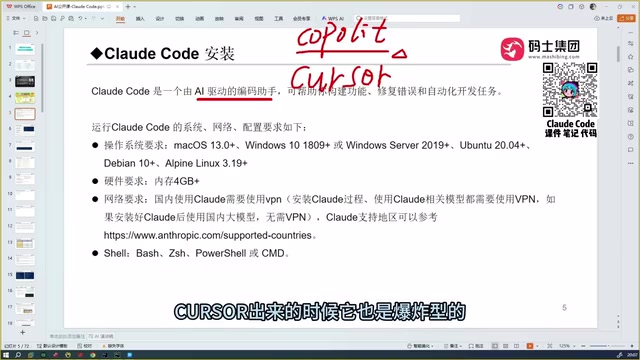
To understand why Claude Code has become so popular, it helps to trace the development trajectory of AI coding assistants. The industry typically divides this evolution into three phases: the first phase, represented by Copilot, is "Autocomplete" — AI passively responds to cursor position; the second phase, represented by Cursor, is "Chat-driven Editing" — developers describe intent in natural language and AI modifies specified files; the third phase, represented by Claude Code, is "Agentic Coding" — AI can autonomously plan tasks, read and write files, execute commands, handle errors, and form a complete "think-act-verify" feedback loop.
From Copilot to Cursor
GitHub Copilot launched in 2021, built on OpenAI's Codex model (a code-specialized fine-tune of GPT-3), embedded as a plugin into mainstream IDEs like VS Code through LSP (Language Server Protocol) for real-time inline code completion. Copilot's historical significance lies in being the first to truly integrate large language model capabilities into developers' daily workflows. Its "ghost text" interaction paradigm became the standard interaction model for virtually all subsequent AI coding tools, and at the time it left countless developers genuinely amazed.
Cursor is essentially an AI-native IDE that deeply rebuilds VS Code. Its core innovations are "Codebase Indexing" and Agent mode. Codebase Indexing vectorizes the entire project via embedding, enabling AI to quickly locate relevant code segments through semantic search. Agent mode allows AI to autonomously plan multi-step tasks, invoke terminal commands, and iteratively modify files. Cursor supports multiple backend models (Claude, GPT-4, etc.) and is significantly smarter than Copilot — capable of automated coding, and in overall capability now comparable to today's Claude Code.
Trae and OpenCode
Later, Trae entered the market (with separate international and domestic versions). For developers in China, the domestic version is the recommended choice — the international version is paid, while the domestic version is specifically optimized for Chinese-language scenarios and handles Chinese semantic understanding quite well. It was once considered a near-perfect coding tool.
OpenCode is also a coding tool, but it's relatively harder to use compared to the others mentioned above, and isn't recommended for beginners.
Side-by-Side Comparison of Major AI Coding Tools
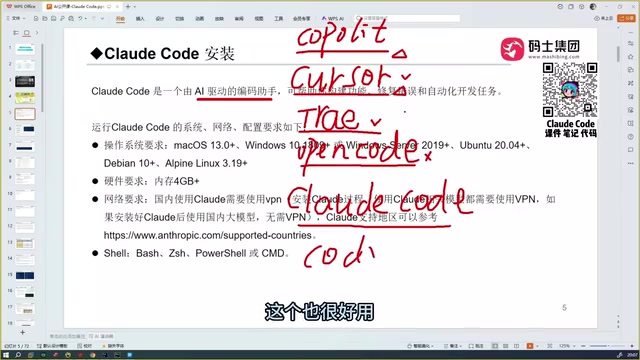
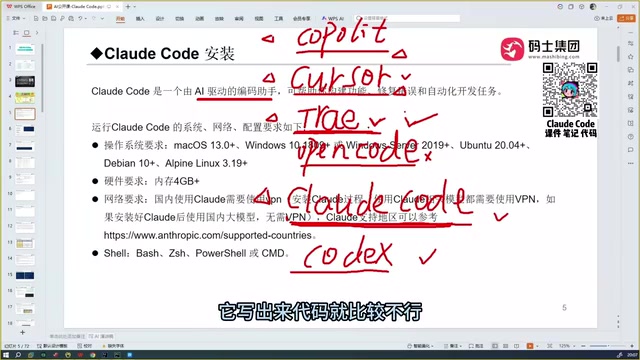
Based on hands-on experience, here's a systematic comparison of Copilot, Cursor, Trae, Codex, and Claude Code.
Model Capability Determines the Tool's Ceiling
The core conclusion is simple: the capability ceiling of any coding assistant ultimately depends on the quality of the underlying large language model. Claude Code stands out precisely because the Sonnet model it relies on performs exceptionally well on code tasks.
Claude 3.5 Sonnet's strong performance in the coding domain stems from Anthropic's focus on "Verifiable Tasks" during training — code correctness can be objectively verified by running tests, which provides high-quality reward signals for reinforcement learning. In authoritative benchmarks like SWE-bench (Software Engineering Benchmark), Claude 3.5 Sonnet has consistently ranked at the top, providing quantitative backing for its stable performance on real engineering projects. Cursor's decoupled architecture of "frontend tooling + swappable backend model" also reinforces this conclusion.
- Trae: Its biggest advantages are being free and having strong Chinese language understanding, but code generation accuracy is somewhat lacking in more technically demanding scenarios.
- Codex: Paired with OpenAI's flagship model (such as GPT-5), it can go head-to-head with Claude Code and is a serious option worth considering.
- Claude Code: Delivers the best performance in code accuracy — after comparing multiple domestic and international tools, it offers the best overall experience.
Accuracy Is the Core Differentiator
Cursor, Trae, and Claude Code can all achieve automated coding, but Claude Code has the edge in code accuracy. After comparing against mainstream domestic models like Qwen and GLM, this tool combination still delivers the best overall experience.
The underlying logic is straightforward: no matter how automated a tool is, the correctness rate of its generated code is ultimately what determines its real-world value.
Final Thoughts
The pace of iteration in AI coding tools is dizzying — from Copilot's code completion, to Cursor and Trae's automated coding, to Claude Code's ability to read an entire project's context and automatically fix errors, the capability boundaries keep getting pushed further. This evolution is fundamentally about the gradual expansion of AI's "autonomy" in the software development process: from passive code completion to active task planning and closed-loop execution.
For developers, Claude Code represents more than just a productivity boost — it marks a paradigm shift: from "humans write code, AI assists" toward "AI leads, humans oversee." That said, there's no single best tool for everyone. Codex and other solutions are equally worth watching. Your final choice should ultimately be based on your own project type and working habits.
Key Takeaways
Related articles

Greek Fire: The Ultimate Military Secret Guarded by the Byzantine Empire for a Millennium
Greek Fire was the Byzantine Empire's most closely guarded state secret — an ancient flamethrower that burned on water. Learn how it helped repel Arabs and Vikings and ensured the empire's survival.

7 Vibe Coding Agents Tested & Ranked: Which AI Coding Tool Should Beginners Choose?
Hands-on comparison of 7 Vibe Coding agents including Trae, Cursor, Claude Code, Codex, WorkBuddy & CoderWork, ranked by beginner-friendliness and performance.

AI-Generated Series 'Nido de Villanas': How AI Tells a Soap Opera Story
Deep analysis of AI-generated telenovela Nido de Villanas Episode 2: examining dialogue design, narrative tension, and AI's potential in dramatic storytelling.