Getting Started with Codex: A Practical Guide to OpenAI's AI Programming Assistant with Tips to Avoid Common Pitfalls

A practical guide to OpenAI Codex with Claude Code comparison and DeepSeek configuration tips.
This guide covers OpenAI Codex's core capabilities as an AI programming agent, explains why AI coding tools are becoming workplace essentials, compares Codex with Claude Code in terms of code quality and stability, and provides practical advice on configuring DeepSeek—recommending Codex for GPT models and Claude Code for DeepSeek integration.
What is Codex
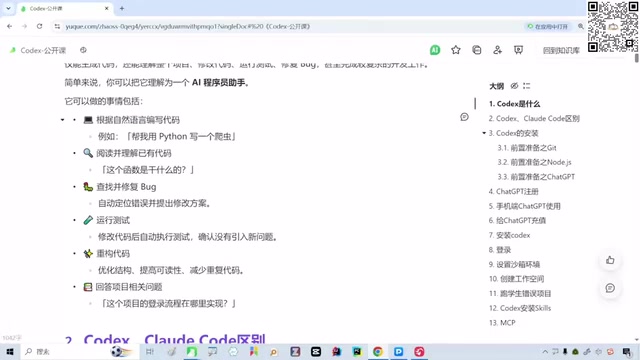
Codex is an AI programming assistant developed by OpenAI. At its core, it can be understood as an Agent tool. You give it instructions, and it helps you complete a range of development tasks—from writing code and running tests to assisting with operations, covering virtually every aspect of a programmer's daily workflow.
An Agent is a core concept in artificial intelligence, referring to a system that can perceive its environment, make autonomous decisions, and execute actions to achieve goals. Unlike traditional single-turn Q&A AI, an Agent has capabilities for multi-step reasoning, tool invocation, and autonomous planning. In programming scenarios, an Agent can not only generate code but also automatically execute it, observe the results, identify errors, and fix them independently, forming a complete "think-act-observe" loop. This capability elevates Codex beyond a simple code completion tool into a true development partner.
Its core strength lies in writing code using natural language. You simply tell it "write me a certain function in Java" or "generate a page in HTML," and even if you're not proficient in that language, Codex can handle it for you. This is why an increasing number of non-programmers are starting to use tools like Codex or Claude Code. Notably, many content creators on Douyin (TikTok China) are already sharing tutorials on using Codex with digital avatars and other scenarios, demonstrating significant productivity gains in real-world applications.
If you've never used tools like these before, you're honestly falling behind the current technology trend.
Why You Must Get Started with AI Programming Tools Now
This is no longer a "nice-to-have" skill—it's gradually becoming a hard requirement for job hunting and career advancement.
Here's a very real phenomenon: many companies now directly ask in interviews, "Have you used Claude Code? Have you used Codex?" If you answer no, you might be eliminated on the spot.
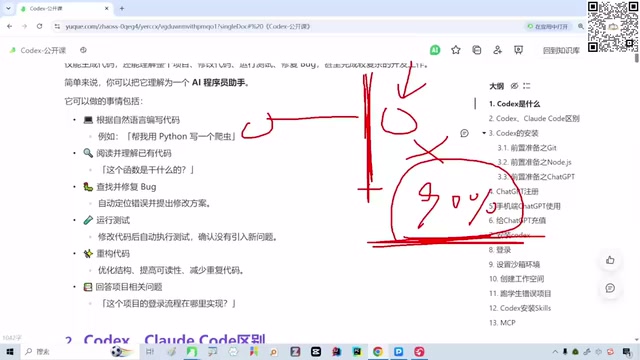
Taking it a step further, some companies have even started incorporating AI code generation rates into performance metrics. Some practitioners report that their companies require AI code generation rates of 90% or above—failing to meet this threshold results in performance deductions. AI code generation rate is a new efficiency metric that has emerged during enterprise digital transformation in recent years. It's typically tracked through development tool plugins or platforms, calculating the proportion of AI-assisted generated code relative to total committed code over a given period. The rise of this metric stems from data GitHub published in 2023—developers using Copilot had an average of 46% of their code generated by AI, with coding speed increasing by 55%. However, there's widespread debate in the industry about the reasonableness of this metric: core competencies like code quality, architectural design ability, and systems thinking are difficult to measure with a simple generation rate number, and excessive pursuit of numbers may lead developers to abuse AI-generated redundant code just to hit targets.
That said, there are problems with this evaluation approach: some managers who aren't technically savvy judge performance purely by "lines of generated code," which is inherently unfair. Frontend code is naturally far more voluminous than backend code, and using the same yardstick to measure different roles is simply unreasonable. Frontend development involves three layers of code—HTML structure, CSS styling, and JavaScript interaction. A simple page component might require dozens or even hundreds of lines of code to handle layout, responsive adaptation, animations, and user interaction logic. Backend code, on the other hand, tends toward abstraction of business logic and data processing, where equivalent functionality often requires fewer lines but with higher logic density. Therefore, using uniform code line counts or generation rates to evaluate developers across different tech stacks ignores the differences in code complexity and information density.
Regardless, the trend is crystal clear—even veteran programmers with eight or nine years of experience should get started immediately if they haven't used Claude Code or Codex yet.
Codex vs. Claude Code Comparison
There are actually quite a few AI programming tools on the market. Besides Codex, there's Cursor, Claude Code, Trae, and more. Below we'll focus on comparing the two mainstream tools: Codex and Claude Code.
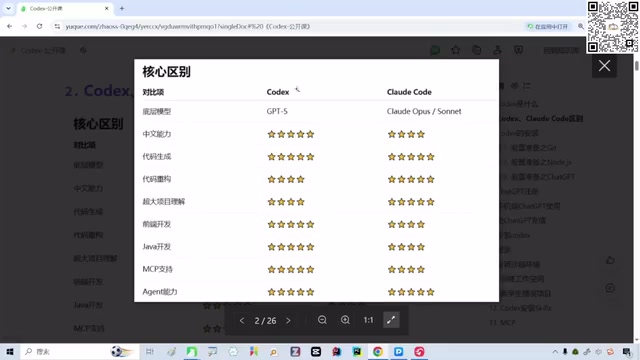
Code Generation Quality: Codex Has a Slight Edge
From actual usage experience, when handling the same task, Codex generally produces slightly better results than Claude Code. Therefore, between the two, Codex is more suitable as your go-to daily AI programming assistant.
Claude Code's Account Banning and Stability Issues
Here's a detail worth noting: recently, Claude Code's account banning issue has been quite severe. Claude Code is developed by Anthropic, and its terms of service have strict restrictions on usage regions and methods. Reasons some users encounter account bans include: accessing through unofficial channels, using shared API Keys, abnormal request frequency within short timeframes, or initiating connections from unauthorized regions. Anthropic employs a fairly aggressive risk control strategy—once abnormal usage patterns are detected, accounts are immediately banned.
Many users have turned to configuring domestic models like DeepSeek with these tools to lower the barrier and reduce risk—avoiding compliance issues while reducing network latency for a more stable experience.
Practical Advice and Pitfall Guide for Configuring DeepSeek with Codex
Regarding Codex's integration with third-party models, here's some very practical advice that could save you significant time and frustration.
Not Recommended: Using Codex with DeepSeek
Many people follow online tutorials attempting to connect Codex with DeepSeek (such as DeepSeek V4), but the success rate is extremely unstable—it works sometimes and doesn't work other times. Despite repeated attempts and tutorial searching, stable success remains elusive.
The underlying reason is likely this: Codex is now deeply integrated with ChatGPT, and when the system detects you're connecting to external models, it often actively blocks the connection. In 2025, OpenAI repositioned Codex as a native programming agent within the ChatGPT ecosystem, rather than an independent, extensible third-party tool. This means Codex's runtime environment, authentication, and model invocation are all deeply bound to the ChatGPT platform. From a technical architecture perspective, Codex tasks execute in OpenAI's cloud sandbox, using the specifically optimized codex-1 model (based on o3), with permissions managed through ChatGPT's authentication system. The benefit of this deep integration is consistent user experience and high security, but the trade-off is significantly reduced compatibility with third-party models—the platform simply wasn't designed with a standardized model-switching interface.
Although the Codex website once stated it could integrate with other models, DeepSeek isn't on its supported list—perhaps due to platform strategy considerations, though the exact reasons are unknown.

Want DeepSeek? Just Use Claude Code Directly
Based on comprehensive practical experience, here's the recommendation:
- If you want to use GPT-series models: Use Codex directly—this is the purest and smoothest experience Codex offers.
- If you want to configure DeepSeek: Abandon the Codex combination approach entirely and use Claude Code to configure DeepSeek instead—the setup is much easier.
For users who genuinely want to connect third-party models, consider using an API relay/proxy service to achieve this. There are plenty of tutorials available online. An API relay/proxy is an intermediary service that forwards overseas AI model API requests to domestically accessible nodes. It works by having users send requests to the relay server, which then forwards them to official API endpoints like OpenAI or Anthropic, and returns the responses to the user. Relays typically support the OpenAI API format, so tools compatible with that format (like Claude Code, Cursor, etc.) can connect by simply modifying the API address. Note that using relays involves security risks of data passing through third-party servers, and some relays cannot guarantee stability or response speed—enterprise users should evaluate carefully.
Summary: The Best Path to Getting Started with Codex
For developers with zero prior experience, Codex is an AI programming assistant worth prioritizing. It can help you complete coding, testing, operations, and a whole range of tasks using natural language, genuinely replacing a large portion of repetitive work.
The most hassle-free usage path is: pair Codex with native GPT models, and don't waste time trying to integrate DeepSeek on Codex. If you truly prefer domestic models, Claude Code is the more suitable vehicle.
In an era where AI code generation rates are increasingly becoming workplace performance metrics, mastering these tools early is no longer an optional question—it's a mandatory one.
Key Takeaways
Related articles

Disaster and Glory of the Apollo Program: The History We Must Revisit Before Returning to the Moon
From the fatal Apollo 1 fire to Apollo 8's daring lunar orbit to Apollo 11's successful landing—revisiting the disasters, fears, and compromises of the Apollo program and their lessons for today's return to the Moon.

Netflix Trust Exercise Turns Into Firing Trap: Where Are the Boundaries of Corporate Trust?
A Netflix employee was fired after sharing private info in a trust exercise. We analyze the risks of corporate trust exercises and how employees can protect themselves.

AMD CDNA5 Architecture Deep Dive: Technical Evolution and the AI Computing Competition Landscape
Deep analysis of AMD's CDNA5 architecture covering Chiplet packaging upgrades, HBM memory evolution, and low-precision compute optimization, examining how AMD challenges NVIDIA's AI chip dominance.