Getting Started with Codex: How OpenAI's Coding Agent Differs from ChatGPT

Codex is an AI coding agent that autonomously reads code, fixes bugs, and runs tests — representing a new "direct AI to code" paradigm.
Codex is OpenAI's AI coding agent, fundamentally different from ChatGPT: ChatGPT "talks" by providing knowledge and code snippets for developers to copy and debug themselves, while Codex "acts" by autonomously reading projects, modifying code, and running tests until the task is complete. AI tools won't eliminate programmers — they shift the role from "writing code" to "expressing requirements, reviewing, and optimizing," making programming fundamentals more important than ever. The most competitive developers will be those best at communicating clear requirements to AI. Learning tools like Codex and Claude Code is moving from a nice-to-have to an industry essential.
What Exactly Is Codex
Codex is an AI coding agent released by OpenAI. Unlike typical chat tools, its core purpose is to "do the work for developers" — not just generate code snippets, but actually read code, understand project structure, fix bugs, run tests, and even execute commands and scripts.
In other words, Codex is not a back-and-forth Q&A chatbot. If you just want casual conversation with the occasional code snippet you can copy and paste yourself, tools like Doubao or DeepSeekAd are perfectly sufficient. The value of Codex lies in its ability to autonomously complete programming tasks — it's closer to having a hands-on developer sitting right next to you.

The Fundamental Difference Between Codex and ChatGPT
Many people are confused when they first encounter Codex: it's built on OpenAI's large models, so isn't it basically the same as ChatGPT? This is a very common misconception.
A useful analogy can clarify the relationship: ChatGPT is like a teacher; Codex is like a hands-on programmer.
Suppose you want to implement a login feature in a Spring Boot project. If you ask ChatGPT, it will explain the concepts and show you how the code should be written — but once it generates the code, you still need to Ctrl+C and Ctrl+V it back into your IDE and debug it yourself. ChatGPT handles the "talking."
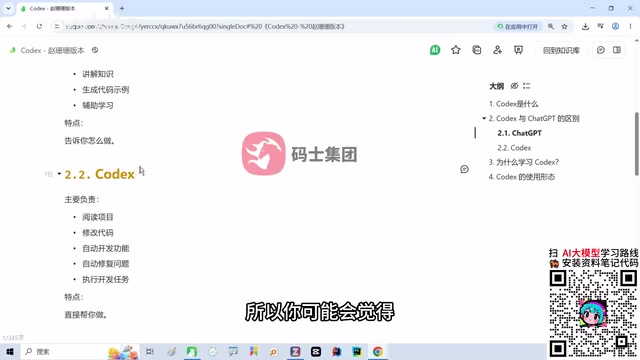
Codex works completely differently. You simply tell it, "Help me implement the login feature," and it will read through the entire project on its own, autonomously modify and generate code, run tests, and debug — then come back and tell you "It's done" once everything is working. Codex handles the "doing."

This distinction between "talking" and "doing" is the most fundamental difference between a coding agent and a traditional chat model. ChatGPT is a provider of knowledge and answers; Codex is an executor of tasks. Once you understand this, it becomes clear why the two deliver such dramatically different experiences despite both being built on large language models.
Core Capabilities of an Agent
More specifically, Codex as a coding agent can handle tasks such as:
- Reading and understanding existing codebases
- Generating new code and integrating it into a project
- Locating and fixing bugs
- Running tests, executing commands and scripts
- Autonomously debugging until the task is complete
These capabilities combined make it far more than a "code generator" — it becomes a development collaborator with the ability to act independently.
Coding agents are able to accomplish these tasks through a "perceive–plan–act" loop: they first perceive the current environment by reading files and searching the codebase, then the underlying model formulates a sequence of steps, and finally real tools (such as terminal commands, file read/write interfaces, and test runners) are invoked to execute those steps. The result of each action is fed back into the model, which then adjusts its next step accordingly — until the task is complete. This is fundamentally different from an ordinary chat model's single-turn Q&A, where the model has no knowledge of whether the code actually runs. An agent can continuously observe environmental changes and self-correct. Codex runs in an isolated cloud sandbox, meaning it can safely execute arbitrary commands without affecting the developer's local environment, and it also makes parallel task handling possible.
Why Developers Should Learn Codex
We have entered the AI era. The old development model was pure manual coding — every line written by hand. Increasingly, that work is being delegated to AI tools and agents, and the developer's role is shifting from "the person who writes code" to "the person who directs AI to write code."

There's a common anxiety worth addressing here: will AI replace programmers? The answer is no. Tools like Codex and Claude Code won't make programmers disappear — if anything, they shift the programmer's responsibility toward review and optimization.
The critical question is: if you know nothing about programming, can you meaningfully review or optimize what the AI produces? Clearly not. So AI hasn't eliminated the professional bar — it has redefined what competitiveness looks like.
The Skills That Matter Are Changing
What will truly be valuable in the future is no longer "who can type code the fastest." Writing five thousand lines of code in a day may have been impressive in the past, but in the era of AI-assisted development, that's no longer the core advantage.
The most competitive people will be those who are best at communicating requirements to AI. The entire development model has shifted from "writing code yourself" to "directing AI to write code." Developers who know how to work with AI tools will vastly outperform those who rely solely on manual coding.
This is precisely why learning Codex, Claude Code, Trae, and similar AI coding tools matters so much: they are the core instruments of assisted development, and essential skills for staying competitive in the new development paradigm.
"Communicating requirements to AI" is commonly known in the industry as Prompt Engineering — but in an agent context, the demands are far higher than crafting ordinary chat prompts. Working with tools like Codex requires the ability to break down vague business requirements into clearly scoped technical tasks, with explicit input/output formats, constraints, and acceptance criteria. Without that clarity, the agent will execute, but may go in entirely the wrong direction. This is also why a solid programming foundation remains indispensable — only someone who understands code can judge whether the AI's implementation is sound, whether there are performance risks, and whether security boundaries have been respected. Claude Code, Trae, and similar tools belong to the same category as Codex and share the same underlying principles, so mastering one significantly reduces the learning curve for the others.
Summary
At its core, Codex represents a fundamentally new mode of human-machine collaboration. It frees developers from the tedium of hands-on code execution, allowing them to focus on expressing requirements, reviewing solutions, and ensuring quality. Understanding the "doing" vs. "talking" distinction between Codex and ChatGPT is the first step into the AI programming era. For every developer, learning to collaborate with these kinds of agents is rapidly shifting from a "nice-to-have" to an absolute necessity.
Related articles

Why PostgreSQL Is the Top Choice in the AI Era: A Complete Guide from Beginner to Advanced
PostgreSQL usage hit 55.6% in Stack Overflow's 2025 survey. Learn why it's the go-to data foundation for AI apps — covering vector search, graph queries, full-text search, and a structured learning path.

LangChain-Fireworks 1.7.1 Released: Fix for Streaming Reasoning Preservation
LangChain-Fireworks 1.7.1 fixes reasoning content loss in streaming and tool call loops, refreshes model profile data, and upgrades langgraph-sdk to 0.4.6.

langchain-huggingface 1.2.3 Released: Dependency Updates and Security Fixes Explained
langchain-huggingface 1.2.3 released with transformers & torch dependency upgrades, API token leakage security fix, and torch.accelerator device-agnostic detection.