Getting Started with Dify: A Complete Guide to the Open-Source Enterprise AI Application Platform

A beginner's guide to Dify, the open-source enterprise-grade AI application platform.
This guide explains what Dify is—an open-source AI application platform within the LLMOps ecosystem—covering its positioning, how it differs from Coze, its RAG and Agent workflow capabilities, private deployment advantages for enterprises, and a step-by-step learning path from concepts to real-world practice.
What Is Dify: Understanding the Core of This Open-Source AI Application Platform
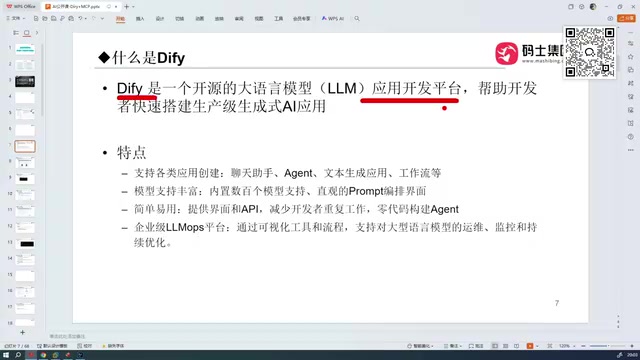
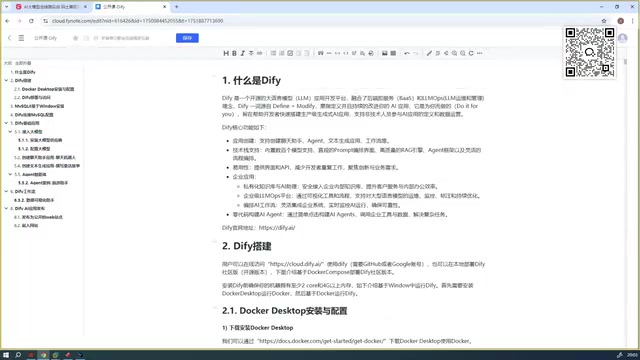
Among the many AI development tools available, Dify has become a popular choice for enterprises and developers building AI applications. In simple terms, Dify is an open-source AI application platform—users can build all kinds of AI applications on top of it, whether to boost personal productivity or solve real-world business problems.
Dify's core positioning is to help users "create AI applications on the platform." These applications can be workflow automation tools or intelligent assistants tailored to specific business scenarios, spanning everything from personal efficiency gains to complex enterprise-level requirements.
From a technical ecosystem perspective, Dify is an important part of the LLMOps (Large Language Model Operations) toolchain. LLMOps is an extension of the MLOps concept into the era of large language models—where MLOps is the best-practice framework for engineering machine learning, LLMOps focuses specifically on the development and operation of applications built on large language models such as GPT, Claude, and Llama. It covers the complete lifecycle management, from model integration, prompt management, and application orchestration to monitoring, evaluation, and version iteration. Within this framework, Dify encapsulates the tedious underlying engineering work into a visual interface, enabling developers without an algorithm background to quickly deliver AI applications.
Dify's Open-Source Nature: Full Control Over Your Data
Dify's source code is fully open, so users can directly access the code for local deployment, secondary development, or customization. For enterprises that prioritize data security, this open-source nature offers tremendous flexibility—you can deploy Dify on your own servers and maintain full control over data flow and system architecture.
An open-source ecosystem also means more active community support and faster feature iteration. Compared with the inherent limitations of closed SaaS platforms in areas like data compliance and private deployment, Dify's openness is often a decisive advantage in enterprise selection. This is especially true in industries such as finance, healthcare, and government, where data sovereignty requirements are strict—"data must not leave the domain" is practically a hard compliance requirement, making open-source private deployment the only viable path. Dify is released under the Apache 2.0 license, which permits commercial use, further reducing legal and compliance concerns for enterprises.
Dify vs. Coze: The Core Difference Between Enterprise-Grade and Individual-Grade
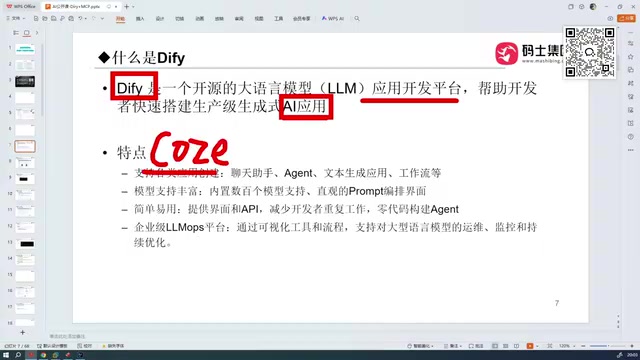
Dify is often compared with Coze. The two share some overlapping features, but their positioning is clearly distinct.
Comparing the Two Platforms
Coze is more oriented toward serving individual developers or small teams, with a product design that emphasizes quick onboarding and lightweight usage. In large enterprise scenarios, however, Dify is often the better choice.
The core differences show up across the following dimensions:
- Private deployment capability: Dify's open-source nature supports full deployment within an enterprise's internal network, meeting compliance requirements that data must not leave the domain.
- System controllability: Enterprises can deeply customize based on the open-source code to accommodate complex internal system integration needs.
- Scalability: For complex workflows and high-concurrency scenarios, Dify's architecture offers stronger capacity.
From a broader industry perspective, this divergence reflects the overall landscape of the current AI application tooling market—lightweight platforms aimed at consumer (C-end) users (such as Coze and ByteDance's Doubao) and engineering-focused platforms aimed at enterprise (B-end) users (such as Dify and Microsoft Copilot Studio) are forming two relatively distinct tracks. When making a selection, enterprises should, beyond comparing features, also comprehensively evaluate the vendor's long-term maintenance capability, SLA commitments, and compatibility with existing IT architecture.
Of course, this doesn't mean Dify is unsuitable for individual users. Dify is equally capable of building efficiency tools for individuals—it's just that its ceiling of capabilities naturally aligns more closely with enterprise-level needs.
What Can Dify Do: From Personal Productivity to Enterprise Business Implementation
Dify's use cases can be divided into two major directions.
Boosting Personal Productivity
For individual users, Dify can be used to build all kinds of productivity-enhancing AI applications. For example, you can create automated content-processing workflows that hand off repetitive daily tasks—text processing, information organization, content generation—to AI, saving significant time.
Enterprise Business Solutions
For enterprises, Dify's value lies in solving specific business problems. Enterprises can build AI applications for particular scenarios based on Dify—intelligent customer service, knowledge base Q&A, document processing automation, and more—directly connecting to real business processes to generate quantifiable business value.
Worth special attention is Dify's outstanding capability in AI workflow building. Dify's workflow engine integrates the two core paradigms of modern AI application development at its foundation. The first is RAG (Retrieval-Augmented Generation)—by combining an enterprise's private knowledge base with a large language model, AI can generate accurate answers based on internal documents retrieved in real time, rather than relying on knowledge frozen at training time. This effectively addresses the problems of model "hallucination" and knowledge timeliness. The second is the Agent paradigm—giving AI the ability to autonomously plan tasks, call external tools (such as search engines, databases, and APIs), and dynamically adjust its execution path based on intermediate results. Through visual workflow orchestration, even users without a deep programming background can string these complex AI capability nodes together to build sophisticated automated processes. This is precisely how Dify lowers the barrier to AI application development.
Dify Learning Path: From Introductory Concepts to Enterprise Practice
For developers who want to systematically master Dify, a step-by-step approach is recommended.
A Four-Stage Learning Path
A complete Dify learning journey typically includes the following stages:
- Understanding the concepts: Clarify Dify's positioning, core components, and applicable scenarios.
- Basic operations: Get familiar with the platform interface and master fundamentals such as application creation and model configuration.
- Workflow building: Learn the logic of workflow orchestration and understand the role of each type of node and how they combine.
- Enterprise-level practice: Turn theory into real delivery capabilities through real project cases (such as 20+ enterprise-grade projects).
DSL Files: A Practical Resource to Accelerate Learning
In the practical process, Dify's DSL files are learning assets worth paying attention to. DSL stands for Domain Specific Language, referring to a programming or configuration language designed for a specific application domain. Compared with general-purpose programming languages like Python and Java, a DSL's design goal is not to solve every problem, but to provide the most concise expression within a specific domain that closely matches the business logic—for example, SQL is dedicated to database queries, and HTML is dedicated to describing web page structure. A Dify DSL file is essentially a complete configuration blueprint for an application, describing in a structured format (usually YAML) the types, parameters, connections, and business logic of all workflow nodes in a Dify application. This is also the technical foundation that enables low-code/no-code platforms to achieve "application portability"—users can export a carefully designed application as a DSL file, reproduce it in a different environment with one click, or share it with other community members for reuse. By studying and reusing these files, learners can quickly understand the construction logic of excellent applications and iterate and optimize on top of them. This "use it as-is and learn by extension" approach is a practical shortcut to efficiently mastering Dify.
Conclusion
With its open-source openness, private deployment options, and powerful workflow orchestration capabilities, Dify is becoming the platform of choice for a growing number of enterprises and developers building AI applications. Its position within the LLMOps toolchain enables it to transform cutting-edge AI paradigms such as RAG and Agent into directly deployable business capabilities. Compared with Coze, which is more focused on individuals and small teams, Dify has a more significant competitive advantage in enterprise-level scenarios.
Whether you are an individual developer or an enterprise technical team, Dify offers a relatively gentle learning curve. Systematically mastering Dify's AI workflow-building capabilities will be a core skill of great market value in the AI era.
Key Takeaways
Related articles

WebMCP in Practice: How MakeMyTrip Is Reshaping the Travel Booking Experience
India's largest OTA platform MakeMyTrip uses WebMCP to standardize AI Agent interactions with web apps, replacing fragile DOM scraping with natural language-driven test automation and simplified complex booking scenarios.

Deep Dive into the EYG Programming Language: A New Portable Programming Paradigm Designed for Humans
Deep analysis of the EYG programming language's core design, including algebraic effects, program state persistence, and cross-platform portability, exploring how it addresses modern software fragmentation.

WebMCP in Practice: How MakeMyTrip Is Reshaping the Travel Booking Experience
India's largest OTA platform MakeMyTrip uses WebMCP to standardize AI Agent interaction with web apps, solving DOM scraping fragility, enabling natural language test automation, and simplifying complex international flight bookings.