Getting Started with Florence-2-Large: One Model for Multi-Task Vision

Florence-2-Large: one model, many vision tasks via prompt switching—benefits, limits, and code.
Florence-2-Large is a sequence-to-sequence vision foundation model trained on 126M images with 5.4B annotations. It unifies captioning, object detection, region description, visual grounding, and segmentation prompt generation through prompt switching, eliminating multi-model orchestration. The article covers four priority scenarios, five key limitations (text parsing, color loss, small objects, vocabulary boundaries, undisclosed hardware), comparisons with base, Kosmos-2, InternVL, and Llama 3.2 Vision, plus Python starter code and deployment tips including licensing and fine-tuning.
Title
Getting Started with Florence-2-Large: One Model for Multi-Task Vision
Meta Description
Florence-2-Large is a multi-task vision foundation model deployed by Lucataco on Replicate, unifying image captioning, object detection, visual grounding, and segmentation prompts. This article covers its core capabilities, four ideal use cases, five key limitations, model selection comparisons with base, Kosmos-2, InternVL, and more, plus Python starter code.
Article Content
In the engineering practice of vision AI, a recurring pain point is this: you use one model for image captioning, switch to another for object detection, and then have to deploy yet another set for region localization. Every added capability brings extra inference latency and another layer of service orchestration complexity. Florence-2-Large attempts to solve this with a "unified architecture + prompt-based task switching" approach. Based on the getting-started guide published by AImodels.fyi, this article outlines the model's capability boundaries, use cases, and deployment considerations.
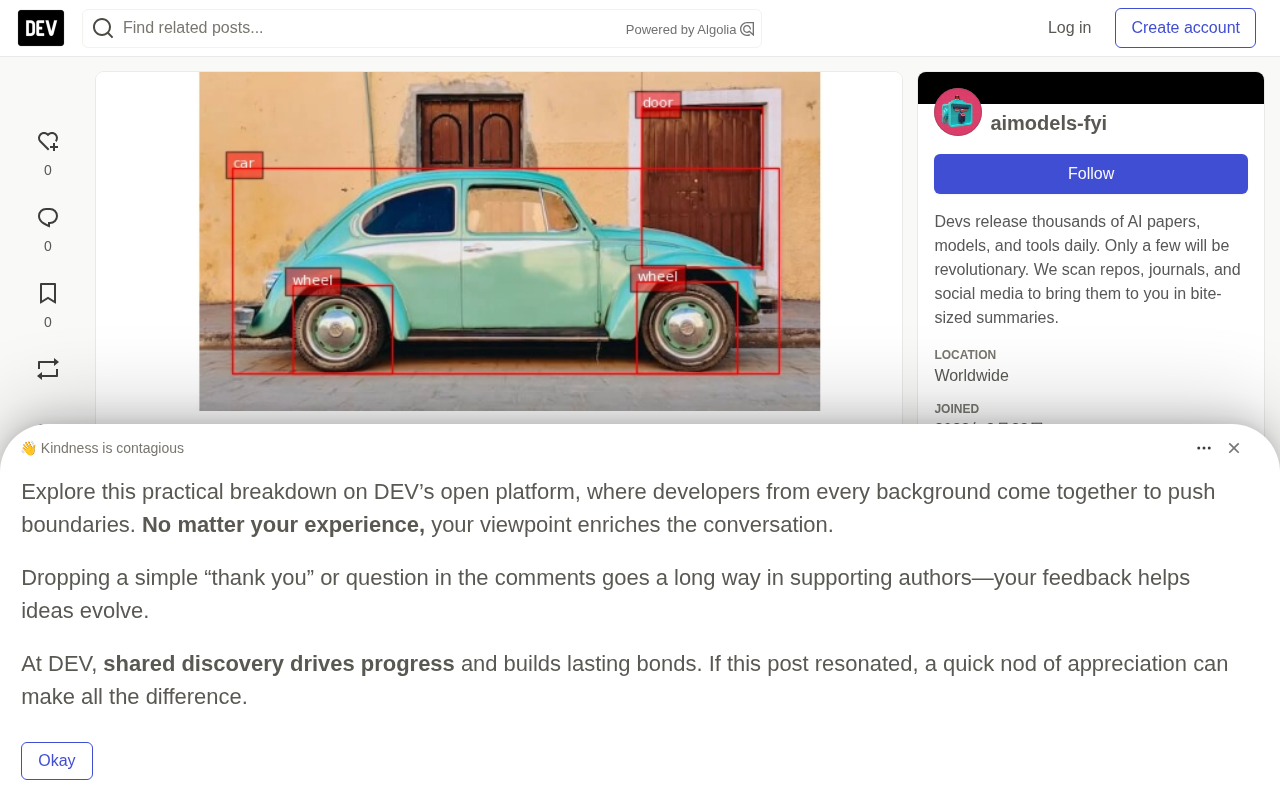
What a Unified Architecture Means
Florence-2-Large is a vision foundation model built on a sequence-to-sequence Transformer architecture. It takes two types of input—images and text prompts—and outputs task results uniformly in text form. According to the original authors, the model was trained on the FLD-5B dataset, which covers 126 million images and contains 5.4 billion visual annotations.
The core value of this design is not about achieving the best performance on any single task, but about "deploy once, reuse across tasks." Image captioning, object detection, region description, visual grounding, and segmentation prompt generation are all invoked by switching the task_input parameter, with no need to fine-tune a separate model for each task. For pipelines that need to chain multiple vision capabilities, this directly eliminates the latency and engineering complexity of model switching.
Sequence-to-sequence architecture was originally used for machine translation; its characteristic is that it takes one sequence as input and outputs another, with the two ends able to have different lengths. Florence-2 concatenates the feature sequence produced by passing an image through a vision encoder with the token sequence of a text prompt, feeds it into the encoder, and then has the decoder autoregressively generate a text answer. The flexibility of this design lies in the fact that the same set of weights can handle any "input → text" mapping. Task differences are expressed entirely by prompt prefixes (such as <CAPTION>, <OD>) without changing the network structure or adding task heads. The cost is that outputs must be "textified"—coordinates, polygons, and other structured results all have to be serialized into strings and then parsed, which is the root cause of the parsing overhead mentioned later.
Four Scenarios Worth Prioritizing
Multi-task pipelines for product intelligence. After an e-commerce platform ingests a product image, it can use different prompts to generate listing descriptions, detect SKUs or defects, and localize price tag regions—all within a single inference framework. Compared with chaining multiple specialized models, a unified architecture reduces service orchestration overhead.
Document and form understanding. Scenarios such as insurance claims, mortgage material review, and contract analysis require simultaneously recognizing text regions, detecting form fields, and grounding natural language references to specific image regions. Florence-2-Large's advantage is that it uses prompts to drive structured element extraction without relying on rule-based extraction logic.
Zero-shot visual grounding. The model supports specifying targets in natural language and returning bounding boxes, such as "find the red bicycle in the image." This means that when building interactive retrieval tools, you don't have to first collect annotated data and then train a specialized detector.
Large-scale accessibility caption generation. Platforms serving visually impaired users or organizations archiving massive image collections can use it to batch-generate natural language descriptions. Compared with smaller models, the large version produces more informative descriptions when handling complex scenes containing multiple objects and actions.
Five Limitations You Must Know
First, the output is in text format. The bounding box coordinates and segmentation prompts returned by the model are strings, and downstream systems must parse and convert them before use. This introduces extra latency, and when the text format is inconsistent in edge cases, the parsing logic needs to handle errors gracefully.
Second, color information may be discarded. The model schema notes "Grayscale input image," implying that input may be converted to grayscale. If your task depends on color discrimination—such as identifying red anomalies or distinguishing objects by color—this model is not suitable unless you preprocess to encode color into grayscale space or pair it with a color-aware model.
Third, performance is limited on small objects and fine-grained tasks. Tiny defects in industrial quality inspection, small printed text, and millimeter-scale component recognition may suffer from missed detections or vague descriptions. Such scenarios are better suited to specialized detection or OCR models trained on high-resolution close-up data.
Fourth, the task vocabulary has boundaries. The model's capability range is limited to the prompt types trained during the FLD-5B annotation stage. For highly vertical new tasks—such as rare failure mode detection in manufacturing or geological structure recognition in satellite imagery—if the visual patterns differ too much from the training data, the model may produce hallucinations or generic descriptions.
Fifth, speed and hardware requirements are not disclosed. As a large vision-language model, inference typically requires a GPU. Latency-sensitive applications such as large-scale batch inference or real-time video streams may hit performance bottlenecks more easily than smaller models or inference-optimized versions.
Understanding the "grayscale input" limitation requires distinguishing two things: the model architecture itself does not reject color images, and the vision encoder typically accepts three-channel input; but if the preprocessing pipeline converts the image to a single channel during resizing and normalization, color information is already lost before it enters the model. Florence-2's training data consists mainly of image-text pairs and annotations, and color is not a focus of its supervision signal, so even if the input retains color, the model may not reliably use hue for judgments. In practice, you can verify this in two ways: compare whether the output description changes when the same object is recolored; or explicitly include color as part of the text_input prompt and observe whether the model can ground accordingly. If the two results show no difference, it means the color channel cannot be relied upon for that task.
How to Choose Compared with Similar Models
Compared with florence-2-base of the same architecture, the large version has more parameters and higher accuracy on complex scenes and fine-grained tasks; the base version is 15%–20% faster in inference and uses less memory. Choose base when throughput is the priority, and large when quality is the priority and the compute budget allows.
Compared with kosmos-2, the latter is designed with vision-language alignment as its core and is stronger at open-ended reasoning and spatial relationship question answering (such as "what is to the left of the person"); Florence-2-Large is more efficient on batch annotation tasks and supports more structured output formats.
Compared with internvl3_5-30b, the latter has broader language understanding and reasoning capabilities but is slower and more compute-intensive. Choose InternVL when you need fine-grained scene understanding or complex image question answering; choose Florence-2-Large for high-throughput annotation pipelines and single-task vision workloads.
Compared with ollama-llama3.2-vision-11b, the latter leans toward conversational, general-purpose image question answering; if you are building a chatbot interface, choose Llama 3.2 Vision, while if you need structured task execution and fine-grained subtasks such as detection and grounding, Florence-2-Large is more suitable.
As for realistic-vision-v4.0, it is an image generation model with the opposite function and complementary role to this model: one understands images, the other generates them.
Inputs, Outputs, and Starter Code
The implementation on Replicate accepts three types of input: a URI-format image; a task_input enum (default Caption) specifying the vision subtask to perform; and an optional text_input natural language prompt to guide task execution, such as specifying target classes for detection. The output includes text (the task result in text form) and an optional img (a visualization rendering bounding boxes or segmentation masks on the input image). The model files are in Hugging Face format and run on Replicate infrastructure via Cog.
The simplest call only needs to specify the task as Caption:
import replicate

client = replicate.Client(api_token="your-api-token")

output = client.run(
    "lucataco/florence-2-large:da53547e17d45b9cfb48174b2f18af8b83ca020fa76db62136bf9c6616762595",
    input={
        "image": "https://example.com/car.jpg",
        "task_input": "Caption",
        "text_input": None
    }
)
print(output)

The values of `task_input` are not arbitrary strings but fixed enums from the **task prompt vocabulary** defined during model training. Common ones include `<CAPTION>`, `<DETAILED_CAPTION>`, `<MORE_DETAILED_CAPTION>`, `<OD>` (object detection), `<DENSE_REGION_CAPTION>` (region description), `<REGION_PROPOSAL>`, `<CAPTION_TO_PHRASE_GROUNDING>` (visual grounding), `<REFERRING_EXPRESSION_SEGMENTATION>`, and `<OCR_WITH_REGION>`. The Replicate wrapper maps these tokens to readable names such as Caption, ObjectDetection, and Grounding, but under the hood they are still these special tokens. Choosing the wrong task name or inventing your own will not raise an error; the model will simply degrade to generic descriptions. Therefore, before integration, consult the task list in the original repository and hard-code the name mapping in your configuration.
# Returns: {"text": "A green car parked in front of a yellow building.", "img": "https://..."}
When switching to object detection, change task_input to ObjectDetection and list the classes you care about in text_input, for example "car, person, traffic sign". For visual grounding, set task_input to Grounding and write the natural language target in text_input, for example "the red bicycle".
Practical Judgments Before Deployment
Coordinate parsing is an unavoidable step. The official FAQ explicitly states that text output usually cannot be used directly in production; coordinate strings need to be parsed back into arrays, polygon coordinates, or numpy masks, and error handling must be prepared for edge cases with malformed formats.
Commercial licensing must be verified independently. The model uses the Microsoft Research License, and research licenses often impose restrictions on commercial product distribution. Before planning commercial use, carefully read the specific terms in the Hugging Face repository.
Fine-tuning is not covered by the hosted service. The model on Replicate only provides inference. If you want to adapt to your own data for a specific domain, you need to pull the original Florence-2 code from Hugging Face or the research repository and train locally or on your own compute.
The impact of image resolution lacks official documentation. Higher resolution may improve small object detection but increases inference latency. It is recommended to test the trade-off between latency and accuracy using actual business image sizes.
One final reminder: the deployed version on Replicate stays at an earlier point in time. The hosted inference is maintained independently by Replicate, but the maintenance status of the original Florence-2 research code needs to be confirmed in Microsoft's Hugging Face repository.
The Microsoft Research License is a research-use license that generally allows academic and non-commercial use but imposes additional conditions on commercial distribution, hosted services, and sublicensing. Some versions also require derivative models to be open-sourced as well or require a separate commercial license application. Determining whether commercial use is allowed cannot rely solely on "whether it can be downloaded for free"; you must check the license text in the repository item by item, focusing on: whether it allows use in revenue-generating products, whether it allows offering as an API externally, and whether it requires attribution or contributing improvements back. If the product is in an early validation stage, you can first use the research license for prototyping; before commercialization, it is advisable to involve legal review or consider a commercially friendly alternative model as a fallback to avoid being forced to migrate after launch.
One-line Summary
Florence-2-Large uses a unified architecture and prompt switching for multiple tasks, eliminating multi-model orchestration, but you need to weigh text parsing, color loss, and licensing restrictions.
Paragraph Summary
Florence-2-Large is a vision foundation model based on a sequence-to-sequence Transformer, trained on the FLD-5B dataset containing 126 million images and 5.4 billion annotations. Its core value is not极致 performance on any single task but "deploy once, reuse across tasks": image captioning, object detection, region description, visual grounding, and segmentation prompt generation can all be invoked by switching task_input, eliminating the latency and engineering complexity of chaining multiple models. The article provides four priority scenarios (product intelligence, document forms, zero-shot grounding, accessibility description) and five limitations (text output requires parsing, color may be lost, small objects are limited, task vocabulary has boundaries, speed and hardware are undisclosed), and compares model selection with base, Kosmos-2, InternVL, and Llama 3.2 Vision. During deployment, pay attention to coordinate parsing error tolerance, Microsoft Research License commercial verification, fine-tuning requiring original code, and the trade-off between resolution, accuracy, and latency.
Related articles

Gemini 4 Argon Hands-On: AI Builds Board Games, Constructs Temples, and Trains Robots Autonomously
Gemini 4 Argon hands-on roundup: AI autonomously builds a desk racetrack and temple in Blender, writes a ray tracing engine, trains a humanoid robot to sink 7 shots, plus API pricing and developer access.

The Magic Octagonal Coin: Why Only 9% of People Can Predict Its Flip?
Only 9% of people can correctly predict the Magic Octagon coin flip. This article explains its spatial rotation mechanism, common cognitive pitfalls, and a new hypothesis based on Relevance Theory, exploring the limits of human spatial reasoning.

Sam Altman: AI Is Entering the Era of Scientific Discovery — Math Breakthroughs Will Replicate in Biology and Energy
Sam Altman says AI is entering the era of scientific discovery — math breakthroughs will replicate in biology, materials science, and energy to help develop new drugs and energy sources.