Getting Started with n8n: A Deep Dive into the Open-Source Workflow Automation Platform

n8n is a powerful open-source low-code automation platform with 500+ nodes and deep AI integration support.
n8n is a general-purpose low-code workflow automation platform — not just an AI tool. With 500+ native integration nodes, flexible flow control, and mature AI/RAG support, it covers everything from traditional automation to AI Agent development. Its main challenge for Chinese users is a node ecosystem built primarily for Western services.
What Is n8n: More Than Just an AI Workflow Tool
Many people, when they first encounter n8n (pronounced "n-eight-n"), instinctively categorize it as an "AI workflow tool." That's not quite accurate — at its core, n8n is a general-purpose workflow automation platform. It handles everything from data cleaning and web scraping to deep integration with large language models for building complex AI applications.
More precisely, n8n is a low-code platform. Low-code has become a major trend in enterprise software — by combining visual drag-and-drop interfaces, pre-built component libraries, and templates, it multiplies development efficiency. Gartner predicts that by 2025, 70% of new applications globally will be built using low-code or no-code technologies. n8n sits in the "low-code" camp rather than "no-code": it retains code extensibility (supporting JavaScript expressions and custom function nodes), allowing users with programming knowledge to go beyond the visual interface and handle more complex business logic. Without writing large amounts of code, you can drag and drop nodes in a visual interface to build automated workflows tailored to your business needs. This low-code approach is precisely what makes it accessible to newcomers.
How n8n Differs from Dify and Coze
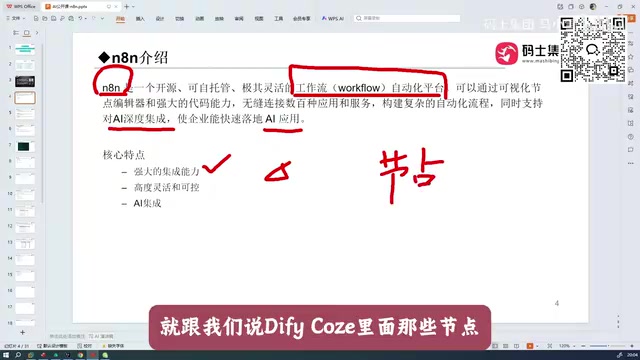
If you've used Dify or Coze, you'll notice that n8n's node concept is similar — each node handles an independent function. But understanding the differences helps you make the right tool choice: Dify is positioned as an LLMOps platform, focused on developing, deploying, and operating large model applications; Coze (扣子), launched by ByteDance, is built for rapid AI Bot and agent creation, deeply integrated with domestic LLM ecosystems like Doubao. Both platforms' workflow capabilities serve AI-centric scenarios with relatively well-defined boundaries. n8n, by contrast, follows an "automation-first" design philosophy — AI integration is a capability extension, not its core identity. This means n8n covers a much wider range of use cases: from traditional task automation all the way to AI Agent construction. For cross-system data pipelines, scheduled task orchestration, and multi-step business workflows — scenarios that have nothing to do with AI — n8n often outperforms AI-specialized platforms. That's the core reason it's earned the title of "workflow powerhouse."
Three Core Strengths of n8n
Now that we've established what n8n is, let's look at where it truly shines.
1. A Massive Integration Ecosystem with 500+ Nodes
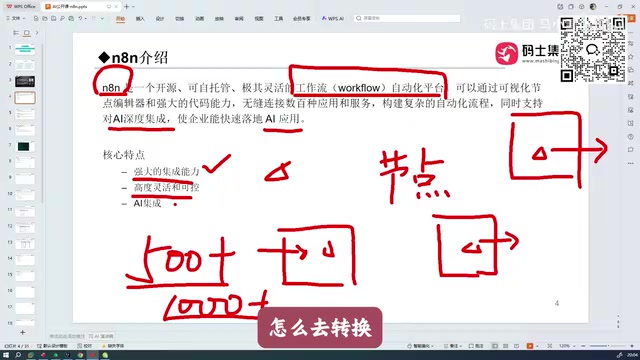
One of n8n's biggest advantages is its remarkably rich native node library. Each node handles one independent function: publishing videos, scraping web pages, fetching news content, and more. By most counts, n8n has at least 500 built-in nodes, with some estimates putting the number above 1,000. By comparison, platforms like Dify and Coze offer far fewer native nodes.
A rich node ecosystem means you can connect to virtually any mainstream service on the market without writing integration code from scratch.
2. Highly Flexible Flow Control
n8n's second strength is the flexibility of workflow construction. By combining different types of nodes, you can implement fairly complex business logic:
- Branch nodes: Route execution down different paths based on conditions
- Loop nodes: Process data in bulk
- Error-handling nodes: Manage exceptions gracefully
- Data transformation nodes: Clean and format data
A single workflow can handle high levels of business complexity — almost any combination of nodes can be assembled to meet your requirements. This level of control is something many closed SaaS platforms simply can't match.
3. Mature AI Integration Capabilities
n8n provides solid AI integration support, enabling you to build AI Agents, RAG pipelines, and other intelligent applications on top of it. RAG (Retrieval-Augmented Generation) is a core architectural pattern in modern AI applications: before calling a large language model to generate a response, the system first retrieves relevant content from an external knowledge base (such as documents or databases) and feeds it as context to the model — improving accuracy, keeping responses current, and reducing hallucinations. n8n's support for RAG means users can orchestrate the full pipeline — "document parsing → vectorization → storage → retrieval → model invocation" — directly within a workflow, without building a standalone RAG framework from scratch. This means n8n isn't just for traditional automation; it can serve as the foundation for AI applications, seamlessly embedding large model capabilities into automated workflows.
Why Is n8n Less Common in China? The Localization Gap
With all these capabilities, why is n8n adoption relatively low among Chinese enterprises? The reason is straightforward.
A Node Ecosystem Built for Global (Primarily Western) Markets
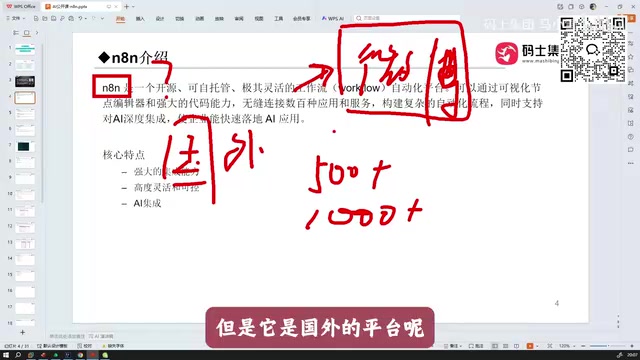
The core issue is this: n8n is a platform built for international markets, and its node ecosystem primarily covers overseas services.
A few telling examples:
- There's a YouTube node for publishing videos, but no native nodes for Weibo or Bilibili
- You can send messages to Telegram, but there's no direct WeChat integration node
- The Google Sheets node lets you write data to spreadsheets, but Feishu (Lark) multi-dimensional tables aren't supported
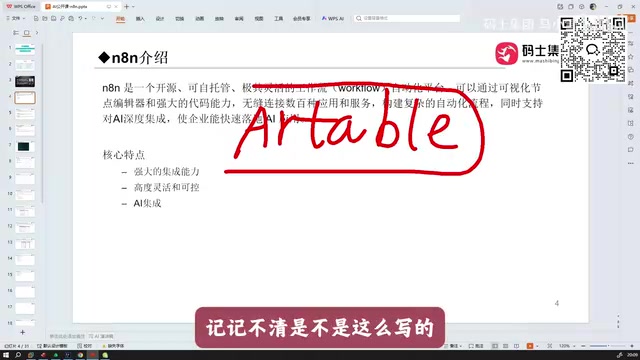
- Airtable and similar online databases are supported, but domestic database products have little to no native support
The Hidden Cost of Missing Localization
For users in China, platforms like WeChat, Feishu, Weibo, and domestic databases are almost entirely without out-of-the-box nodes. In these cases, you'll need to rely on the HTTP Request node — n8n's universal "catch-all" connector. As long as the target service exposes an open API (such as a REST API), you can manually construct request headers, bodies, and authentication parameters through the HTTP node to complete the integration. Feishu, DingTalk, and WeCom all provide comprehensive open API documentation, so technical users can get integrations working via the HTTP node — it's a viable path. However, compared to native nodes, it requires extra debugging effort and significantly diminishes the "plug-and-play" experience.
This doesn't mean n8n can't work in a Chinese context — it just means this tradeoff is worth evaluating before committing to the platform.
Getting Started with n8n: From Concept to Practice
For developers and operators looking to get hands-on with n8n, the first step isn't rushing to build complex workflows — it's building the right mental model:
- Recognize it as a low-code general-purpose platform, not an AI-exclusive tool — its applications are broad
- Leverage node combinations to build robust automated flows using branches, loops, and error handling
- Evaluate node coverage early — if your business heavily depends on Chinese platforms, budget time for HTTP node integrations
n8n's core value lies in making automation visual, composable, and extensible. Whether you're processing data, distributing content, or building an AI Agent, it provides a flexible enough foundation for the job. Once you understand the node logic, getting up to speed within a week is entirely achievable.
Key Takeaways
Related articles

Disaster and Glory of the Apollo Program: The History We Must Revisit Before Returning to the Moon
From the fatal Apollo 1 fire to Apollo 8's daring lunar orbit to Apollo 11's successful landing—revisiting the disasters, fears, and compromises of the Apollo program and their lessons for today's return to the Moon.
Netflix Trust Exercise Turns Into Firing Trap: Where Are the Boundaries of Corporate Trust?
A Netflix employee was fired after sharing private info in a trust exercise. We analyze the risks of corporate trust exercises and how employees can protect themselves.

AMD CDNA5 Architecture Deep Dive: Technical Evolution and the AI Computing Competition Landscape
Deep analysis of AMD's CDNA5 architecture covering Chiplet packaging upgrades, HBM memory evolution, and low-precision compute optimization, examining how AMD challenges NVIDIA's AI chip dominance.