Getting Started with Software Testing: A Complete Guide to Core Concepts and Classification Systems

A complete beginner's guide to software testing core concepts, classification systems, and essential terminology.
This guide covers software testing fundamentals from the ground up, including the definition of software (program + data + documentation), B/S vs C/S architecture differences, testing classifications by phase, technique, and method, and essential concepts like smoke testing, regression testing, and exploratory testing. It also provides practical interview preparation tips for aspiring QA professionals.
What Is Software? It's More Than Just a Program
Many beginners instinctively think "software is just a program," but this understanding is incomplete. In the context of software testing, Software = Program + Data + Documentation — these three components together form the system under test.
This definition originates from the IEEE (Institute of Electrical and Electronics Engineers) standard and is widely accepted in the software engineering field. A program is a collection of instructions that a computer can execute; data refers to the information objects processed by the program, including input data, output data, and intermediate data; documentation encompasses all textual and graphical materials produced during software development, maintenance, and usage. This triad model is particularly important for testers because it clearly defines the boundaries of testing — you need to test not only code logic but also verify data integrity and documentation accuracy.
Take Taobao as an example: the program is the Taobao App itself; data includes user information, browsing history, order details, shopping cart, favorites, and other business data; documentation covers user manuals, privacy policies, help documents, and more. This means testers must verify not only whether program functions work correctly but also whether data is accurate and documentation is properly maintained.
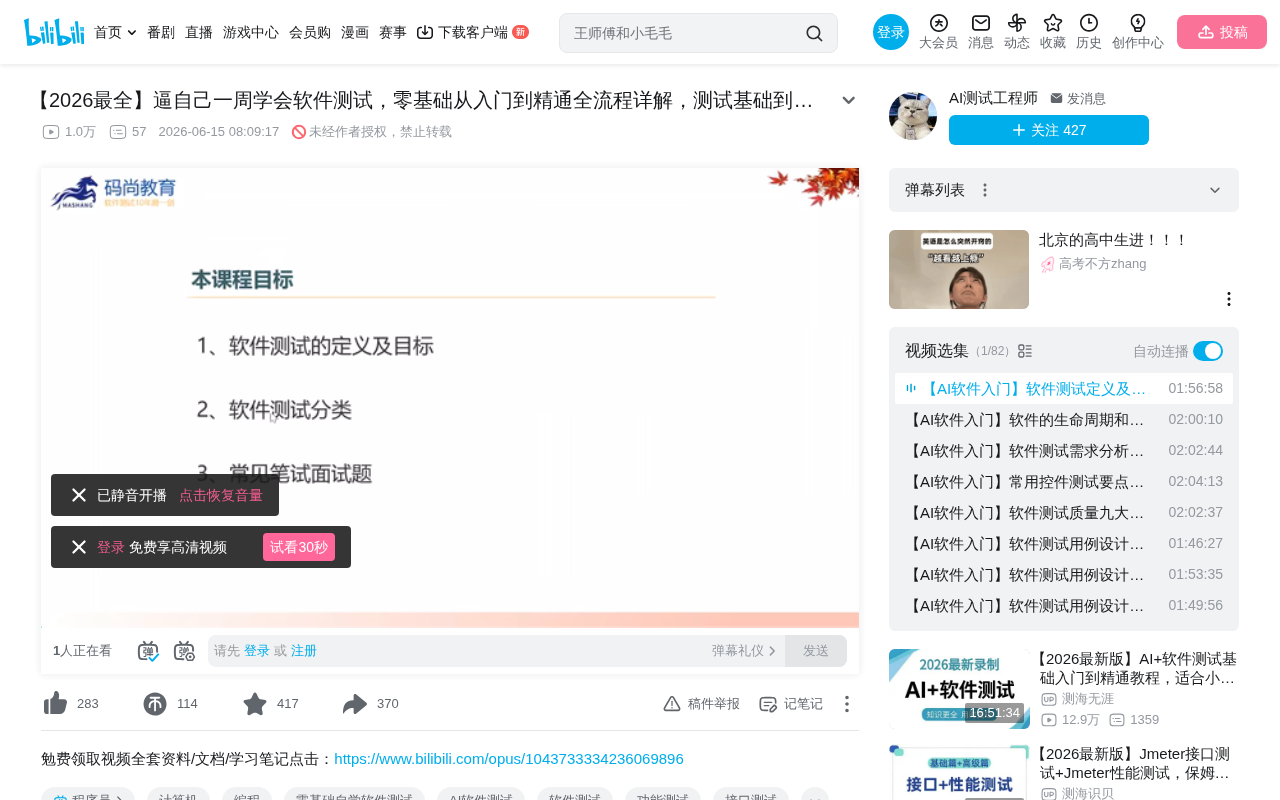
Software can be categorized into two major types: application software and system software. Application software is developed to solve specific needs, such as Taobao (shopping), WeChat (social networking), and Meituan (lifestyle services). System software provides the runtime environment for other programs, such as Windows, Android, iOS, Linux, and other operating systems. Without system software, application software cannot run.
The Difference Between B/S and C/S Architecture
Application software comes in two architectural patterns:
- B/S Architecture (Browser/Server): Software accessible through a browser, such as the web versions of Taobao and JD.com
- C/S Architecture (Client/Server): Software that requires installing a client application, such as WeChat, QQ, and other desktop or mobile apps
The distinction is simple: if you can access it directly through a browser, it's B/S architecture; if you need to install a client, it's C/S architecture.
However, the differences go far beyond access methods — they involve fundamental differences in underlying technology stacks and testing strategies. B/S architecture is based on HTTP/HTTPS protocols, uses HTML, CSS, JavaScript, and other web technologies on the frontend, and provides services through APIs on the backend. It's inherently cross-platform but constrained by browser sandbox security mechanisms. C/S architecture clients interact directly with the operating system, can access local hardware resources (such as cameras and file systems), offer better performance, but require separate development and testing for different platforms.
For testers, B/S architecture requires focusing on browser compatibility, network latency, and frontend-backend API consistency. C/S architecture demands attention to installation/uninstallation, version upgrades, local caching, and system resource usage. This distinction is frequently asked in interviews and is essential information for testing work, as different architectures require different testing strategies.
Definition and Purpose of Software Testing
The standard definition of software testing is: the process of using manual or automated means to run or test a system, with the purpose of verifying whether the software meets specified requirements, or identifying differences between expected results and actual results.
There are several key concepts to understand here:
The Software Requirements Specification (SRS) serves as the standard basis for testing. SRS is a formal document defined in the IEEE 830 standard. Requirements are not defined by testers but are collected and organized by product managers from user needs. Testers use this as their standard to verify whether the software's actual behavior matches the requirements.
In practice, SRS takes many forms: large enterprises may have strict Word documents, internet companies may use Confluence, Feishu Docs, or requirement descriptions in JIRA, and startups may only have verbal explanations or prototypes from product managers. Testers should note that when requirement documents are incomplete, they should proactively communicate with product managers for confirmation rather than testing based on their own assumptions. Ambiguity and incompleteness in requirements are themselves "defects" that testers need to identify — this falls under static testing during the requirements review phase.
Expected results are what should be obtained according to the specification; actual results are what you get by operating the software under test. When these two don't match, a Bug is produced — this is the most fundamental technical term in software testing.

The purpose of software testing can be summarized in three points:
- Finding Bugs: Discover as many defects as possible to ensure software quality
- Reducing Costs: The earlier a bug is found, the lower the cost to fix it. Problems discovered later often involve larger scope of changes, requiring more manpower and time
- Improving Quality: Enhance user experience and overall product quality by finding and fixing issues
Regarding the second point, IBM's Systems Sciences Institute provided classic quantitative data: the cost of fixing a defect found during the requirements phase is 1x, during design it's 5x, during coding it's 10x, during testing it's 20x, and after product release it soars to 150x. This multiplier relationship is known as the "defect amplification effect" or the "1-10-100 rule." The reason is that late-stage fixes involve not only code changes but may also require redesigning architecture, modifying database structures, updating released versions, handling user complaints, and even facing legal risks. This is the fundamental reason why modern software engineering emphasizes the "Shift-Left Testing" philosophy.
The Software Testing Classification System
Software testing has different classification methods from different dimensions, and this is a frequently tested topic in interviews and written exams.
By Phase: From Unit Testing to Acceptance Testing
Following the software development lifecycle, testing is divided into four phases:
| Phase | Test Object | Tester | Description |
|---|---|---|---|
| Unit Testing | Program code (modules/classes/functions) | Developers | Verifies the smallest testable units |
| Integration Testing | Multiple units combined | Developers | Verifies that modules work together correctly |
| System Testing | Complete software system | Testers | Comprehensive verification against the SRS |
| Acceptance Testing | Complete software system | Testers/Users | Confirms software meets user requirements |
Unit testing is the process of verifying the smallest testable units in software — in object-oriented programming, this is typically a method or function. Common unit testing frameworks include JUnit and TestNG for Java, pytest and unittest for Python, and Jest and Mocha for JavaScript. Unit tests typically follow the AAA pattern (Arrange-Act-Assert): prepare test data, execute the method under test, and assert whether the result meets expectations. In practice, unit test coverage is an important metric for code quality, with the industry typically requiring core modules to achieve over 80% line coverage. TDD (Test-Driven Development) elevates unit testing to the level of a development methodology.
Acceptance testing is further divided into Alpha testing and Beta testing, with the core difference being:
- Alpha testing: Conducted in the company's internal environment, with controlled conditions and concentrated timeframes
- Beta testing: Conducted in real user environments (i.e., "public beta"), with uncontrolled conditions and scattered timeframes
- Alpha testing precedes Beta testing — "internal testing first, then public testing"
By Testing Technique: Black Box, White Box, and Gray Box
- Black box testing: Ignores internal implementation logic and only verifies whether external functions work correctly. You input values and check whether the output matches expectations
- White box testing: Focuses on the specific implementation of internal code logic, requires the ability to read development code, and has higher technical requirements
- Gray box testing: Falls between black box and white box, considering both external functionality and some internal logic
Junior and mid-level testers primarily perform black box testing.
By Whether the Test Object Is Running
- Dynamic testing: Tests by running the system under test, verifying whether actual results match expected results
- Static testing: Tests without running the system, including document reviews, code walkthroughs, desk checks, etc.
By Testing Method: Manual Testing vs. Automated Testing
- Manual testing: Testing through manual operations (clicking around)
- Automated testing: Using code or tools to replace manual operations for testing. The two are complementary — automation doesn't eliminate the need for manual testing
By Testing Content
- Functional testing: Verifies whether each software function is correctly implemented
- UI testing: Checks layout, colors, fonts, typos, and other visual elements
- Compatibility testing: Verifies functionality across different browsers, operating systems, and devices
- Usability testing: Evaluates from the user's perspective whether operations are convenient and easy to understand
- Security testing: Verifies whether the system can resist malicious attacks and protect user data from theft
- Performance testing: Verifies whether the system can still function normally under high concurrent user loads

Four Essential Testing Concepts You Must Master
Smoke Testing
Smoke testing is performed before system testing to verify whether the software's core functions work properly. Only after smoke testing passes is the software handed over to the testing department for formal system testing. If smoke testing fails, the software is sent back to the development team for fixes before resubmission. This process prevents testers from wasting time when basic functionality isn't even working.
The term "smoke testing" originates from hardware engineering. In the early days, after assembling electronic devices, engineers would first power them on to see if any components started smoking — if they did, it indicated a serious hardware problem that needed to be resolved before detailed testing could proceed. After this concept was adopted in software testing, its meaning evolved to: quickly verifying whether the software's core workflows function before conducting thorough system testing. Smoke test cases typically cover about 20% of the software's core functional paths and are designed to be executed within 30 minutes to 2 hours. In CI/CD environments, smoke tests are usually automated and integrated into the build pipeline, triggered automatically after each code commit.
Regression Testing
Regression testing is the process of re-verifying previously fixed bugs. It operates on two levels: first, confirming whether the bug has truly been fixed; second, verifying whether the fix has introduced new problems — which is why you also need to test functional modules related to the bug.
Regression testing is so important because modules in software systems often have complex dependencies, and modifying code in one place can create a "butterfly effect" that impacts seemingly unrelated features. Statistics show that the probability of introducing a new bug while fixing an existing one is approximately 15%-50%. In agile development, each iteration cycle (typically 2-4 weeks) involves numerous code changes, making manual regression testing extremely costly. Therefore, regression testing is the scenario with the highest ROI for test automation — by automating stable regression test cases, you can execute them quickly after each build, significantly shortening the feedback cycle. CI tools like Jenkins, GitLab CI, and GitHub Actions all support automatically triggering regression test suites.
Random Testing and Exploratory Testing
These two types of testing are supplementary tests based on the tester's experience and intuition, going beyond conventional logic. For example, entering a negative number in a top-up function to see if the system throws an exception. These tests often uncover edge cases that developers easily overlook and serve as an effective complement to formal testing.
It's worth noting that Exploratory Testing is not entirely random "monkey testing" but rather a systematic testing method. Systematized by testing experts James Bach and Cem Kaner, its core philosophy is to perform test design and test execution simultaneously, leveraging the tester's domain knowledge and intuition to discover defects. A commonly used approach is Session-Based Test Management (SBTM), which uses fixed time periods (typically 60-90 minutes) as test sessions, sets a clear test charter, and records findings and coverage after the session ends. Exploratory testing is particularly effective at discovering scenarios not described in requirement documents, user experience issues, and boundary condition defects.
Key Points for Software Testing Interview Preparation
Software testing interviews typically consist of three rounds: a written exam, a technical interview, and an HR interview. Common topics in the written exam include:
- Components of software (Program + Data + Documentation)
- The definition and three purposes of software testing
- The difference between Alpha testing and Beta testing
- The difference between black box testing and white box testing
- The timing and workflow of smoke testing
- The content and methods of regression testing
- Distinguishing dynamic testing from static testing (document reviews and code walkthroughs are static testing)
These concepts don't need to be memorized by rote. The key is to understand the essence of each type of testing — what it tests, who performs it, and when it's performed. Building this cognitive framework will allow you to confidently handle any variation of these questions.
Key Takeaways
Related articles

Disaster and Glory of the Apollo Program: The History We Must Revisit Before Returning to the Moon
From the fatal Apollo 1 fire to Apollo 8's daring lunar orbit to Apollo 11's successful landing—revisiting the disasters, fears, and compromises of the Apollo program and their lessons for today's return to the Moon.
Netflix Trust Exercise Turns Into Firing Trap: Where Are the Boundaries of Corporate Trust?
A Netflix employee was fired after sharing private info in a trust exercise. We analyze the risks of corporate trust exercises and how employees can protect themselves.

AMD CDNA5 Architecture Deep Dive: Technical Evolution and the AI Computing Competition Landscape
Deep analysis of AMD's CDNA5 architecture covering Chiplet packaging upgrades, HBM memory evolution, and low-precision compute optimization, examining how AMD challenges NVIDIA's AI chip dominance.