Getting Started with SRC Vulnerability Discovery: The Legal Boundaries and Operating Mechanisms of White Hat Hackers

SRC is an official enterprise vulnerability collection platform, and white hats must hunt bugs within authorized scope and fulfill confidentiality obligations to profit legally.
This article systematically introduces the concept, operating mechanism, and legal boundaries of SRC (Security Response Center). SRC is an official vulnerability collection platform built by enterprises. After discovering vulnerabilities within the authorized testing scope, white hats submit them through the platform; enterprises verify and fix them and provide bounties, points, or honors, creating a win-win cycle. The article emphasizes that the only dividing line between legal bug hunting and hacking is written authorization, and unauthorized testing may violate relevant laws. It also notes that white hats are strictly prohibited from disclosing details before remediation and provides a beginner learning path.
What Is SRC? Much More Than Just an Acronym
SRC, short for Security Response Center, plays the role of a vulnerability collection hub in a company's security system. According to a systematic course explained by a Bilibili content creator, SRC is essentially a platform officially built by enterprises specifically to collect security vulnerability reports submitted by white hat hackers.
Various applications, systems, and platforms operated by enterprises inevitably have business logic flaws or other security risks during online operation. The purpose of SRC is to give these risks a proper feedback channel rather than letting them be maliciously exploited.

White hat is the term used in the cybersecurity field for a special group of technicians. They possess penetration testing and vulnerability discovery skills similar to those of hackers, but unlike black hat hackers who exploit vulnerabilities for profit, white hats choose to report vulnerabilities to enterprises or relevant platforms after discovering system flaws, rather than maliciously exploiting them. This term originates from the early Western film metaphor of "good guys wear white hats, bad guys wear black hats." A white hat's income sources typically include vulnerability bounties issued by enterprise SRCs, project compensation from crowdtesting platforms, and formal positions at security vendors. For enterprises, the white hat community functions as an external security testing force distributed globally, capable of discovering and helping fix risks before attackers do, which is why mainstream internet companies have generally established vulnerability collection and incentive mechanisms for white hats.
How SRC Works: How White Hats and Enterprises Create a Win-Win
The SRC workflow is not complicated, but every step has clearly defined responsibilities:
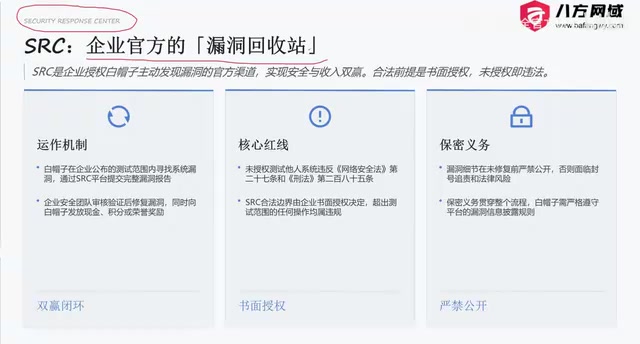
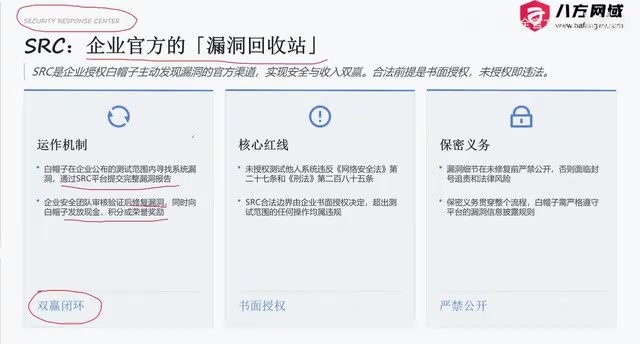
- White hats look for vulnerabilities in systems or platforms within the testing scope published by the enterprise
- They submit vulnerability reports through the SRC platform, giving feedback to the enterprise security team
- The enterprise security team verifies whether the vulnerability actually exists
- Once confirmed, they carry out remediation
- Based on the vulnerability severity, they issue bounties, points, or honorary rewards to the white hat
The brilliance of this mechanism lies in this—white hats gain material returns and industry recognition, while enterprises gain the opportunity to fix vulnerabilities, forming a positive cycle for both sides. The content creator summarized this in the video as a "win-win" and emphasized that this continuous feedback mechanism is precisely the core driving force that enables SRC platforms to operate over the long term.
The Line Between Legal and Illegal: Authorization Is the Only Pass
This is the part of the entire SRC system that brooks no ambiguity. The content creator repeatedly emphasized in the course: without authorization, any testing behavior targeting someone else's system is suspected of being illegal, specifically involving Article 27 of the Cybersecurity Law of the People's Republic of China and Article 285 of the Criminal Law.
The essential difference between legal bug hunting and hacking behavior lies in whether written authorization from the enterprise has been obtained. Any operation beyond the testing scope constitutes a violation.
You may not have noticed that in many security chat groups, a common high-risk scenario appears: someone claims, "Help me test whether my platform has vulnerabilities, and tell me if it does," and testing begins based solely on a verbal request. The content creator explicitly warned about this—one sentence does not represent written authorization, the risk is enormous, and you must absolutely not do it.
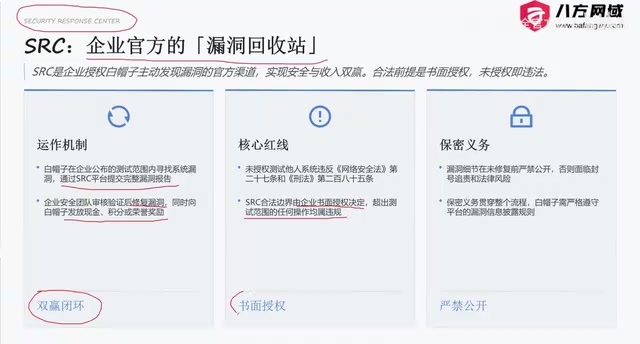
Article 27 of the Cybersecurity Law of the People's Republic of China mainly stipulates that no individual or organization may engage in activities that endanger cybersecurity, such as illegally intruding into others' networks, interfering with the normal functions of others' networks, or stealing network data, nor may they provide programs or tools specifically used for such activities. Article 285 of the Criminal Law corresponds to the crimes of "illegally intruding into computer information systems" as well as illegally obtaining computer information system data and illegally controlling computer information systems, and serious circumstances may result in fixed-term imprisonment and fines. What both laws share is that "whether authorization was obtained" serves as the core criterion for judgment. Even if the tester subjectively has no malicious intent, as long as they enter another person's system without permission, scan unauthorized targets, or read non-public data, they may violate the above provisions. Therefore, in the SRC context, the testing scope description published by the enterprise and the written authorization email are the prerequisite basis for white hats to carry out any testing behavior.
White Hats' Confidentiality Obligation: What to Do After Finding a Vulnerability
Finding a vulnerability is only the first step; how it is handled afterward is equally critical. The content creator reminded viewers that after submitting a vulnerability report and before the vulnerability is fixed, white hats are strictly prohibited from disclosing vulnerability details.
The reason is straightforward: once disclosed, the vulnerability may be exploited by malicious parties, bringing cascading risks. At best, the platform may ban the account; at worst, the person may face accountability or legal risk. The correct approach is to communicate with the enterprise in a timely manner and wait for remediation to be completed, so that the bounty or honor can be obtained smoothly.
Complying with confidentiality obligations is not only a legal requirement but also basic professional conduct for white hats seeking long-term standing in the SRC ecosystem.
Beginner Roadmap: Five Stages from Concept to Practice
This course breaks the learning path into five parts, offering clear guidance for absolute beginners:
- Clarify what SRC is, and where the boundaries of legality lie
- Understand why enterprises cannot do without SRC, and build a business perspective
- Review mainstream domestic SRC platforms, and understand the characteristics and entry paths of each platform
- Learn how to avoid pitfalls, and avoid crossing the red lines of law or platform rules
- Take the Butian platform as an example, and walk through the complete vulnerability submission process
- Prepare an attack machine, penetration testing tools, and a self-built vulnerability lab, and conduct practical demonstrations of high-frequency vulnerabilities
From conceptual understanding to tool preparation and then to hands-on lab practice, this path covers the key links from theory to practice. The content creator specifically mentioned that many highly viewed tutorials online either lack substantive content or sound like incomprehensible jargon, so the course chooses to start from the most beginner-friendly and basic perspective, striving to cover every detail.
The Butian platform is one of China's earlier third-party vulnerability response platforms for white hats, operated under Qi An Xin. Unlike enterprise-built SRCs, Butian aggregates the vulnerability collection needs of a large number of vendors. After registering on the platform, white hats can submit vulnerabilities according to the testing scope published by each vendor, and the platform coordinates vendor confirmation and bounty payment. For newcomers, the advantages of third-party platforms like Butian are the large number of vendors, relatively lower barriers to entry, and usually clear vulnerability severity rating rules and public leaderboards, making it easier to accumulate experience and reputation. In addition to Butian, common similar platforms in China include Vulbox, CNVD (China National Vulnerability Database), and others, while enterprise-built ones include Tencent TSRC, Alibaba ASRC, ByteDance BSRC, and so on, each with different emphases and rule differences.
Final Thoughts
SRC vulnerability discovery is a path that balances technical growth and legal income, but its premise is always authorization and compliance. Understanding how SRC works, holding the legal red line, and fulfilling confidentiality obligations—these three form the underlying framework for white hats getting started. For absolute beginners, rather than rushing to use tools, it is better to first understand the rules clearly—this is precisely the key to taking fewer detours.
One-line Summary
SRC is an official enterprise vulnerability collection platform, and white hats must hunt bugs within authorized scope and fulfill confidentiality obligations to profit legally.
Paragraph Summary
This article systematically introduces the concept, operating mechanism, and legal boundaries of SRC (Security Response Center). SRC is an official vulnerability collection platform built by enterprises. After discovering vulnerabilities within the authorized testing scope, white hats submit them through the platform; enterprises verify and fix them and provide bounties, points, or honors, creating a win-win cycle. The article emphasizes that the only dividing line between legal bug hunting and hacking is written authorization. Unauthorized testing may violate Article 27 of the Cybersecurity Law and Article 285 of the Criminal Law, and verbal requests do not constitute authorization. At the same time, white hats are strictly prohibited from disclosing details before the vulnerability is fixed, otherwise they may have their accounts banned or even face accountability. Finally, the article provides a beginner path from understanding concepts, reviewing mainstream platforms, learning pitfall avoidance, to practical submission on the Butian platform and self-built lab exercises, emphasizing understanding the rules before using tools.
Related articles

AI Agents and MCP in Practice: Master Autonomous Agent Architecture in 6 Minutes
From the four core structures of AI Agents to the MCP protocol, Tool Calling, vector memory, multi-agent collaboration, and security, this covers seven key steps of autonomous agent development, plus practical FastMCP deployment tips.

The AI Reverse Engineering Era: What Makes an Engineer Competitive Is Being Redefined
Senior engineer Satya argues AI is shifting from generating code to understanding systems. A 300K-star GitHub reverse-engineering project can clone the Adobe suite. An engineer's edge is no longer frameworks or prompt tricks, but end-to-end system understanding, verifying AI findings, debugging failure cases, and business abstraction.

iPhone Duo vs. Micro-Dramas: The Format Battle Between Foldables and Vertical Video
iPhone Duo and Samsung Z Fold's wide-aspect foldables are challenging vertical micro-dramas. The Verge finds creators already shoot dual-format, and the hardware-content battle is far from over.