Getting Started with WorkBuddy: How an AI Operations Gateway Becomes Your Digital Employee

WorkBuddy evolves AI from answering questions to taking action — a local gateway that gives LLMs control over your computer.
WorkBuddy represents a fundamental shift in AI interaction — from conversational Q&A to hands-on task execution. Running locally as an AI operations gateway, it controls browsers, reads and writes files, and calls external APIs, acting as a 24/7 digital employee. Its power comes from two mechanisms: a Skill library covering execution-heavy tasks like coding and knowledge management, and the MCP protocol, which standardizes how real-world platform data flows into LLMs. The flip side is cost: continuous autonomous operation causes token consumption to compound quickly, making cost awareness essential from the start. It's best suited for heavy execution tasks; lightweight chat models remain the better choice for simple Q&A.
From "Talking" to "Doing": The Fundamental Shift in AI Agents
For the past year, most AI tools we've known have stayed at the level of "answering questions" — you ask, it responds. Chatbots like DeepSeek, Doubao, and Tongyi Qianwen are, at their core, information output machines. But a new generation of AI agents — represented by WorkBuddyAd and OpenClawAd, affectionately nicknamed "lobsters" by Bilibili creator Shangxi — has completely changed that interaction model.
These tools are no longer content with telling you how to do something. They actually do it for you. As the original video puts it: ordinary AI = "answering questions," while a lobster = "completing tasks + logging results." That's a critical distinction — the former only talks, the latter talks and acts.
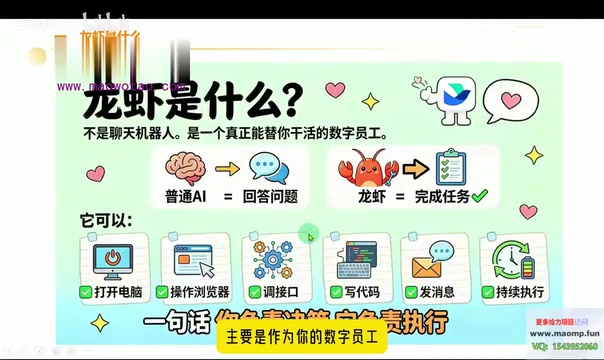
What can it actually do? It can open your computer, operate a browser, call APIs, write code, send messages, and keep executing — continuously. In other words, it plays the role of a digital employee: on call 24 hours a day, where you make the decisions and issue the commands, and it handles the execution on the ground. That positioning is exactly why people describe it as a genuine productivity liberator.
What It Really Is: An AI Operations Gateway
Strip away the flashy concepts, and tools like WorkBuddy come down to one word: Gateway. Shangxi's definition in the tutorial is refreshingly blunt: it "opens up your computer's permissions to a large language model."
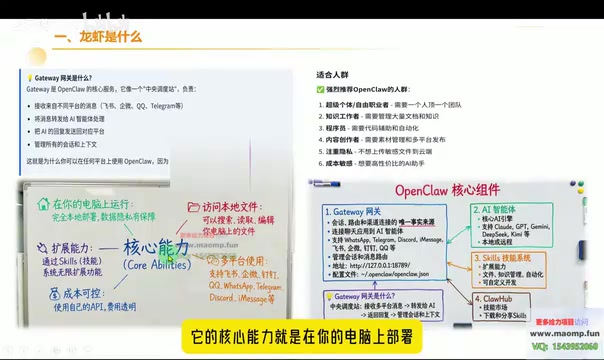
Its core capabilities rest on three pillars:
- Local deployment: Runs directly on your machine rather than purely in the cloud — a significant advantage for privacy;
- Local file access: Can read and edit files on your computer and act on them based on your instructions, meaning it can draw on your local documents and knowledge bases to generate content;
- Cross-platform integration: Connects to various platforms via API, and uses interface tools like MCP (Model Context Protocol) to pipe external platform data into the LLM.
Here's an example from the tutorial: you ask it to create a document, name it, draft content based on a local knowledge base or project plan, save it to a specific drive, and even send it out — all in one go. Throughout the process, it simulates your mouse and keyboard actions, functioning like a digital clone that does the hands-on work for you.
MCP: The Bridge Between Data and LLMs
The tutorial offers a plain-language explanation of MCP: it's a type of interface that opens up data from various platforms to AI large language models. For example, once a business data provider like Qichacha connects its corporate registry data to WorkBuddy via an MCP interface, the agent can access company information nationwide. It's this combination of "skills + data" that elevates an agent from mere text generation to an executor capable of tapping into real-world resources.
MCP (Model Context Protocol) is a standardized communication protocol proposed and open-sourced by Anthropic in late 2024. It was designed to solve the fragmentation problem of LLMs and external tools each "speaking their own language." Before MCP, every AI application that wanted to integrate a new external service — a database, a calendar, a code execution environment — had to build a bespoke connector, making maintenance extremely costly. MCP's core idea is to define a universal "plug and socket" standard: as long as a platform exposes its data interface according to the MCP spec, any MCP-compatible AI client can call it directly, with no custom adaptation needed. Think of it as the USB standard for the AI world — regardless of brand, if the connector spec matches, it just works. That's why the tutorial emphasizes that "once Qichacha's data is connected via MCP, the lobster can look up corporate records" — Qichacha follows the MCP protocol and exposes a standardized data interface, so the agent can use it without knowing anything about the underlying implementation.
Core Value: Skills Make the Agent "Capable of Anything"
If the gateway is the skeleton, then Skills are the flesh and blood that make WorkBuddy truly powerful. The original video emphasizes that through Skill extensions, the lobster can become "capable of anything" and run automated workflows around the clock.
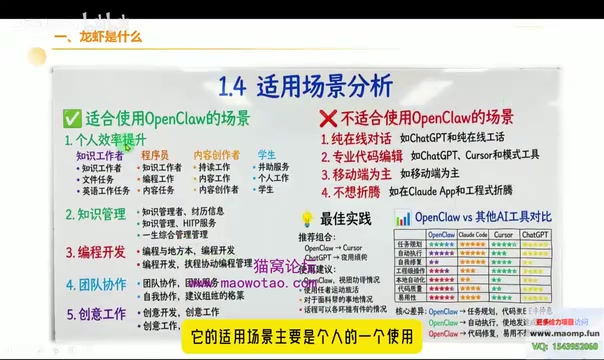
In terms of use cases, it leans toward personal productivity enhancement, with typical examples including:
- Knowledge management
- Programming and development
- Code writing and learning
- Creative work
One important caveat: if all you need is conversational Q&A, this isn't the optimal choice — you're better off going straight to lightweight chat models like Doubao or DeepSeek. WorkBuddy's value lies in execution, not small talk. Understanding that boundary is important for beginners choosing the right tool.
Usage Costs: Your "Electricity Bill," Measured in Tokens
The more powerful the agent, the less you can afford to ignore costs. The tutorial specifically calls out a cautionary phenomenon: some users of OpenClaw have accidentally racked up tens of thousands — or even over a hundred thousand — yuan in charges.
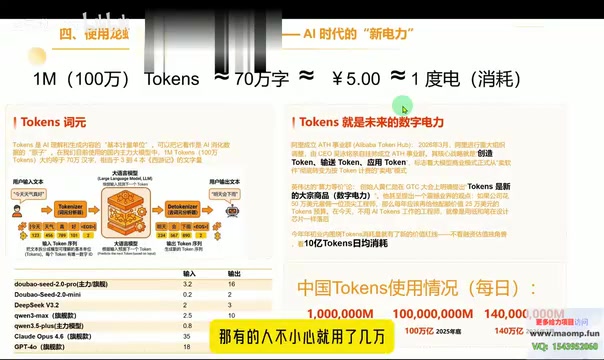
The underlying logic: an agent's costs come primarily from compute consumption, and the unit of compute is the Token. Shangxi uses a vivid analogy — tokens are like electricity, and using AI generates a power bill.
The video offers a rough conversion: approximately 1 million tokens ≈ 1 kilowatt-hour of electricity, and one kWh of industrial power costs around 5 RMB. The exact numbers are illustrative estimates, but they carry a real signal: when an agent can run automatically for 24 hours straight, token consumption accumulates fast. Cost awareness is something every user should develop from day one. Electrical power as foundational infrastructure for AI is, in this sense, more than just a metaphor.
Tokens are the basic unit of measurement for how LLMs process text — but they don't map directly to characters or words. For English, 1 token is roughly 4 characters or 0.75 words; for Chinese, the higher density of characters means 1 Chinese character typically corresponds to 1–2 tokens. The key thing to understand: every time a model processes a request, both the input prompt and the output response consume tokens. The reason agents burn through tokens far faster than regular chat is that they execute tasks through repeated "think → act → observe" loops: the intermediate result of each step gets fed back into the model as context, causing the context window to balloon as the task progresses. An instruction that sounds simple — "organize these 100 files for me" — can trigger dozens of model calls, consuming tokens at a scale that far exceeds user intuition. Most LLM APIs are priced in dollars per million tokens, so setting a spending cap before using an agent is a highly recommended safeguard.
Final Thoughts: Understanding the Lobster Is Step One
The heart of this introductory content is building the right mental model for AI operations gateways like WorkBuddy: it's not a smarter chatbot — it's a digital employee that can actually do the work. Its value lives in Skills and local permissions; its costs hide in tokens.
Once you've answered the three fundamental questions — what it is, what it can do, and what it costs — you'll have a solid foundation for everything that follows: choosing your ecosystem, setting up deployment, and building real-world workflows. For anyone looking to genuinely boost their productivity with AI, this is the starting point you can't skip.
Related articles

Should U.S. College Fraternities Be Banned? A Researcher's Incisive Observations
Why not just ban U.S. college fraternities? A researcher finds the key resistance comes from decision-makers' own fraternity identities and schools' "willful ignorance."

Microsoft Discovery: Accelerating Scientific Discovery with AI Agents
Microsoft's Discovery platform runs specialized AI agents to help researchers screen and prioritize the most promising compounds and experimental paths, reducing experiments and accelerating scientific discovery.

Cambridge Heavy Industries Secretly Develops Desktop-Scale Nuclear Fusion Device
Cambridge Heavy Industries is secretly developing a desktop-scale laser-driven nuclear fusion device, targeting the equipment supply market for fusion power plants. This article analyzes its miniaturization technology path, commercialization logic, and unique positioning in the fusion startup wave.