Giannis Uses Google Search to Find a Pickup Court: A Real-World Demo of AI Search

Giannis uses Google AI search to find a pickup court, showing search shifting from information retrieval to task completion.
The article documents NBA star Giannis Antetokounmpo's real experience using Google Search's AI feature in Miami to find a popular pickup court. His conversational query included vague constraints like "popular," "downtown," and "always has a game," and AI search returned a specific court, Jose Marti, instead of a list of links. The article argues that finding a pickup court is a typical local plus experiential need, requiring AI search to integrate maps, social media, forums, and other sources to judge court activity. This case reflects the broader trend of search products shifting from information retrieval to task completion, while cautioning that one success doesn't guarantee overall reliability—the real-world quality of recommendations ultimately needs on-site verification.
When an NBA Superstar Uses AI Search to Find a Court
Imagine you've just arrived in an unfamiliar city and want to find a high-quality pickup game. What do you do? Ask a friend, scroll through social media, or open a maps app? NBA superstar Giannis Antetokounmpo (the "Greek Freak") gave an unexpected answer: he went straight to Google Search's AI feature.
On the streets of Miami, Giannis said to the camera: "I've been in Miami for a minute and haven't seen those three balls (referring to the three basketballs on the court?). Let's see what Google Search can do—help me find a popular pickup court in downtown Miami, and make sure there are always people playing there."
This clip from a YouTube video captures a real AI search experience. It's not just a tech demo; it's a signal: AI search is shifting from "looking up information" to "solving real problems."

The Search Process: From Vague Request to Precise Result
Giannis's query was very conversational: "Find a popular court downtown, the kind that always has a game going." This isn't something traditional keyword search handles easily. Traditional search would require you to type "Miami pickup courts recommendations" and then filter the results yourself. AI search, on the other hand, needs to understand vague constraints like "popular," "always has a game," and "downtown," and then produce a specific location.
The result? The search returned "Jose Marti" (José Martí Park). Giannis nodded repeatedly when he saw it: "Good court, I like it." Then he headed straight there.
In this process, AI search played the role of a "local guide." It didn't give ten options to agonize over; it directly recommended a spot that met the criteria. For scenarios requiring quick decisions, this ability to "give an answer directly" is clearly more valuable.
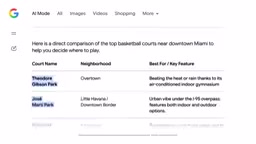
The core difference between AI search and traditional keyword search lies in intent understanding and how results are generated. Traditional search engines rely on inverted indexes and keyword matching; users must break their needs into keyword combinations and then manually filter results. AI search (such as Google's Search Generative Experience) is based on large language models and can parse multiple constraints in natural language—such as "popular," "always has a game," and "downtown"—and translate these vague conditions into comprehensive queries across multiple data sources. It typically performs query expansion first, then calls vertical data sources like maps, reviews, and social media, and finally the model generates an integrated answer. This "understand-retrieve-generate" pipeline enables it to handle experiential needs that traditional search struggles to structure.
Why AI Search Suits Needs Like "Finding a Pickup Court"
Finding a pickup court is a typical "local + real-time + experiential" need. A maps app can tell you where basketball courts are, but it can't tell you "whether people are always playing there," "how good the competition is," or "what the vibe is like." That information usually lives in local word-of-mouth.
The potential of AI search is that it can integrate multiple sources—map data, social media discussions, forum posts, reviews—and then make a comprehensive judgment. Giannis's query implicitly contained these constraints: popular (requires social signals), downtown (location), always has a game (real-time activity).
From the video, Google Search produced a specific court name, and Giannis accepted the result. This shows that AI search already has some ability to understand "local experiential needs." Of course, one successful search doesn't prove reliability across all scenarios, but at least it demonstrates the direction.

The "experiential" nature of local life information is key to understanding this scenario. Unlike structured data (such as business hours or addresses), whether a court "always has people playing" or "has a good vibe" is tacit knowledge, usually existing only in local residents' daily experience or scattered social posts. To use this kind of information, AI search must rely on retrieval-augmented generation (RAG) technology: first recall relevant snippets from forums, reviews, and social media, then have the model determine whether these snippets point to a "high-activity" court. This process faces challenges such as sparse information, strong timeliness requirements, and uneven geographic coverage, so a single successful case indicates the technical direction is viable rather than that the system is already broadly reliable.
The Underlying Tech Trend: Search Is Becoming an "Action Entry Point"
Giannis's experience reflects a major trend in search products: moving from "information retrieval" to "task completion." In the past, the endpoint of search was a list of links; now, the endpoint of search might be going directly to a place or doing something.
This shift places higher demands on AI search. It must understand not only language but also intent, context, and constraints. When Giannis says "the kind that always has a game going," the AI needs to understand the social nature of a pickup court—an empty court and a court where you can join a game at any time have completely different value.
Google Search demonstrated this understanding in the demo. It didn't return a bunch of court listings; it directly pinpointed a venue that met the criteria. This "less is more" approach to presenting results is precisely what sets AI search apart from traditional search.

"Task completion search" has been an important direction in the evolution of search products in recent years. Traditional search ends at "information retrieval" and returns a list of links; AI search attempts to move the endpoint to "action"—directly providing actionable suggestions, booking entry points, or navigation instructions. This shift requires the system to not only understand query semantics but also model the user's context (time, location, preferences) and assess the real-world feasibility of candidate results. In Giannis's case, Google Search output a single court recommendation rather than a list, essentially transferring the cognitive load of "filtering and decision-making" from the user to the model side—this is a typical interaction paradigm of task completion search.
AI on the Pickup Court: From Search to Reality
After arriving at Jose Marti court, Giannis quickly joined the game. In the video he shouts, "Let me see what you've got," followed by a series of moves on the court. Someone nearby comments, "He can play both ends," "He's playing well."
The interesting part of this footage is that the "output" of AI search ultimately has to be tested in the real world. Whether the court is good, whether there are games, what the vibe is like—these conditions that the AI judged during search were verified after Giannis arrived. From the video, he was satisfied.
This also reminds us that the value of AI search ultimately depends on the "real-world quality" of what it recommends. Recommending a court is easy; recommending the "right" court is hard. Giannis's experience at least shows that AI search can already give reliable answers in local life scenarios.
What This Means for Ordinary Users
Giannis using Google Search to find a pickup court looks like a lighthearted entertainment video, but it hides the practical value of AI search. For ordinary users, this capability means that when you need to quickly solve a "local + experiential" problem, AI search may be more efficient than traditional search.
Of course, one demo doesn't represent everything. AI search still has room for improvement in accuracy, real-time performance, and geographic coverage. But Giannis's Miami street experiment at least shows us a direction: search is no longer just answering questions; it's starting to help you make decisions and take action. Next time you're in a new city and want to find a court, a restaurant, or an activity, try letting AI search give you a direct answer—then, like Giannis, go out and verify it.
Related articles

Gemini 4 Neon Leak: A Potential Strong Contender Against Opus 5.5
A Hacker News thread suggests Gemini 4 Neon looks like an Opus 5.5 competitor. This article unpacks the product positioning behind this community signal, shifts in the top-model competitive landscape, and what it means for developers' model selection strategy.

Claude Fable 5.2's Self-Authored Short Film 'Fable' Sparks Discussion
A short film 'Fable,' credited to Claude Fable 5.2 for script, visuals, and directing, appears on Hacker News. This article analyzes the significance of full-pipeline AI creation, community reactions, and what it means for content creators.

Anthropic IPO Pricing: A Signal of AI Giants Going Public
Anthropic's IPO pricing draws attention. This article analyzes its potential impact on AI industry valuation, commercialization paths, and the competitive landscape, and highlights public-market expectations and challenges for AI companies.