GitHub Actions and Pages Service Degradation: How to Address CI/CD Single Point of Dependency Risk

GitHub Actions and Pages degradation exposes CI/CD single-point-of-failure risks and mitigation strategies.
GitHub Actions and GitHub Pages simultaneously experienced service degradation, blocking CI/CD pipelines and delaying site deployments. This article examines the difference between degradation and outage, analyzes the real impact on developer workflows, and explores the systemic risks of single-platform dependency. Practical mitigation strategies including self-hosted Runners, multi-platform redundancy, and degradation playbooks are provided.
Incident Overview: GitHub Actions and Pages Simultaneously Degraded
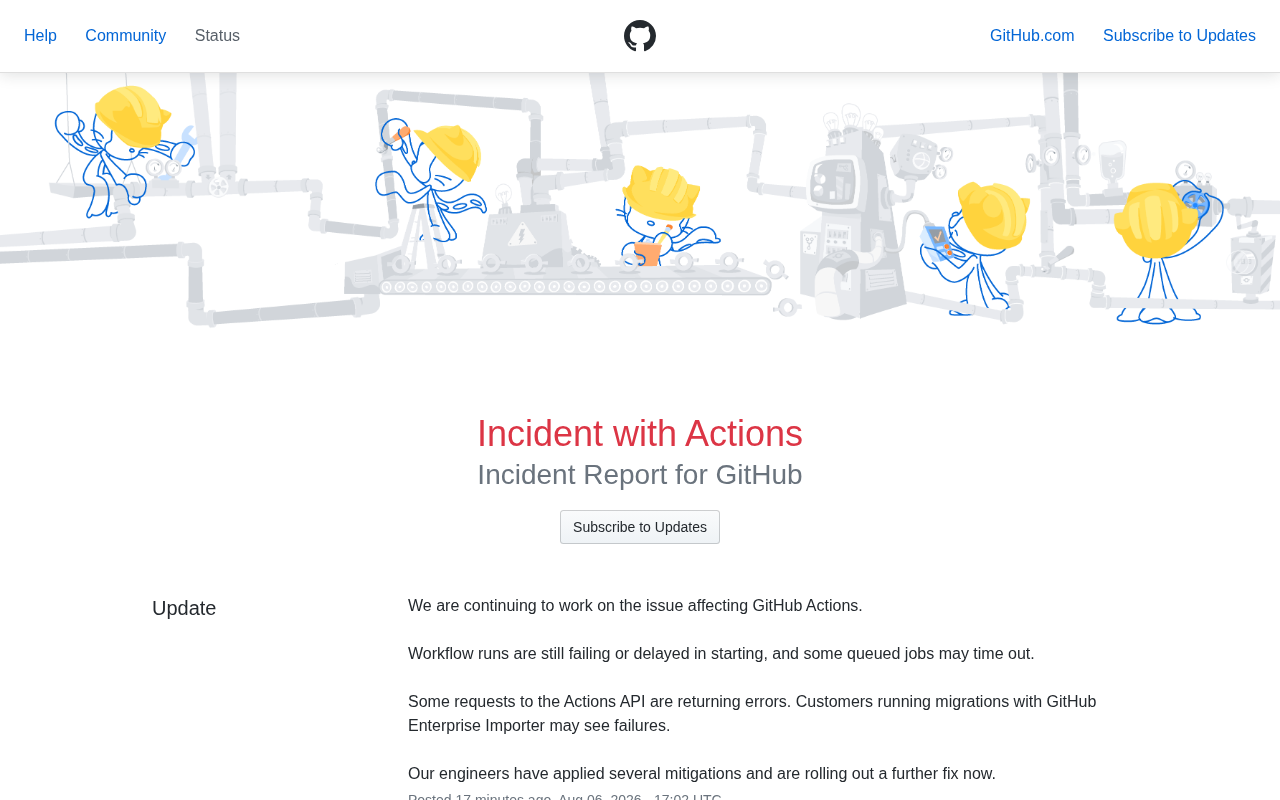
Recently, GitHub's official status page confirmed that two of its core services—GitHub Actions and GitHub Pages—are experiencing degraded availability. The news quickly rose to the top of Hacker News, sparking widespread attention and discussion across the developer community.
For teams that rely on GitHub for daily development, Actions and Pages are far from optional add-ons. GitHub Actions is the core engine for continuous integration and continuous deployment (CI/CD), powering automated build, test, and release pipelines for countless projects. GitHub Pages, meanwhile, serves as the hosting platform for many open-source project documentation sites, personal blogs, and static websites. When both services experience issues simultaneously, the impact ripples across the entire development ecosystem.
Notably, GitHub Actions was first unveiled in 2018 and reached General Availability (GA) in 2019. Built on an event-driven architecture, it defines automation workflows through YAML-formatted workflow files and supports multiple triggers including push, pull_request, schedule, and workflow_dispatch. Under the hood, Actions runs on Azure's virtual machine infrastructure, providing Linux, Windows, and macOS Runner environments. Its Marketplace hosts over 20,000 community-contributed reusable Actions, forming a vast plugin ecosystem. GitHub Pages, originally launched in 2008, is GitHub's free static site hosting service that supports deploying static files directly from a specific branch or directory of a repository, with built-in Jekyll integration. In recent years, Pages' deployment process has been upgraded from the traditional branch-trigger model to a custom workflow deployment model based on GitHub Actions—meaning Actions and Pages are deeply coupled at the technology stack level. Degradation in Actions can directly impact the Pages deployment pipeline, which explains why both services experienced issues simultaneously.
The Difference Between Service Degradation and Complete Outage
You may not have noticed, but this incident was classified as "degraded availability" rather than a complete "outage." The two differ significantly in their actual impact.
In the field of Site Reliability Engineering (SRE), service degradation is a precisely defined operational state. According to the Google SRE Handbook's classification, service states are typically divided into: operational, degraded performance, partial outage, and major outage. In a degraded state, SLA (Service Level Agreement) metrics—such as availability percentage and P99 latency—haven't completely violated commitments but have deviated from normal baselines. For GitHub, Enterprise customers typically have SLAs promising 99.9% monthly availability. If error rates during degradation accumulate beyond the threshold, it may trigger the SLA credit compensation mechanism.
Typical Symptoms of Degradation
Service degradation typically manifests as: partial request failures, increased response latency, longer task queuing times, or intermittent unavailability of certain features. Compared to a complete outage, degradation is more "insidious"—the service appears to still work but behaves inconsistently, which paradoxically causes more confusion for developers and increases debugging costs.
In the context of GitHub Actions, degradation might mean:
- CI jobs remaining in a queued state for extended periods without starting
- Build jobs failing randomly but succeeding on retry
- Workflow execution times noticeably increasing
- Runner resource allocation experiencing delays
For GitHub Pages, degradation might result in delayed site deployments, page updates not taking effect promptly, or intermittent errors when accessing sites.
The Real Impact of GitHub Actions Degradation on Developer Workflows
GitHub Actions has become an extremely critical component in modern software development pipelines. According to community discussion feedback, many teams' release cadences, code merge strategies, and even production deployments are highly dependent on Actions running reliably.
When the CI system becomes unreliable, the chain reactions include:
- Pull Request merge blocking: Many repositories have branch protection rules requiring "CI checks must pass before merging." Actions failures directly block the PR merge process.
- False build failure diagnosis: Randomly failing builds may be mistaken for code issues, causing developers to waste time debugging non-existent bugs.
- Version release delays: Teams relying on automated deployment cannot release new versions on schedule.
This once again highlights a well-worn but critically important topic: the risk of CI/CD single point of dependency.
The Hidden Risks of Single-Platform Dependency and Architectural Reflection
This incident sparked heated discussion on Hacker News, with a recurring theme being reflection on "over-reliance on a single platform."
Systemic Risk from Centralization
GitHub, with its massive community, comprehensive feature ecosystem, and Microsoft's resource backing, has become the de facto standard for code hosting. However, this high degree of centralization also means that when GitHub's core services have problems, millions of projects and developers worldwide are affected.
The CI/CD single point of dependency problem is not unique to GitHub. In 2023, CircleCI required all users to rotate secrets due to a security incident; in 2022, Travis CI's pricing strategy changes forced a large number of open-source projects to migrate. These events collectively reveal an industry trend: as DevOps practices deepen, CI/CD platforms have evolved from auxiliary tools to critical infrastructure, with importance comparable to production databases or message queues. Gartner's 2024 report noted that over 75% of enterprises classify CI/CD platform failures as high-impact risk events.
For enterprises and critical projects, this raises architectural questions worth deep consideration:
- Should backup plans be prepared for CI/CD (e.g., self-hosted Runners, multi-platform redundancy)?
- Can critical deployment processes be manually taken over when GitHub is unavailable?
- Should documentation and static sites have backup hosting channels?
Practical Mitigation Strategies
Facing such service degradation, developers can take the following pragmatic measures:
- Monitor GitHub's official status page: When encountering CI anomalies, first confirm whether it's a platform-side issue to avoid blindly debugging code.
- Configure self-hosted Runners: For critical projects, using self-hosted runners reduces dependency on GitHub-hosted resources while improving build speed. GitHub Actions' Self-hosted Runners allow users to run CI jobs on their own infrastructure (physical servers, virtual machines, containers, or Kubernetes clusters). Advantages include full control over the execution environment, access to internal network resources without exposing ports, freedom from GitHub-hosted Runner usage quotas, and the ability to use specialized hardware like GPUs. However, the trade-offs are equally significant: you must maintain Runner security updates yourself, handle concurrency scaling, manage secrets and credential security, and bear infrastructure costs. Actions Runner Controller (ARC) is the mainstream solution for managing self-hosted Runners in Kubernetes environments, supporting automatic elastic scaling based on workload.
- Workflow retry and fault-tolerant design: Add reasonable retry mechanisms to GitHub Actions configurations to mitigate the impact of intermittent failures.
- Multi-platform deployment backup: Important documentation sites can be simultaneously deployed to Cloudflare Pages, Vercel, or Netlify to avoid single points of failure. The modern static site hosting landscape has formed a diverse competitive ecosystem—Cloudflare Pages leverages its global edge network to provide ultra-low latency content delivery; Vercel centers on the Next.js ecosystem with serverless functions and edge middleware; Netlify stands out with features like Branch Deploy and Split Testing. Common patterns for implementing multi-platform redundancy include: using DNS failover (such as Cloudflare's Load Balancing) to automatically switch to backup sites when the primary is unavailable, or pushing deployment artifacts to multiple platforms simultaneously through CI pipelines. For open-source project documentation, Read the Docs is also a reliable alternative independent of GitHub Pages.
- Establish degradation playbooks: Plan manual deployment processes in advance for when GitHub is unavailable, ensuring critical releases aren't blocked.
Conclusion: Building Resilient CI/CD Workflows
This degradation event affecting GitHub Actions and Pages, while potentially just a brief hiccup, serves as yet another reminder to the entire developer community: the cloud infrastructure we depend on is not always stable and reliable.
As software development grows ever more dependent on automated toolchains, platform reliability has shifted from a nice-to-have to a matter of survival. For critical infrastructure providers like GitHub, fast, transparent incident response and information disclosure are paramount. For developers and teams, building workflows with resilience and redundancy is the enduring approach to handling uncertainty.
Affected users are advised to closely follow GitHub's official status updates and adjust release and deployment plans accordingly. More importantly, use this as an opportunity to examine your own CI/CD architecture and prepare for the next potential service interruption.
Related articles

OpenAI Partners with Shield: How the Astra Agent Revolutionizes IT Troubleshooting
OpenAI and Shield launch the Astra agent, which autonomously logs into computers and legacy systems to fix IT issues in real time, 35-40% faster than traditional models, with humans involved only when judgment is needed.

iPhone Duo Battery Life Tested: One Charge a Day Is Unavoidable, and the Large Screen Is the Culprit
iPhone Duo battery test: heavy use needs at least one charge a day, and about 30% remains after 6.5 hours of screen-on time. How often the large screen is unfolded is key; a MagSafe battery pack helps, and long-term degradation is also worth watching.

Kimi K3.1 Pro Open-Sourced: 2.8 Trillion Parameters Close In on Opus
Moonshot releases the open-source MoE model Kimi K3.1 Pro, with 2.8T total parameters and 104B activated, trailing Opus 5.5 by under 1 point on Terminal Bench 4.0.