GitHub Copilot: Cutting Costs Without Cutting Quality — Four Engineering Optimizations in Detail
GitHub Copilot cuts costs 2-5.5% via four engineering optimizations without sacrificing quality.
The GitHub Copilot team shared four A/B-tested engineering optimizations that reduce AI inference costs without degrading output quality: selective output compression (~5.5%), removing redundant line numbers (~3%), streamlining prompts with regression tests (2.9%), and eliminating orchestration round-trips (~2.3%). The key insight is to optimize complete tasks rather than individual calls, as local token savings can increase global costs through extra agent rounds and context inflation.
The Counterintuitive Question: Why Are Shorter Responses More Expensive?
Why do some AI coding tools return less content each time yet end up slower and more expensive to complete a task? The GitHub Copilot team recently shared their engineering answer, and the core takeaway fits in one sentence: A shorter single response does not mean a more efficient overall task.
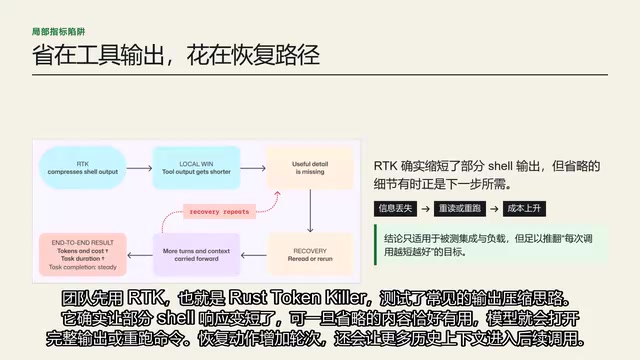
This is an easy-to-miss metrics trap. If compressing output removes information needed in the next step, the agent has to re-read the original content, re-run commands, or add more reasoning rounds. Here, "agent" refers to an autonomous execution agent built on a large language model, following the "Think–Act–Observe" loop architecture (derived from the ReAct paradigm). With each completed loop, the context window accumulates the history of all previous rounds. Because LLM inference cost grows roughly linearly with context length, every additional round not only adds latency but causes the input token count of subsequent rounds to snowball. What looks like local token savings actually leads to a longer journey with an ever-growing context.
The correct optimization target, therefore, is not "a single tool call" but "the complete task from user request to final result." With this goal in mind, GitHub ran four independent online A/B experiments, all measured by the same AI Credits metric. AI Credits is an internal normalized cost metric that weights different model types, input/output token counts, API call volumes, and other dimensions into a single comparable number — because a short call to a premium model can cost more than multiple long calls to a lightweight model, and directly comparing raw token counts often fails to reflect true cost. Here are the results of the four experiments:
- Removing unnecessary line numbers from file reads: cost reduction of ~3%
- Selective output compression: cost reduction of ~5.5%
- Streamlining Task tool prompts: cost reduction of 2.9%
- Eliminating backend notification round-trips: cost reduction of ~2.3%
These figures use the same metric but cannot simply be added together — they may have run during different time periods, on different user populations, and the optimization effects may interact with each other. Together they demonstrate one thing: optimization opportunities are spread across output, prompts, and orchestration at every stage.
The Metrics Trap: Lessons from the Rust Token Killer
The team first tested a common output compression approach using a tool called RTK (Rust Token Killer). RTK is an experimental output compression tool written in Rust, chosen for its extremely high execution performance and memory safety guarantees — in scenarios requiring real-time streaming processing of large volumes of shell output, Rust's zero-cost abstractions and lack of garbage collection ensure that compression operations don't become a latency bottleneck. Its design philosophy is to strip redundant information such as duplicate log lines, progress bars, and blank lines through a rule engine before tool output is returned to the model.
RTK did make some shell responses shorter, but whenever the omitted content turned out to be useful, the model would open the full output or re-run the command to recover the information.
Additional rounds also bring more historical context into subsequent calls. This involves a "token compound interest effect": model APIs charge separately for input tokens and output tokens, and in an agent scenario, the input cost of round N roughly equals the cumulative sum of all outputs from rounds 1 through N-1, because each round of reasoning requires passing in the entire tool call history as context. Ultimately, task completion rates showed no significant improvement, while token consumption and elapsed time actually increased. This result doesn't mean all compression is ineffective — it reveals a critical insight: tokens per call does not equal final cost.
So what content is truly worth removing? GitHub's four improvements share a common direction — reducing work the model "never needed to do" while fully preserving information that actually moves the task forward.
Optimization 1: Selective Output Compression
Earlier versions of compression were too aggressive, even compressing git diff results, causing the agent to frequently backtrack to find the original text. Benchmarking forced the team to develop three clear compression strategies.
Three Compression Principles
- Preserve source-code-like output verbatim: Output from commands like
cat,git diff,git show, and arbitrary scripts is kept unchanged, character for character. Every character in these outputs may carry semantic information — a single space difference could mean an indentation error, and a missing line could cause the model to misjudge code structure. - Only compact-group search results: Search results from
grepand similar tools are only grouped more compactly (e.g., merging multiple matches from the same file into one display), with no match items removed. Search results serve as navigation information for the agent — missing any single entry could cause it to overlook a critical code location. - Compress only noise data: Only repetitive noise in installation, build, test, and progress logs (such as hundreds of dependency resolution lines during npm install, or per-test pass records during pytest) is compressed, and only when the savings are significant enough.
What matters is not whether output gets longer or shorter, but "what it represents." After compression, the complete original text must still be directly recoverable — this recovery path serves both as a safety net and as a sensor for measuring compression quality.

The team tracks whether the agent opens the original text, re-runs commands, re-explores, narrows searches, or adds extra rounds. If these "recovery behaviors" appear frequently, it means the compressor removed valuable content. The actual results: no significant drop in success rate was detected in offline tasks, the agent rarely opened original output, average cost in online experiments decreased slightly, and quality metrics showed no material regression.
Optimization 2: Remove Formatting Before Information
The second optimization is "cleaner" — it removes formatting redundancy rather than useful information. Copilot's View tool used to prepend line numbers to every line of a file it read. Early editing tools needed these numbers for positioning (similar to traditional line-number-based sed or awk operations), but the current editing approach relies on context matching — the model locates modification positions by recognizing semantic features of code snippets, similar to git's context-based diff rather than line-number-based diff. Line numbers had lost their practical purpose.
After removing line numbers, file content was unchanged character for character, yet valuable context space was freed. Take a 1,000-line file as an example: the line number prefix on each line (e.g., " 42 | ") consumes roughly 6–8 characters or 2–3 tokens, meaning line numbers alone account for 2,000–3,000 tokens across the entire file. This seems negligible in a 128K context window, but accumulates rapidly when an agent reads multiple files across multiple rounds. The data shows: inference cost dropped about 5% in offline benchmarks, and the online experiment targeting CLI users reduced average daily model inference cost by about 3%, with no regression detected in quality or edit failure rates.
This case demonstrates that much cost waste actually comes from legacy formatting redundancy, and cleaning it up is a nearly "zero-risk" gain.
Optimization 3: Streamline Prompts — But With Regression Tests
The Task tool's instructions were originally scattered across descriptions, schemas, agent definitions, and system instructions, with extensive circular redundancy. The team cut them roughly in half.
But the first online experiment immediately revealed a regression: what was originally a careful "parallelism suggestion" had been rewritten as a hard scheduling policy, forcing custom agents that could have run in parallel into sequential execution.
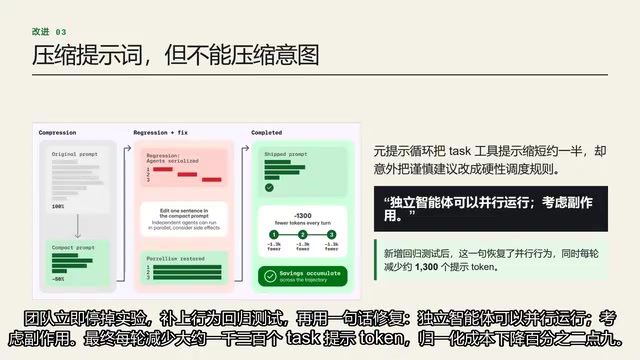
The team immediately stopped the experiment, added "behavioral regression tests," and fixed the issue with a single sentence — explicitly stating "independent agents can run in parallel, but side effects should be considered." The final result was a reduction of about 1,300 Task prompt tokens per round, with normalized cost dropping 2.9%.
The lesson here is critical: expected behaviors from prompts must have test coverage, or key instructions may be silently removed during streamlining, causing hard-to-detect functional degradation. Prompt Engineering has evolved from simple instruction writing into an engineering practice requiring version control and automated testing. The concept of "behavioral regression testing" borrows from traditional software engineering's regression testing: whenever a prompt is modified, a set of predefined test cases automatically runs to verify that the model hasn't regressed on key behavioral dimensions — including edge case handling (e.g., empty files, oversized files), specific instruction adherence (e.g., parallel vs. sequential execution), and output format consistency. Natural language instructions lack compiler protection unlike code — a single word change can cause unexpected drift in model behavior, and such drift is often undetectable in small samples, requiring systematic test suites to catch.
Optimization 4: Eliminate Unnecessary Orchestration Round-Trips
The fourth optimization occurred at the orchestration layer. Previously, when a background shell command or sub-agent completed, the notification only told the model "the task is done" without attaching the result. The model then had to make one call to fetch the result and another call to process it. Two tasks could consume four model calls.

After optimization, the framework batches eligible completion notifications and directly attaches full content using the existing tool result format, allowing the model to process both results in a single call. There's no compression or summarization here — it simply eliminates pure round-trip overhead, reducing average AI Credits by about 2.3%.
This is a classic example of "let the framework handle deterministic work — don't make the model do it." In agent architectures, there are two types of work: uncertain work that requires the model's reasoning ability for decision-making (such as judging code fix strategies or choosing search approaches), and deterministic work whose results are entirely predictable (such as fetching completed task results or concatenating data in known formats). Moving the latter out of the model's reasoning loop and into framework code is a high-leverage cost reduction strategy — because every model call saved not only cuts the token cost of that call but also reduces the historical context inflation across all subsequent rounds.
Evidence Is Local: An Important Caveat
These optimizations come with an easily overlooked caveat — the evidence only holds for the specific product scenario.
A more compact set of file tool instructions worked well in Copilot Code Review but actually increased costs in online experiments for Copilot CLI. Conversely, removing line numbers and selective compression each reduced average prompt tokens by about 5% in large-scale Code Review evaluations, with no material quality change.
The same change must be re-measured and validated in every product scenario where it actually runs. This validation methodology follows a two-stage evaluation system: the first stage is offline benchmarking, using pre-collected representative task sets to iterate quickly in a controlled environment; the second stage is online A/B experimentation, randomly splitting real users into experiment and control groups in production to perform rigorous causal inference while ruling out confounding factors like user population differences and temporal trends. Both stages are essential: offline benchmarks ensure iteration speed, while online experiments ensure external validity of conclusions.
Five Reusable Engineering Lessons
Synthesizing GitHub Copilot's four optimization practices, five lessons can be distilled:
- Optimize the complete task, not a single tool call.
- Optimize the orchestration layer — don't make the model do round-trips the framework can deterministically handle.
- Compress by semantics — prefer lossless transformations and preserve recovery paths.
- Expected prompt behaviors must have tests — otherwise key instructions may be silently removed.
- Evidence is local — validate repeatedly across offline benchmarks, online experiments, and every product workflow.
If you're also building coding agents, you can turn cost optimization into a closed loop: first define end-to-end metrics (success rate, total tokens, latency, model rounds), use offline benchmarks to quickly screen candidate changes, validate through online A/B tests against real user workflows, and then continuously track recovery signals like "re-reads, re-runs, and extra rounds."
Before removing any information, always ask one question first: Will this cause the agent to spend even more to retrieve it later?
Efficiency Isn't About Minimizing Context
GitHub Copilot's changes didn't make the model smarter — they simply removed work the model never needed to do. True efficiency isn't about making context as small as possible, but ensuring every piece of information that enters the context can push the task forward.
Measure complete tasks, preserve useful information, reduce meaningless round-trips, and continuously validate with real evidence — that's the engineering methodology for cutting AI coding costs without cutting quality.
Related articles

A Single Prompt Triggers a Global PHP Security Storm: Is AI a Savior or a Hidden Risk?
A single AI prompt triggered a global PHP security crisis affecting Wikipedia and the Internet Archive. This article reviews the incident, analyzes the OpenAI-Amazon controversy, and explores the security paradox of lowered vulnerability discovery barriers in the AI era and developer response strategies.

When AI Is Taken Away: How Reliance on Shortcuts Undermines Your Problem-Solving Resilience
A study of 1,222 people found that after using AI to answer questions, once AI was removed, people gave up on more problems than a control group that never used AI. The article analyzes the impact of AI reliance on learning resilience and metacognition, and explores design implications for AI learning tools.

Carta and NewView Partner to Let Startup Employees Cash Out Equity Early
Carta and NewView Capital partner to simplify startup tender offers, helping employees sell equity early. Analysis of the mechanism, liquidity pain points, and impact.