GitHub Daily · August 10: Agent Tools Explode Across the Board, Web Autonomy Redefined

Agent tools dominate GitHub Trending as Firecrawl leads with +815 daily stars, revealing a maturing Agent-era supply chain.
Today's GitHub Trending showcases the Agent era's emerging supply chain: Firecrawl (+815 stars) leads as the data acquisition layer for AI, paperclip manages Agent teams like employees, TradingAgents and LifeOS deploy multi-agent collaboration in finance and personal growth, while Ladybird and Dopamine represent the enduring open-source commitment to technological independence and user sovereignty.
GitHub Daily · August 10: Agent Tools Explode Across the Board, Web Autonomy Redefined
As we move into the second half of 2026, the dominant theme on GitHub Trending has become unmistakably clear: AI Agents are transitioning from "lab toys" to "productivity infrastructure." On today's leaderboard, four out of six projects are directly related to Agents, AI harnesses, or web data acquisition. The remaining two represent two fundamentally different open-source philosophies — "independence" and "freedom" — one being Ladybird, a browser engine rewritten from scratch, and the other Dopamine, an iOS jailbreak tool.
This leaderboard reflects a fascinating reality: as foundation model capabilities (GPT-5, Claude Fable 5, etc.) have matured, developer attention is rapidly shifting toward how to orchestrate, manage, and deploy these capabilities. Agents are no longer a single chat window — they're team members that need to be "managed." Let's dive into each project.
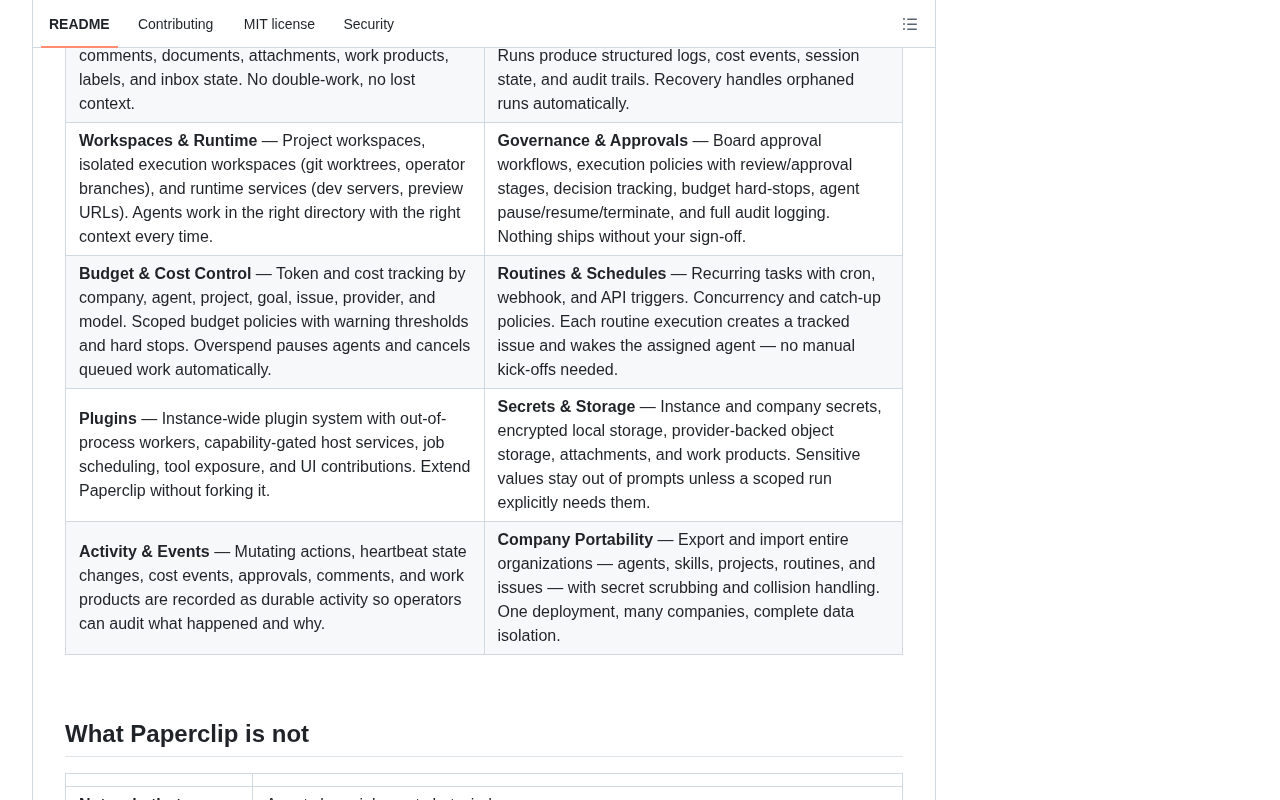
paperclipai/paperclip: Managing AI Agents Like Employees
Project positioning: An open-source "Agent management platform for work" that lets teams manage AI Agents the same way they manage employees.
Problem it solves: Over the past year, enterprises have seen a proliferation of siloed Agents — some writing code, some running data analysis, some handling customer service. But these Agents are scattered everywhere, lacking unified scheduling, permissions, auditing, and observability. Paperclip fills exactly this "AgentOps" gap: when an organization is running dozens or hundreds of Agents, you need to know who's doing what, how many tokens are being consumed, and whether outputs are trustworthy.
Core features: Unified Agent registration and orchestration, task assignment and tracking, and a visual management interface designed for team collaboration. It productizes the concept of "Agent as colleague," enabling non-technical personnel to participate in day-to-day Agent scheduling.
Use cases: AI operations centers for mid-to-large teams, finance/legal departments requiring compliance auditing, and startups scaling AI workflows.
Tech stack: Full-stack TypeScript, consistent with the current trend of "JS/TS dominating the AI application layer" — frontend interaction, backend orchestration, and Agent SDKs can all be built in the same language.
Stars/Forks analysis: 76,155 stars, 14,178 forks, +167 today. The remarkably high fork/star ratio (~18.6%) indicates this isn't merely a bookmarked tool — it's a project being actively deployed and customized by numerous teams. High fork rates typically signal strong real-world adoption.
LadybirdBrowser/ladybird: A "Declaration of Independence" in the Browser Space
Project positioning: A truly independent, open-source web browser with an engine written from scratch — not based on Chromium or WebKit.
Problem it solves: Today, nearly all mainstream browsers run on the Chromium engine, meaning the web is effectively dominated by one company's rendering engine. Ladybird's very existence is a resistance to the trend of "browser diversity dying" — it develops its own HTML/CSS/JS engine, striving to become a third force independent of any tech giant.
Core features: A completely independent rendering engine, adherence to web standards, and C++ implementation for performance and control. Its significance lies more in "architectural sovereignty" — free from any commercial company's roadmap.
Use cases: Users who prioritize privacy and independence, web standards researchers, and systems engineers wanting to learn browser internals.
Tech stack: C++. For developers wanting to deeply understand rendering engines, DOM, and CSS layout algorithms, this is an exceptional living textbook.
Stars/Forks analysis: 65,131 stars but only 3,113 forks — an extremely low fork ratio (~4.8%). This is characteristic of low-level systems projects — most people admire and follow the project, while developers who can actually contribute C++ browser engine code are exceedingly rare. Today's steady +190 growth shows sustained community recognition.
danielmiessler/LifeOS: Bringing Hill-Climbing Algorithms to Life Management
Project positioning: A general-purpose "hill-climbing AI harness" that helps you progressively move from your current state toward your ideal state, covering both life and work dimensions.
Problem it solves: Most productivity tools on the market remain at the "recording" level (to-dos, notes, calendars) and rarely use AI to actually help you decide what to do next. LifeOS introduces optimization algorithm thinking — modeling life goals as an optimization problem, using AI to continuously evaluate the gap between current and ideal states, and providing actionable "next hill-climbing steps."
Core features: State modeling, goal-gap analysis, and AI-driven action recommendations. It's essentially an open-source framework for a "personal AI coach." Author Daniel Miessler is a well-known figure in the security and mental models space, lending the project unique methodological depth.
Use cases: Individuals pursuing self-improvement, knowledge workers needing systematic goal management, and developers wanting to build personalized AI assistants.
Tech stack: TypeScript, following the rapidly iterable web technology path.
Stars/Forks analysis: 17,620 stars, 2,359 forks, +143 today. For a project leaning toward "philosophical/conceptual," its growth rate is quite healthy, reflecting the warming of the "AI + personal growth" niche.
firecrawl/firecrawl: The "Web Context Engine" Feeding AI
Project positioning: A suite of "context APIs" for searching, crawling, and interacting with web pages at scale — purpose-built to provide clean data for AI applications.
Problem it solves: No matter how smart an Agent is, it needs "eyes" to see the world. Raw web pages are littered with ads, scripts, and dynamic rendering, making them terrible when fed directly to LLMs. Firecrawl's core value is transforming messy web content into LLM-friendly structured context — a fundamental requirement for all RAG, Agent, and search applications.
Core features: Large-scale crawling and search, automatic cleaning into Markdown/structured formats, and support for page interaction (clicking, pagination, and other dynamic operations). It standardizes and API-ifies "using the web as AI's data source."
Use cases: Building RAG knowledge bases, competitive intelligence monitoring, real-time internet connectivity for Agents, and any scenario requiring "letting AI read web pages."
Tech stack: TypeScript.
Stars/Forks analysis: 164,548 stars makes it today's undisputed king, surging +815 stars today — the fastest growth on the entire leaderboard. This extraordinary growth directly validates one conclusion: in the Agent era, the value of the data acquisition layer is being massively amplified. When everyone is building Agents, Firecrawl — the one selling shovels — becomes the biggest winner.
TauricResearch/TradingAgents: Multi-Agent Systems Storm Financial Trading
Project positioning: An LLM-based multi-Agent financial trading framework that simulates collaborative decision-making of a real trading team.
Problem it solves: A single LLM making trading decisions tends to be one-sided and lacks checks and balances. TradingAgents mirrors the structure of real investment research teams, having different role-based Agents (fundamental analysts, technical analysts, risk managers, traders) debate and collaborate to reach trading decisions. It applies the cutting-edge concept of "multi-agent collaboration" to the high-value domain of finance.
Core features: Role-based multi-Agent architecture, debate and consensus mechanisms, and an extensible strategy backtesting framework.
Use cases: Quantitative researchers, financial engineering students, and teams exploring AI-assisted investment decisions. (Of course, live trading requires extreme caution.)
Tech stack: Python — the natural home field for finance and data science.
Stars/Forks analysis: 96,937 stars, 18,713 forks, +598 today. The nearly 19% fork rate is equally impressive, indicating that many developers are forking and connecting their own data sources and strategies for experimentation — this is a project with heavy hands-on engagement.
opa334/Dopamine: A Veteran Jailbreak Tool Holding the Line
Project positioning: A semi-untethered jailbreak tool supporting iOS 15 through 26(.0.1).
Problem it solves: In an increasingly locked-down Apple ecosystem, Dopamine represents users' demand for complete control over their devices. It allows power users to bypass system restrictions, install unapproved software, and deeply customize the system.
Core features: Coverage from iOS 15 all the way to iOS 26; semi-untethered jailbreaking means reactivation is needed after reboot but no computer connection is required, balancing convenience and practicality.
Use cases: Security researchers, system customization enthusiasts, and developers requiring low-level access.
Tech stack: C — reaching deep into system internals.
Stars/Forks analysis: 5,888 stars but a staggering 6,185 forks — forks actually exceeding stars, which is extremely rare on GitHub. This anomaly typically occurs in tool projects requiring users to compile, sign, or customize themselves, indicating its users are hardcore technical tinkerers.
Trend Watch: The "Division of Labor" in the Agent Era Is Taking Shape
Connecting today's six projects reveals a clear industry chain:
- Firecrawl handles "perception" — giving Agents eyes to see the world;
- paperclip handles "management" — organizing scattered Agents into controllable teams;
- TradingAgents and LifeOS handle "application" — deploying multi-Agent collaboration in finance and personal growth respectively;
- Ladybird and Dopamine represent another force: the insistence on technological independence and user sovereignty.
Notably, three of the four AI-related projects are written in TypeScript, with only the finance-focused TradingAgents using Python. This confirms that the division of "application-layer AI = TS, algorithm and data-layer AI = Python" is solidifying. Meanwhile, the concentration of high-fork-rate projects (paperclip, TradingAgents, Dopamine) suggests that today's trending projects are primarily "tool-type" rather than "showcase-type" — the community is voting with their feet, actually running these projects.
Today's Must-Watch TOP 3
-
firecrawl/firecrawl — The +815 single-day star growth is today's strongest signal. If you're building any Agent or RAG application, this is an indispensable data foundation. Bookmark it now.
-
paperclipai/paperclip — When your team's Agent count grows from 1 to 20, you'll inevitably need this. A frontrunner in the AgentOps space, worth getting ahead of.
-
LadybirdBrowser/ladybird — In an era of Chromium dominance, an independent browser with an engine built from scratch is nothing short of a miracle. For developers wanting to learn systems-level C++ and browser fundamentals, this is the best textbook available.
Looking ahead: As foundation model capabilities plateau, the competitive focus in the second half of 2026 has clearly shifted to the "orchestration layer" and "data layer." Whoever can help Agents better perceive the world, collaborate more efficiently, and be managed more securely will seize the advantage in this wave. And the existence of Ladybird and Dopamine reminds us: beyond the AI frenzy, the open-source community's commitment to independence and freedom is equally worthy of respect.
Related articles

ml-pipes: Building Software Engineering Best Practices Into ML Inference Pipelines
ml-pipes is an open-source framework that builds pre-run validation, pipeline inspection, tracing, and benchmarking into ML inference pipelines, bridging the MLOps engineering gap.

Aquifer Open Source: A Traffic Smoothing Solution for Peak Shaving Bursty GPU Inference Workloads
Aquifer is an open-source traffic smoothing runtime that uses durable queue buffering and backend backpressure to solve burst traffic challenges in GPU inference services, enabling peak shaving and cost reduction.

AI Mass-Producing Sales Videos: The Horse Racing Revolution in Content Commerce
Breaking down an explosive overseas AI content commerce strategy: batch-generating sales videos via AI workflows and horse-race testing them on TikTok and Instagram with CLI + Codex automation.