GitHub Daily · August 13: Local AI Tools Surge in Popularity, Privacy-First Becomes the Dominant Theme

Local-first AI tools and Agent integration dominate GitHub Trending on August 13, 2026.
Today's GitHub Trending reveals two dominant themes: local-first AI tools and Agent ecosystem integration. FluidVoice, unsloth, and modly bring voice dictation, LLM fine-tuning, and 3D generation to local devices for privacy and speed. Meanwhile, holaOS and obsidian-skills focus on connecting existing Agents to real tools via MCP protocol and Agent Skills, signaling a shift from building Agents to integrating them into workflows.
GitHub Daily · August 13: Local AI Tools Surge in Popularity, Privacy-First Becomes the Dominant Theme
Looking at today's (August 13, 2026) GitHub Trending list, one striking keyword jumps off the page — "Local-first." From on-device speech recognition on macOS, to running LLM training locally, to generating 3D models on local GPUs, today's trending projects unanimously position "no cloud dependency, data stays on your device" as their core selling point. This reflects both the inevitable result of dramatically improved hardware compute power (especially Apple Silicon and consumer-grade GPUs) and market feedback from users increasingly sensitive about privacy and data sovereignty.
Meanwhile, AI Agent workflows remain dominant — holaOS and obsidian-skills are both exploring the path of "letting Agents take over my toolchain." This shows that after coding Agents like Claude Code and Codex have matured, the community's attention is shifting from "building a smarter Agent" to "how to safely and efficiently plug Agents into my existing work environment."
Let's break down the six most noteworthy projects of the day.
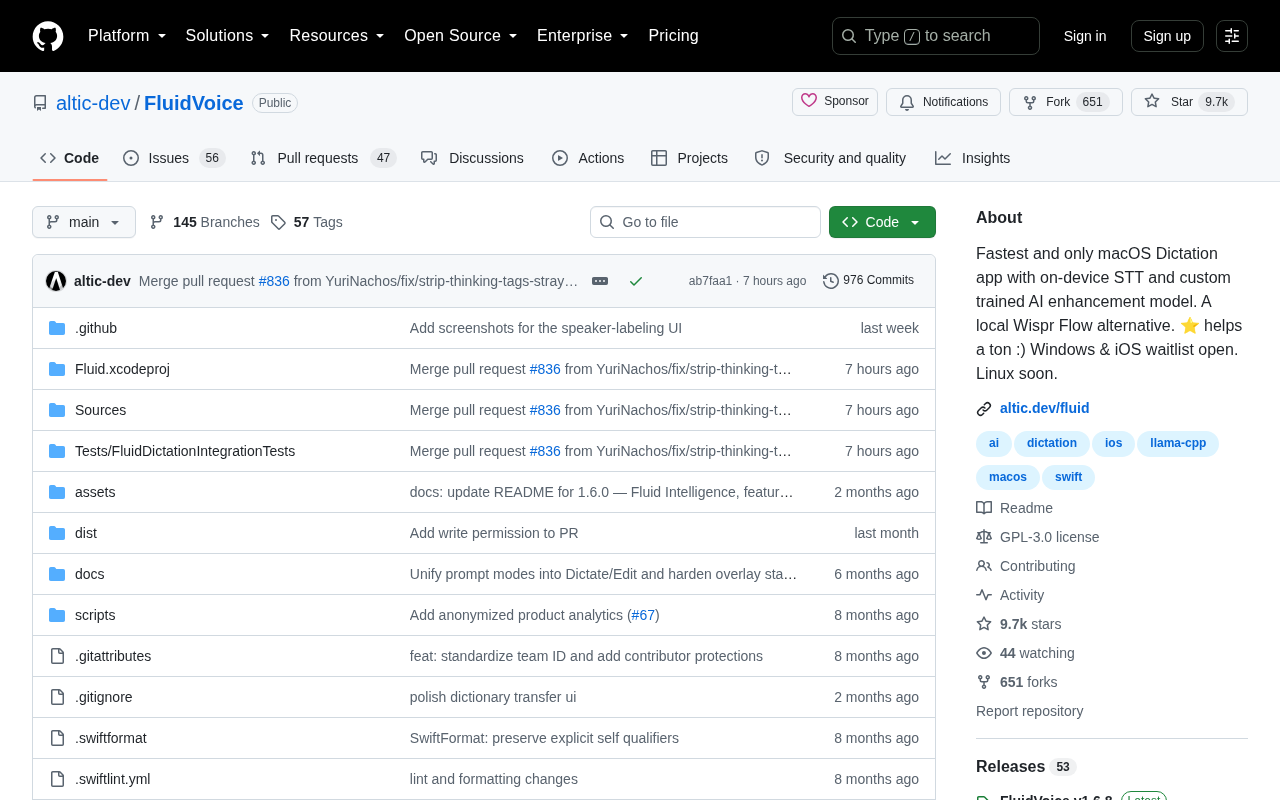
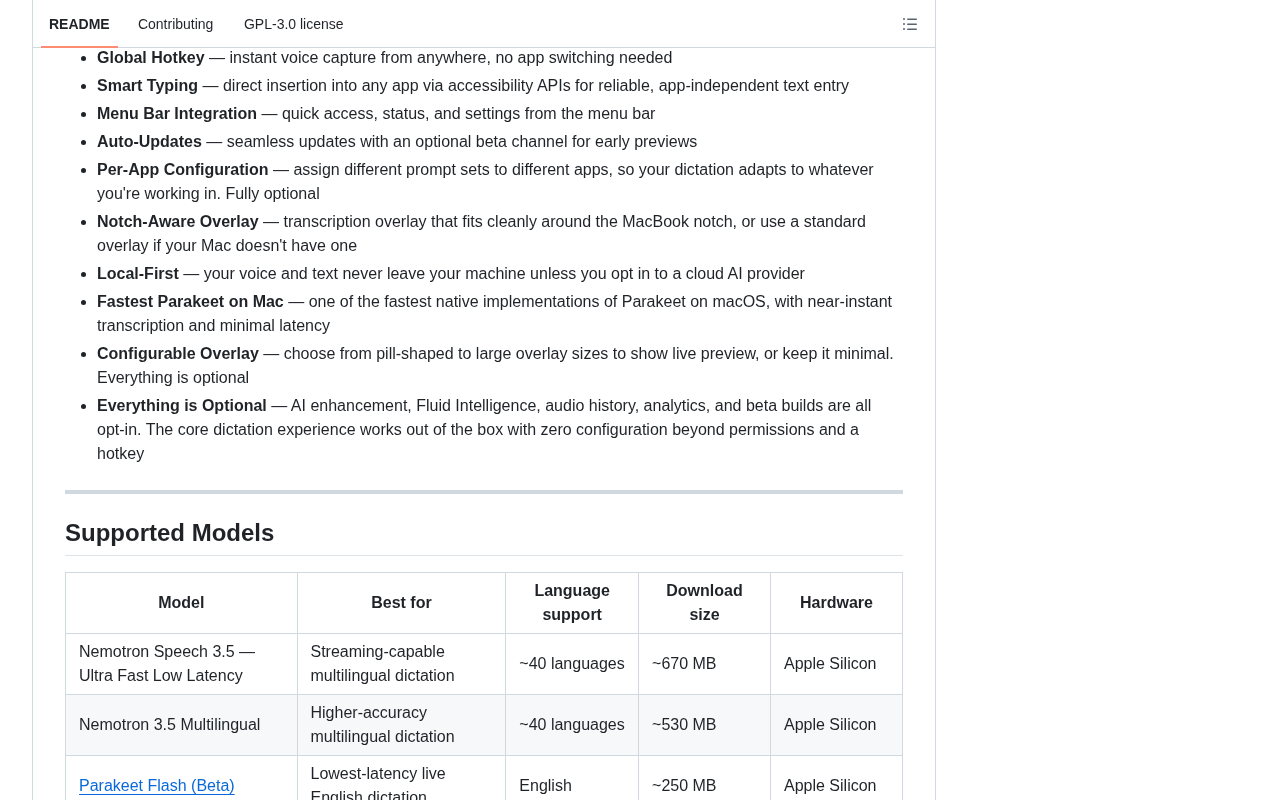
FluidVoice: A Local-First macOS Dictation App That Rivals Wispr Flow
Project positioning: A macOS voice dictation application that runs entirely on-device, featuring a built-in local STT (speech-to-text) engine and a self-trained AI text enhancement model.
Problem solved: Most mainstream AI dictation tools (like Wispr Flow) deliver excellent experiences but rely on cloud processing — every word you speak gets uploaded to a server. For lawyers, doctors, journalists, and enterprise employees who frequently handle sensitive information, this poses critical compliance risks. FluidVoice targets exactly this gap: "Local" is its singular and strongest selling point.
Core features: On-device STT ensures voice data never leaves the device; the self-trained AI enhancement model performs grammar correction, punctuation completion, and spoken-to-written language polishing on recognition results — distinguishing it from the system's native dictation. The developer has also opened waitlists for Windows and iOS, with Linux to follow, demonstrating cross-platform ambitions.
Use cases: Writers who need to dictate long-form text, enterprises requiring data to stay on-premises, and power keyboard users who simply want speed. The "Fastest" claim in their marketing isn't empty — local inference eliminates network round-trip latency.
Tech stack: Native Swift development with deep integration of Apple Silicon's Neural Engine. For developers building local AI applications in the Apple ecosystem, this serves as an excellent architectural reference.
Data analysis: 9,653 Stars, +83 today. For a niche utility application, this growth rate is quite healthy. Its high ranking suggests "local privacy" is evolving from a nice-to-have into a must-have.
unsloth: A Local UI for LLM and Diffusion Model Training/Inference
Project positioning: A local graphical interface for running and fine-tuning various large language models and diffusion models, supporting Qwen3.8, Kimi K3, MiniMax-H3, Gemma 4, DeepSeek-V4, FLUX, and many other cutting-edge models.
Problem solved: Fine-tuning a large model used to require extensive command-line work, CUDA configuration, and VRAM optimization knowledge — an extremely high barrier to entry. unsloth has long been known for "faster, more memory-efficient fine-tuning," and now takes it further by providing a local UI that wraps complex training workflows into visual operations, enabling regular developers and even researchers to customize models on their own machines.
Core features: All-in-one support spanning LLMs to diffusion models (FLUX) across multiple task types; remarkably fast adaptation to the latest open-source models — the listing mentions Qwen3.8, DeepSeek-V4, Gemma 4, and others covering virtually all mainstream 2026 open-source weights. This ability to "keep pace with the community's latest models" is key to unsloth's sustained popularity.
Use cases: Small and medium teams wanting to fine-tune proprietary models on private data, researchers running LoRA experiments, and enthusiasts tinkering with generative AI on consumer-grade GPUs.
Tech stack: Python, with extensive use of VRAM optimization and operator fusion techniques under the hood. Its open-source code is an excellent textbook for learning "how to efficiently train large models on limited hardware."
Data analysis: 70,766 Stars, +592 today — the undisputed leader on today's list in both scale and growth. Nearly 70K stars confirms it has become one of the de facto standards in the open-source fine-tuning space.
holehe: An OSINT Powerhouse Behind an Email Address
Project positioning: An open-source intelligence (OSINT) tool that reverse-looks up an email address to check its registration status across major websites like Twitter, Instagram, and more.
Problem solved: In security research, penetration testing, and anti-fraud investigations, there's a frequent need to determine which platforms a given email has registered on. holehe leverages each site's "forgot password" functionality to determine whether an email is in use and retrieves associated information, automating what would otherwise be tedious manual investigation.
Core features: Detection methods that don't trigger target account alerts, coverage across numerous mainstream platforms, and pure command-line batch operations. It's both a forensics tool for white-hat security professionals and a practical utility for ordinary users to check "which websites have I registered on with this email."
Use cases: Security audits, digital forensics, account asset inventories. It also serves as a reminder: your email may be more exposed than you think.
Tech stack: Python, primarily using async requests. Useful reference for developers wanting to understand authentication endpoint behaviors across major platforms.
Data analysis: 12,163 Stars, +166 today. As a well-established tool, its return to trending likely correlates with recent data breach events or heightened security-related interest.
holaOS: An Open-Source Workbench That Lets Any Agent Control All Your Tools
Project positioning: An open-source "All in One" AI Agent workspace that runs any Agent (Claude Code, Codex, etc.) across your tools, applications, browser, and files, supporting 100+ integrations, the MCP protocol, and shared memory.
Problem solved: There are many powerful Agents today, but they operate in silos — Claude Code handles code, another Agent handles the browser, with no shared context between them. holaOS aims to be the "OS layer" for the Agent era: providing all Agents with a unified runtime environment, unified tool interfaces (via MCP), and shared memory.
Core features: Flexible choice between Bring Your Own Key (BYOK) or built-in models; 100+ integrations covering mainstream SaaS tools; MCP (Model Context Protocol) as the standardized access protocol — this is particularly noteworthy, indicating MCP is becoming the universal bus for the Agent ecosystem. Shared memory solves the context fragmentation pain point in multi-Agent collaboration.
Use cases: Knowledge workers who need AI to automate tasks across multiple tools, and technical teams wanting to build team-level Agent hubs.
Tech stack: TypeScript, full-stack web + desktop architecture. A great engineering reference for developers looking to build Agent orchestration layers.
Data analysis: 6,125 Stars, +258 today — a standout growth rate on the list. Competition in the "Agent workbench" space is fierce, so its rapid climb indicates precise positioning.
obsidian-skills: Teaching Your Agent to Understand Obsidian
Project positioning: An Agent skill pack built for Obsidian, enabling AI Agents to use the Obsidian CLI along with open formats like Markdown, Bases, and JSON Canvas.
Problem solved: Obsidian is a top-tier tool in knowledge management, but there has been no standard approach for AI Agents to safely and structurally read/write its note vaults. This project, led by the well-known developer kepano (an Obsidian core team member), packages Obsidian's capabilities into Agent-callable "skills," making AI a true operator of your second brain.
Core features: Embraces open formats (Markdown, JSON Canvas, etc.), meaning data won't be locked in; enables Agents to operate note vaults in a controlled manner via CLI; fundamentally represents the "Agent Skills" paradigm landing in a concrete application.
Use cases: Users managing knowledge in Obsidian who want AI to help organize, search, and generate notes; developers exploring the combination of personal knowledge bases and Agents.
Tech stack: Primarily documentation and format specifications (language field is empty), with core value lying in "protocols and conventions" rather than code itself.
Data analysis: 45,290 Stars, +252 today. With over 45K stars and kepano's endorsement, it has become the benchmark project for the "Agent Skills" concept.
modly: Turning Images into 3D Models on Your Local GPU
Project positioning: A desktop application that uses local AI to generate 3D models from images, running entirely on your own GPU.
Problem solved: Image-to-3D has previously been mostly cloud-based paid services, with high costs and copyright/privacy concerns. modly localizes this capability, letting creators generate 3D assets for free and without limits on their own machines.
Core features: Pure local GPU inference with no need to upload materials; desktop-level usability that lowers the technical barrier to 3D generation.
Use cases: Indie game developers, 3D printing enthusiasts, AR/VR content creators, and designers who need rapid prototype modeling.
Tech stack: TypeScript for the desktop shell, with underlying calls to local 3D generation models. Valuable reference for developers building local AI desktop applications.
Data analysis: 5,114 Stars, +70 today — a steady start for an emerging vertical tool.
Today's Trend Observations
Viewing all six projects together, two clear storylines emerge:
Storyline One: Local-first has become the overwhelming trend. FluidVoice (local voice), unsloth (local training), and modly (local 3D generation) — three completely different domains all positioning "runs on your own device" as their number-one selling point. This indicates consumer hardware compute has crossed a critical threshold, and the dual pressures of privacy and cost are pulling AI back from the cloud to local devices.
Storyline Two: The Agent ecosystem is shifting from "building Agents" to "connecting Agents." Neither holaOS nor obsidian-skills is creating new models — they're solving "how to let existing Agents safely operate my real tools and data." The frequent appearance of new paradigms like MCP protocol and Agent Skills signals that the Agent application layer is moving toward standardization and engineering maturity.
Today's Must-See TOP 3
- unslothai/unsloth — If you want to fine-tune the latest open-source LLMs on your own machine, this is the indispensable go-to tool, with the most mature scale and ecosystem.
- holaboss-ai/holaOS — If you're interested in the future form of Agents, this "Agent operating system" represents the integration direction, and its growth rate best reflects community interest.
- altic-dev/FluidVoice — A perfect example of local privacy + extreme speed, and a best practice for Swift + Apple Silicon that every Apple ecosystem developer should study.
Local-first and Agent integration are the two most vibrant currents in the open-source community right now. Whoever can deliver both "powerful" and "private and controllable" will seize the advantage in the next wave of AI applications.
Related articles

Poison-Resistant Concept Anchoring: A New Approach to Defending Against AI Data Poisoning
Deep dive into Poison-Resistant Concept Anchoring, defending against data poisoning via signed anchors and bounded updates. Experiments show 62% poison isolation with 0% false rejection rate.

Hungarian Algorithm Explained: Principles, Complexity, and Engineering Implementation Guide
In-depth explanation of the Hungarian Algorithm: core principles, O(N³) time complexity advantages, and engineering implementation. Covers assignment problem definition, step-by-step algorithm walkthrough, Python/C++ libraries, and applications in multi-object tracking and resource scheduling.
OpenAI's First Enterprise AI Report: H…
OpenAI's First Enterprise AI Report: How ChatGPT Is Changing the Way Organizations Work
OpenAI's first enterprise AI report reveals three key traits of ChatGPT Enterprise adoption: the shift from novelty to necessity, writing and coding as top use cases, and data governance as a core prerequisite.