GitHub Daily · August 20: Mojo Tops the Charts & The Local-First Open Source Rebellion

Mojo tops GitHub Trending as local-first tools and AI infrastructure projects dominate the charts.
Modular's Mojo language platform tops the GitHub Trending chart, reflecting the community's desire to restructure the AI compute stack and break CUDA lock-in. OpenLogi surges 1,225 stars in a single day as the fastest-growing project, with its local-first, no-account, no-telemetry philosophy striking a nerve against bloated vendor software. The day's dominant themes are local-first privacy rebellion and deepening AI infrastructure.
GitHub Daily · August 20: Mojo Tops the Charts & The Local-First Open Source Rebellion
Today's Trending list presents a fascinating split: on one side, heavyweight platforms carrying the ambition of "the future of AI infrastructure" (Modular's Mojo, Tencent's AI red-teaming tool); on the other, small but beautiful tools championing "local-first, no accounts, no telemetry" (OpenLogi, Google Timeline Visualizer). This tension perfectly reflects the two core sentiments of the 2026 open-source community—anticipation for the restructuring of the AI compute stack, and rebellion for privacy and data sovereignty.
Meanwhile, Agent-related infrastructure projects continue to permeate the charts, and established open-source productivity tools like Plane demonstrate with steady growth that the "open-source SaaS alternatives" track remains red-hot. Let's dive deep into each one.
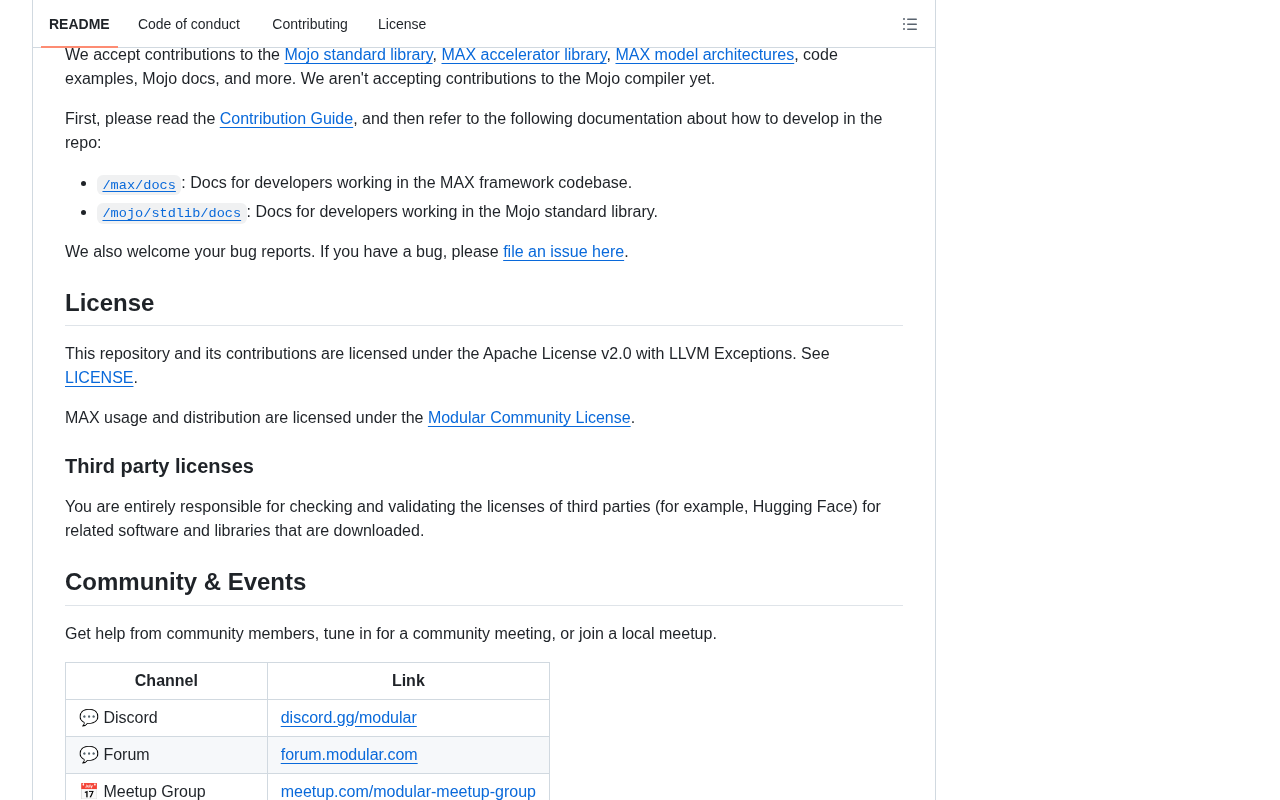
modular/modular: Mojo and MAX, Redefining the AI Compute Stack
Project positioning: Modular Platform is a complete computing platform for AI, encompassing the high-performance programming language Mojo and the inference engine MAX.
Problem solved: The current pain point in AI development is the "two-language gap"—researchers write models in Python, but production performance optimization requires dropping down to C++/CUDA. This fragmentation makes iteration costs extremely high. Mojo's ambition is to use a single language that combines Python's ease of use with C's performance, so developers don't have to choose between "easy to write" and "fast enough."
Core features: Mojo is highly compatible with Python syntax but introduces systems-level programming capabilities (such as zero-cost abstractions, explicit memory management, and SIMD vectorization). Combined with the MAX inference engine, Modular aims to provide an end-to-end, hardware-agnostic AI deployment solution, breaking free from vendor lock-in to specific GPU ecosystems.
Use cases: AI companies requiring extreme inference performance, teams looking to reduce their GPU bills, and infrastructure engineers tired of CUDA lock-in.
Tech stack: Primarily written in the Mojo language itself—a case of "building yourself with the language you created." For developers, it's an excellent specimen for observing next-generation systems-level language design.
Stars/Forks analysis: 27,472 stars with 340 daily growth. For a language/platform-level project, this is quite substantial. The steady rather than explosive growth indicates it's attracting serious developers genuinely interested in low-level technology, not fleeting curiosity traffic. Topping the charts reflects the community's sustained desire to "break the fragmentation of the AI compute stack."
AprilNEA/OpenLogi: Local-First, Declaring War on Logitech's Bloatware
Project positioning: A local-first Logitech Options+ alternative written in Rust, capable of remapping buttons, adjusting DPI, and SmartShift via the HID++ protocol.
Problem solved: Logitech's official driver Options+ has long been infamous—bloated, requiring mandatory account login, background telemetry, and high resource consumption. For users who just want to remap a few buttons, installing an entire cloud service suite is like using a sledgehammer to crack a nut. OpenLogi strikes directly at this pain point: no accounts, no telemetry, purely local.
Core features: Native Rust implementation means extremely low resource usage and lightning-fast response; direct HID++ protocol manipulation ensures fine-grained hardware control; the "local-first" design philosophy completely eliminates any possibility of data leakage.
Use cases: Anyone using high-end Logitech mice (like the MX Master series) who's been tortured by the official software—especially privacy-conscious developers and Linux users who prefer minimal systems.
Tech stack: Rust 🦀. This once again confirms Rust's dominance in the "systems-level tool rewrite" space—safe, high-performance, cross-platform, and the ideal choice for replacing aging C++ drivers.
Stars/Forks analysis: 11,026 stars with a massive single-day surge of 1,225—the fastest-growing project today. This explosive growth is backed by deep user resentment—the terrible Logitech software experience has been building for years, and OpenLogi's emergence precisely ignited community sentiment. It's the perfect case study of "users fighting back against vendor bloatware."
agent-substrate/substrate: The Core Foundation for AI Agents
Project positioning: Agent Substrate, a core system/infrastructure layer for AI agents.
Problem solved: As Agent applications explode, developers find every team reinventing the wheel—state management, tool calling, task orchestration, context persistence... Substrate aims to provide a unified "foundation" (substrate literally means "base layer"), letting Agent developers focus on business logic rather than infrastructure.
Core features: As a "core system," it emphasizes generality and composability, providing stable runtime support for various upper-layer Agent frameworks.
Use cases: Teams building autonomous agents or multi-Agent collaborative systems who want a reliable underlying runtime to manage Agent lifecycles.
Tech stack: Go. Choosing Go over Python is a telling signal—it means this project is positioned as high-concurrency, production-grade infrastructure, not rapid prototyping. Go's goroutine model is naturally suited for managing large numbers of concurrent Agent instances.
Stars/Forks analysis: 1,279 stars, 246 forks. The fork ratio is remarkably high (nearly 20%), indicating it's attracting many engineers who want to build on top of it. While the absolute numbers aren't large, for an emerging infrastructure project, this "high fork ratio" suggests it may be forming a developer ecosystem.
mahlernim/google-timeline-visualizer: Turn Your Footprints into a Year's Travel Map
Project positioning: Visualize your year's travel footprint using Google Location History (Timeline) data.
Problem solved: Google quietly records massive amounts of our location data, but this data is nearly invisible and unusable to users themselves. This project returns "data owned by the platform" back to users, letting you intuitively see where you've been and how far you've traveled over a year.
Core features: Locally parses Google's exported location history files to generate annual travel visualizations. It's essentially an exercise in "data sovereignty"—your footprints should be yours to interpret.
Use cases: Users who love documenting and enjoy year-end reviews; geeks interested in personal data visualization; and privacy-conscious individuals who want a memento before deleting their Google data.
Tech stack: Kotlin. Using Kotlin for a data visualization tool is somewhat unusual—it may target Android/desktop platforms and demonstrates Kotlin's breadth as a general-purpose language.
Stars/Forks analysis: 906 stars with 575 in a single day—a staggering growth rate. These "personal data visualization" projects often go viral on social media because the results are shareable and showoff-worthy. Its popularity also echoes today's chart-wide privacy theme.
makeplane/plane: The Backbone of Open-Source Project Management
Project positioning: An open-source alternative to Jira, Linear, Monday, and ClickUp—a modern project management platform.
Problem solved: Commercial project management tools have expensive subscriptions and lock data in vendor clouds. Plane offers a self-hostable open-source solution covering tasks, sprints, documents, and triage workflows.
Core features: Modern interaction experience on par with first-tier products like Linear, while supporting self-deployment—letting enterprises enjoy advanced product design while maintaining complete control over their data.
Use cases: Small and medium teams focused on data privacy, open-source communities, and startups unwilling to be held hostage by SaaS subscriptions.
Tech stack: TypeScript, the standard for modern full-stack web development.
Stars/Forks analysis: 56,195 stars—the largest mature project on today's chart. While 54 daily growth isn't explosive, for a project that has already accumulated over 50,000 stars, this kind of sustained, steady growth is precisely the hallmark of product maturity and community health.
Tencent/AI-Infra-Guard: Security Armor for the AI Ecosystem
Project positioning: A full-stack AI Red Teaming platform from Tencent that protects the AI ecosystem through Agent scanning, Skills scanning, MCP scanning, AI infrastructure scanning, and LLM jailbreak evaluation.
Problem solved: As Agents and MCP (Model Context Protocol) proliferate, AI system attack surfaces are expanding dramatically—jailbreaks, prompt injection, malicious tool calls, and other threats keep emerging. Traditional security tools cannot cover these AI-native risks. AI-Infra-Guard fills the emerging gap of "AI infrastructure security."
Core features: Full-stack coverage is its biggest highlight—from LLM jailbreak evaluation to Agent, Skills, MCP protocol, and underlying infrastructure scanning, forming a complete AI offensive and defensive assessment system.
Use cases: Enterprise security teams with production-grade LLM/Agent systems deployed, AI compliance auditors, and AI developers who want to run red-team tests before going live.
Tech stack: Python, the natural choice in the AI security domain. Backing from a major company (Tencent) also adds credibility.
Stars/Forks analysis: 4,750 stars, 471 forks. For a specialized security tool, this volume indicates that "AI security" is moving from a fringe topic to mainstream attention. Its appearance on the charts signals the community's collective awakening to security concerns in the Agent era.
Today's Trend Observations
Looking across today's charts, three main threads are clearly discernible:
First, local-first and privacy rebellion have become the dominant theme. OpenLogi's war against Logitech's bloatware, Google Timeline Visualizer's reclamation of personal data sovereignty, and Plane's alternative to SaaS lock-in—together they express a single sentiment: users want to reclaim control over their data and devices. This is one of the strongest value orientations in the 2026 open-source community.
Second, AI infrastructure continues to deepen. From Modular restructuring the compute stack, to Agent Substrate building the agent foundation, to AI-Infra-Guard safeguarding AI security—people are no longer satisfied with "calling LLM APIs" but are building more fundamental, systematized AI infrastructure. The "picks and shovels" of the Agent era are being forged in volume.
Third, Rust and Go continue to divide the systems-level project space. OpenLogi uses Rust, Substrate uses Go—the two languages each excel in their respective domains (tools/concurrent services), while Python firmly holds the AI application layer.
Today's Must-See TOP 3
-
AprilNEA/OpenLogi — A massive 1,225-star single-day surge, a perfect exemplar of the local-first philosophy. If you're a Logitech user or a Rust enthusiast, this is absolutely not to be missed.
-
modular/modular — The AI compute stack revolutionary that topped the charts. Mojo's progress deserves long-term tracking by every developer interested in AI infrastructure.
-
Tencent/AI-Infra-Guard — Indispensable security armor for the Agent era. When your AI system is about to go live, this might be the first tool you should run.
Today's charts tell us: the open-source community is advancing along two parallel paths—digging deeper into AI infrastructure, and defending data sovereignty from within. These two forces may well be the most worthwhile bets for the year ahead.
Related articles

DIY Air Purifier: Building a Silent CR Box with PC Fans and an Aluminum Frame
Learn how to build a quiet Corsi-Rosenthal air purifier using PC case fans and an aluminum frame, covering fan selection, PWM speed control, and cost analysis.

Universality of Gradient Descent Training: Does Neural Network Architecture Choice Really Matter?
Exploring the universal approximation capability of gradient descent training, analyzing the relationship between neural network architecture choice and learnability, from UAT to NTK theory.

From AI to Large Models: Understanding the Conceptual Landscape and Technological Evolution of Artificial Intelligence
Understand how AI, machine learning, deep learning, large models, and generative AI relate to each other. From Deep Blue to ChatGPT, learn how Transformer architecture gave rise to LLMs.