GitHub Daily · August 4th: Uber Open-Sources AI Agent Security Framework, Enterprise-Grade Agent Protection Takes Center Stage

Uber's AI Agent security framework ADR tops GitHub Trending as Agent governance becomes the new frontier.
Uber's newly open-sourced enterprise AI Agent security framework ADR surges to the top of GitHub Trending with 140 new stars in a single day, marking the shift from Agent orchestration to security governance. Meanwhile, frontend and runtime staples like webpack, Deno, Angular, and Tailwind CSS maintain their positions, and the compound-engineering-plugin's popularity signals a maturing AI programming tool ecosystem around Claude Code and Cursor.
GitHub Daily · August 4th
Today's Trending list presents an interesting "old meets new" landscape: on one side, Uber's freshly open-sourced enterprise AI Agent security framework ADR leads the pack, signaling that the Agent wave has entered the deep waters of "security governance"; on the other, webpack, Deno, Angular, and Tailwind CSS — veteran infrastructure projects in the frontend and runtime space — remain firmly on the list, proving that the moat around foundational engineering tools is still rock-solid. Additionally, plugin tools for the Claude Code / Cursor ecosystem continue to attract developer attention, as AI-assisted programming transitions from "early experimentation" to "engineering at scale."
Today's core signal is crystal clear: As AI Agents move from demos to production environments, security, observability, and engineering workflows are becoming the new battleground for the entire open-source community. Let's dive into the details.
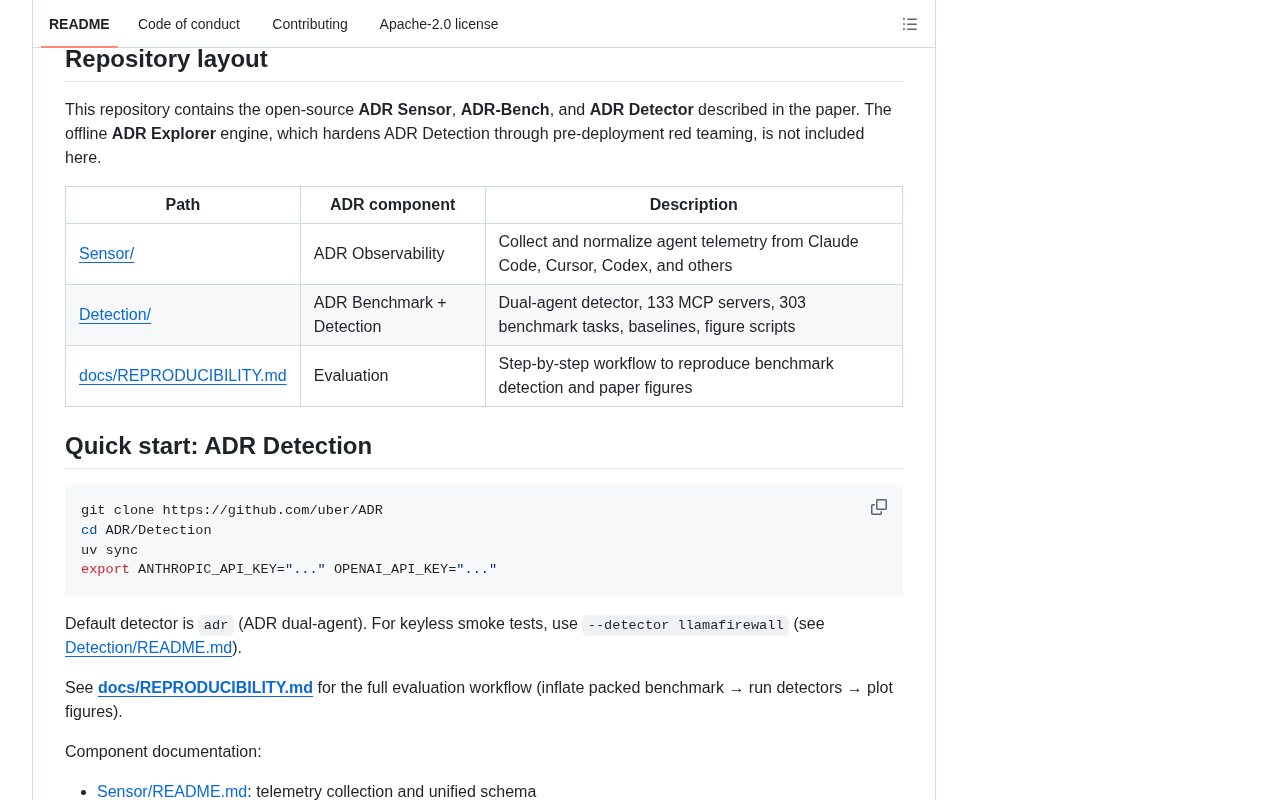
uber/ADR: The "Security Checkpoint" for AI Agents Entering Production
Project positioning: ADR is Uber's open-source enterprise-grade AI Agent security framework, safeguarding Agents in production environments through three core capabilities: observability, security benchmarking, and threat detection.
Problem it solves: Over the past two years, Agent frameworks have proliferated — from task orchestration to tool calling, everyone competed on making Agents smarter. But a long-overlooked issue remains: when an Agent is actually deployed in enterprise production, autonomously calling APIs, accessing databases, and executing code, who ensures it won't be hijacked by prompt injection? Who monitors its anomalous behavior? ADR fills exactly this gap in "Agent security governance." It's not yet another Agent orchestration framework — it's a "firewall + audit system" for Agents.
Core features: The three-in-one security capabilities deserve special attention — observability lets you trace the complete chain of every Agent decision and tool call; security benchmarking provides a quantifiable evaluation system to assess Agent robustness under adversarial inputs; threat detection identifies prompt injection, privilege escalation, and other attacks in real-time. The most compelling point: it's already deployed internally at Uber, meaning it has been battle-tested against real-scale traffic and attack surfaces — it's not a lab toy.
Use cases: Any enterprise team planning to deploy LLM Agents in production systems. For example, if a financial company wants an Agent to automatically handle customer service tickets and call internal APIs, running ADR security benchmarks before launch and integrating threat detection post-deployment is practically mandatory.
Tech stack: Implemented in Python, making it low-friction for teams familiar with LLM application development, and aligned with the Python-centric reality of today's AI engineering ecosystem.
Stars/Forks analysis: 503 stars with 140 new stars in a single day, and 60 Forks. For a freshly open-sourced project, this growth rate is fierce — 140/503 means nearly 30% of all stars flooded in today. The relatively high Fork-to-star ratio of 60 suggests many people aren't just bookmarking it — they're actually cloning it to study or trial. Big-company backing + production validation + hitting the Agent security pain point — three factors stacking together make this hype entirely unsurprising.
webpack/webpack: The Veteran Frontend Bundler Still Standing Guard
Project positioning: The most classic module bundler in the JavaScript ecosystem, packaging massive numbers of modules into a few optimized resource bundles through its loader system and code splitting mechanism.
Problem it solves: Modern frontend applications consist of hundreds or thousands of modules, styles, images, and JSON files — how do you efficiently organize and lazy-load them? webpack is one of the earliest and most mature answers to this question.
Core features: A powerful loader ecosystem handles CommonJS, AMD, ES6 modules, CSS, images, and more; code splitting supports on-demand loading, forming the bedrock of performance optimization for large SPAs.
Use cases: Although next-gen tools like Vite and esbuild have captured many new projects with their speed advantages, a massive installed base of large enterprise frontend projects with complex build pipelines still relies heavily on webpack.
Tech stack: JavaScript.
Stars/Forks analysis: 65,883 stars, but only 8 new stars today. This is the classic "mature infrastructure" curve — enormous absolute stock, slowing growth. Its presence on the list is more about long-term reputation inertia than explosive growth. This also reflects the shifting competitive landscape in the bundler space.
gabime/spdlog: The High-Performance Logging Weapon for the C++ World
Project positioning: A fast C++ logging library — header-only, high-performance, and easy to integrate.
Problem it solves: Logging is a hard requirement in C++ projects, but writing your own high-performance async logger is both tedious and error-prone. spdlog provides an out-of-the-box solution validated across numerous projects.
Core features: Extreme performance optimization (async logging, fast formatting), rich output targets (files, console, syslog, etc.), and header-only design for easy integration.
Use cases: Game engines, high-frequency trading systems, embedded services — any C++ project where logging performance matters.
Tech stack: C++. The codebase itself is an excellent reference for learning modern C++ high-performance design, particularly its template usage and async queue implementation.
Stars/Forks analysis: 29,342 stars, 5,365 Forks, with 9 new stars today. Another steadily maturing project — the high Fork ratio indicates it's been extensively forked for secondary development and integrated into various systems, making it a truly "infrastructure-grade" library.
denoland/deno: The Modern Challenger to Node.js
Project positioning: A modern JavaScript and TypeScript runtime created by Node.js creator Ryan Dahl, implemented in Rust.
Problem it solves: Deno is a "reflection piece" on Node.js design flaws — a secure-by-default permission model, native TypeScript support, and built-in toolchain (formatting, testing, bundling), aiming to address the complexity and security issues accumulated over years in the Node ecosystem.
Core features: Sandboxed permission control by default (file and network access require explicit authorization), runs TS without configuration, Web standard APIs first, and an all-in-one built-in toolchain.
Use cases: Server-side applications that prioritize modern development experience and security, edge computing, and script/tool developers.
Tech stack: Core written in Rust, combining performance with memory safety — itself a textbook case of large-scale Rust engineering.
Stars/Forks analysis: 107,983 stars with 27 new today, having crossed the 100K milestone. The relatively stable growth indicates it has become an undeniable force in the JS runtime space, with sustained community endorsement.
angular/angular: The Anchor of Enterprise Frontend Frameworks
Project positioning: Google-led enterprise frontend framework, focused on "confidently delivering web applications."
Problem it solves: Provides a strongly-typed, convention-heavy, full-toolchain solution for large team collaboration and complex business frontend projects, reducing maintenance costs at scale.
Core features: A complete framework ecosystem (routing, forms, HTTP, dependency injection — all included), deep TypeScript integration, and strong conventions to reduce team disagreements.
Use cases: Large enterprise internal systems, complex frontend projects requiring long-term maintenance.
Tech stack: TypeScript.
Stars/Forks analysis: 100,700 stars, 27,382 Forks, with 8 new stars today. The extremely high Fork count (over 27K) stands out across the entire list, reflecting its enormous installed-base value as a teaching resource and enterprise template starting point.
tailwindlabs/tailwindcss: The Utility-First CSS Revolution
Project positioning: A utility-first (atomic) CSS framework that rapidly builds UIs by composing small class names.
Problem it solves: Traditional CSS struggles with naming difficulties, style bloat, and poor reusability. Tailwind's preset atomic classes let developers compose styles directly in HTML, dramatically accelerating UI development.
Core features: Atomic class names, a highly configurable design system, and on-demand generation (minimal production bundle size).
Use cases: Rapid prototyping, component library construction, and teams pursuing design consistency. It works especially smoothly with modern frontend frameworks like React/Vue.
Tech stack: TypeScript.
Stars/Forks analysis: 96,245 stars with 30 new today — a notably bright growth rate among veteran projects. This shows that the utility-first philosophy continues to spread, and Tailwind has evolved from a "controversial new approach" to a de facto mainstream paradigm.
EveryInc/compound-engineering-plugin: The "Universal Adapter Layer" for AI Programming Tools
Project positioning: The official Compound Engineering plugin, compatible with multiple mainstream AI programming tools including Claude Code, Codex, and Cursor.
Problem it solves: Today's AI programming tools are blooming in diversity — Claude Code, Cursor, and Codex each have their own ecosystems, often locking developers into a single tool. This plugin aims to provide a cross-tool "compound engineering" workflow, chaining different AI assistants' capabilities together for compounding effects.
Core features: Multi-tool compatibility, unified engineering workflow encapsulation, moving AI-assisted programming from "point-and-ask Q&A" to "structured processes."
Use cases: Developers and teams who heavily use AI programming tools and want the flexibility to switch between multiple tools.
Tech stack: TypeScript.
Stars/Forks analysis: 23,756 stars, 1,944 Forks, with 33 new stars today. For an ecosystem plugin project, accumulating over 20K stars alone demonstrates that AI programming tools have achieved a sufficiently large user base, with derivative tools rapidly forming a new sub-ecosystem.
Trend Observation: AI Agents Enter the Deep Waters of "Engineering and Governance"
Connecting today's list, one main thread emerges clearly:
First, AI is shifting from "can we use it" to "dare we use it in production." Uber ADR's rise to the top is no accident. As enterprises in 2025-2026 connect GPT-5, Claude 4/Fable 5-powered Agents to real business operations, the "boring but critical" capabilities — security, observability, threat detection — become the deciding factors for whether Agents can scale in deployment. ADR represents the extension of Agent infrastructure from the "orchestration layer" to the "governance layer."
Second, the AI programming tool ecosystem is maturing and spawning derivative markets. The popularity of compound-engineering-plugin shows that Claude Code, Cursor, and similar tools are no longer just products — they're platforms. Plugins, workflows, and adapter layers are forming new open-source opportunities around them.
Third, frontend infrastructure remains rock-solid. Veterans like webpack, Deno, Angular, and Tailwind staying evergreen remind us: no matter how hot AI gets, solid engineering infrastructure always has a market, and its moat runs deep.
Today's Must-See TOP 3
- uber/ADR — If you're building production-grade AI Agents, this is today's unmissable project. Big-company validation + hitting the security hard requirement = the future direction of Agent governance.
- EveryInc/compound-engineering-plugin — A must-see for heavy AI programming users; cross-tool workflows may reshape your daily development routine.
- denoland/deno — For developers wanting to understand modern JS/TS runtimes and large-scale Rust engineering practices, Deno remains the best learning target.
Looking ahead: As Agents enter enterprise production at scale, we can expect more open-source projects focused on "Agent security, evaluation, and observability" to emerge — this will be a hot track worth continuously following on GitHub in the second half of 2026.
Related articles

Tail-Call Optimization in C: Principles, History, and musttail in Practice
A deep dive into tail-call optimization (TCO) in C: technical principles, compiler implementation history, and practical use of the musttail attribute in interpreters, state machines, and more.

Germany Sets Startup Record in Six Months: Europe's Innovation Engine Accelerates
Germany set a new startup registration record in six months, with Berlin, Munich, and other cities driving growth in AI, Deep Tech, and green energy. An analysis of the policies, capital, and structural shifts fueling Europe's innovation engine.

Math PhD to AI: A Transition Path from Operator Theory to Machine Learning
Is transitioning from a math PhD to AI/ML viable? This article analyzes core advantages, feasible paths, and practical strategies for operator theory backgrounds moving into artificial intelligence.